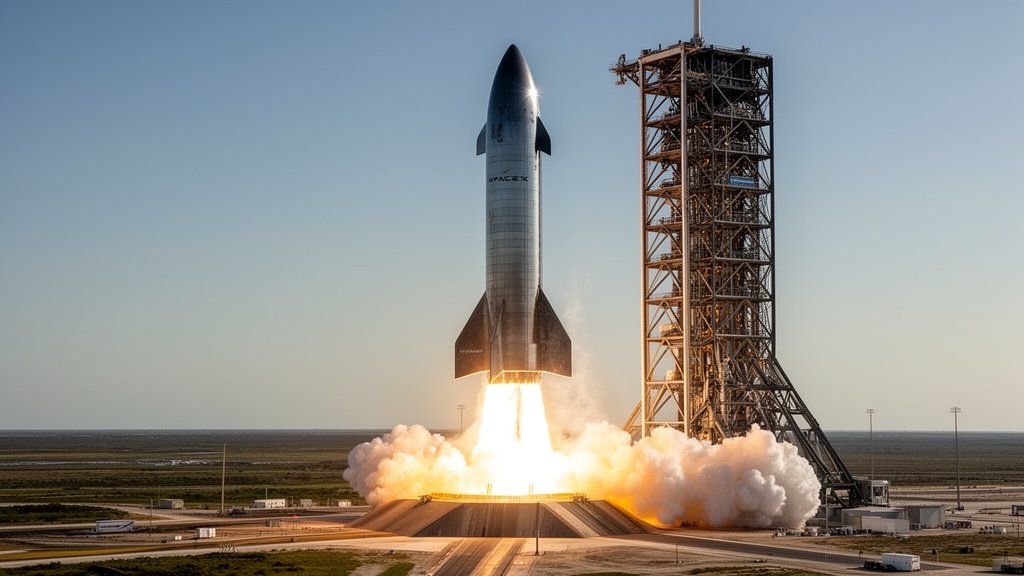
In a display of engineering prowess that is reshaping the future of global telecommunications and aerospace logistics, SpaceX has successfully executed a mission involving the Starship rocket, launching from its private facility in Starbase, Texas. This operation—a test flight that doubled as a functional deployment—saw the massive vehicle carry 20 Starlink satellites into suborbital space. The successful delivery of these assets signals a pivotal moment for the company: the transition of Starship from a purely experimental test platform into an operational vehicle capable of servicing the rapidly expanding Starlink network.
The Starbase Milestone: An Engineering Triumph
The launch at Starbase, the company’s dedicated manufacturing and launch site near Boca Chica, Texas, serves as a testament to the rapid iteration cycle that defines SpaceX’s development philosophy. By conducting this test flight with a tangible payload, SpaceX engineers are validating not just the structural integrity and flight dynamics of the Starship vehicle—the most powerful rocket ever built—but also the precision of its orbital insertion capabilities. The deployment of 20 Starlink satellites adds critical mass to the constellation, which provides high-speed, low-latency internet access across the globe, particularly in underserved regions.
Starship represents a paradigm shift in rocketry. Unlike traditional expendable rockets, the design philosophy here is centered on full and rapid reusability. By effectively integrating payload deployment into the flight testing regime, SpaceX is compressing its development timelines, learning in real-time how the vehicle handles the mechanical stresses of flight while carrying actual hardware into suborbital trajectory.
Scaling the Constellation: The Starlink Connection
While the primary objective of this flight was the continued testing of the Starship launch system, the successful deployment of 20 Starlink satellites is a strategic win for SpaceX. As the company continues to launch its Falcon 9 fleet at an unprecedented cadence, Starship’s massive fairing capacity offers a future roadmap for launching significantly larger numbers of satellites—or larger, more advanced satellites—in a single mission.
The current iteration of the Starlink network relies on a vast “megaconstellation” of thousands of satellites operating in low Earth orbit (LEO). This configuration ensures continuous global coverage. By testing Starship’s ability to inject payloads directly into the required orbital plane, SpaceX is laying the groundwork for a more efficient and cost-effective deployment strategy. This will ultimately reduce the cost-per-kilogram to orbit, a figure that remains the “holy grail” of the aerospace industry and a key driver in the competition for commercial space dominance.
The Economic and Industrial Impact on South Texas
The transformation of the Boca Chica region into “Starbase” has had profound economic implications. What was once a remote coastal area has been rapidly developed into a hub of 21st-century aerospace manufacturing. The infrastructure required to support the massive Starship vehicle—including the “Mechazilla” launch and catch towers—represents a multi-billion dollar investment in American industrial capacity.
Local economic indicators suggest that the continued frequency of launches from Texas is providing a sustained boost to regional employment and supply chain development. From high-tech manufacturing roles to specialized logistics and engineering support, the Starship program is creating a new vertical in the Texas economy. Furthermore, the presence of such a high-profile facility has attracted a talent pool of engineers, scientists, and technicians to the region, creating a vibrant aerospace cluster that is likely to grow as Starship transitions to operational service.
Regulatory and Environmental Considerations
Operating at this scale requires rigorous coordination with the Federal Aviation Administration (FAA) and other regulatory bodies. Every launch involves complex flight path approvals, airspace management, and environmental assessments. The successful flight serves as evidence of the increasingly sophisticated collaboration between private industry and federal regulators. As SpaceX moves toward more frequent flights, the ability to maintain regulatory compliance while increasing operational tempo will be a critical skill set. This balance is essential for the long-term sustainability of the Starship program and its potential role in NASA’s Artemis missions, which aim to return humans to the lunar surface using a lunar-lander variant of Starship.
Future Predictions: The Path to Mars and Beyond
Looking beyond the current success of deploying 20 satellites, the broader vision for Starship is nothing short of interplanetary colonization. The vehicle is designed to be the primary engine for humanity’s expansion to Mars. Each successful flight test provides terabytes of flight data, allowing engineers to refine the Raptor engines, the thermal protection system, and the automated landing sequences.
In the near term, we can expect SpaceX to increase the frequency of these flights, moving from suborbital tests to orbital refueling missions—a critical requirement for deep-space travel. The ability to transfer propellant in orbit will be the next major hurdle the company must clear. If today’s successful deployment is any indication, the pace at which SpaceX solves these complex engineering challenges suggests that the Starship era is already well underway.
FAQ: People Also Ask
What makes this particular Starship launch significant for the Starlink network?
This launch is significant because it shifts the Starship program from purely developmental testing to functional payload delivery. Deploying 20 Starlink satellites demonstrates that the rocket is not only capable of flight but also capable of performing the mission-critical tasks for which it was designed, specifically expanding the orbital internet constellation.
How does Starship differ from the SpaceX Falcon 9?
Falcon 9 is a partially reusable, workhorse rocket that has been the backbone of SpaceX’s operations for years. Starship is significantly larger, more powerful, and designed for full and rapid reusability. It is built to carry much heavier payloads to orbit and is the vehicle SpaceX intends to use for Moon and Mars missions.
What is the purpose of the ‘Starbase’ facility in Texas?
Starbase is SpaceX’s primary R&D, manufacturing, and launch site for the Starship vehicle. Located near Boca Chica, Texas, it serves as the central hub for the testing of Starship prototypes and the massive Super Heavy booster, enabling the company to iterate on designs at a speed that would be impossible at government-owned launch sites.
Does this launch impact the future of the Artemis moon missions?
Yes, the progress made during this test is directly applicable to the development of the Human Landing System (HLS) variant of Starship. NASA has contracted SpaceX to use a modified Starship to land astronauts on the lunar surface as part of the Artemis program, so every successful flight test brings the agency closer to that goal.