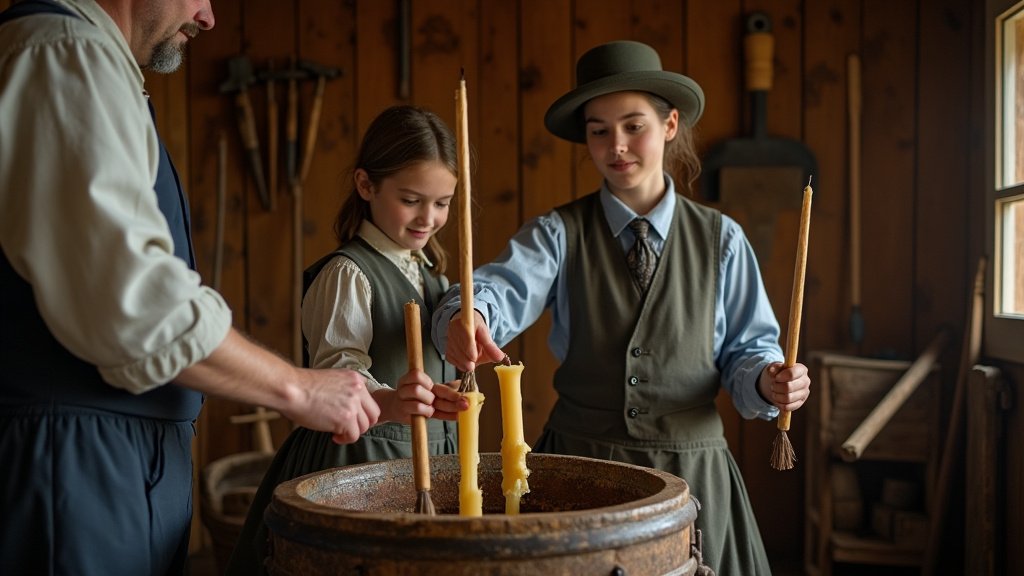
Visitors at the historic Stauffer-Will Farm in Aurora are witnessing a vivid resurrection of 19th-century pioneer life, effectively transforming the quiet, pastoral landscape into a tangible 1870s living history experience. By engaging directly with period-accurate tools and authentic culinary traditions, families are bridging the widening gap between the era of digital convenience and the gritty, resourceful reality of Oregon’s agricultural roots.
Key Highlights
- Immersive Educational Programming: A hands-on, 1870s-style educational experience that prioritizes physical engagement over observation.
- Authentic Skill Demonstration: Interactive stations featuring traditional candle dipping, open-hearth bread baking, and the operation of rare, period-specific manual tools.
- Historical Stewardship: A rare opportunity to tour a site maintained to reflect the exact homesteading conditions of the Clackamas County pioneer era.
The Living Legacy of Oregon’s Homestead Era
The Stauffer-Will Farm is not merely a venue for weekend outings; it serves as a critical repository for the agrarian history of the Pacific Northwest. Nestled in the Willamette Valley, the farmstead offers a rare window into the lives of families who claimed land under the Homestead Act of 1862. Unlike static museums that present history behind glass, the ‘Farm Days’ event at Stauffer-Will is designed to be kinetic. It forces visitors to slow down and consider the sheer caloric and temporal cost of 19th-century survival.
The Mechanics of History
When visitors engage in candle dipping, they are learning the chemistry of tallow and beeswax, a process that occupied vast amounts of time for frontier women. This activity serves as an anchor for understanding the ‘domestic economy’ of the 1870s. Similarly, the bread baking sessions are not just about cooking; they are lessons in microbiology, heat management, and the limitations of wood-fired ovens. These sessions demonstrate that the pioneers were not just farmers but also master engineers of their immediate environment.
The use of period tools provides a tactile education that no textbook can replicate. Participants handle plows, planes, and churns that define the mechanical limitations of the era. This creates a specific ‘historical friction’—a realization of how much effort was required to produce even the most basic necessities of life. By understanding the effort, modern families gain a deeper appreciation for the infrastructure of the current world.
Secondary Angles: The Psychology of ‘Slow Living’
Beyond the historical education, the popularity of the Stauffer-Will Farm events signals a growing societal interest in ‘slow living.’ As the modern world accelerates, there is a measurable psychological shift toward activities that require focused, manual labor. This phenomenon, often termed ‘historical tourism,’ acts as a counterbalance to the over-digitization of modern life. People are seeking tangible, sensory-heavy experiences where the feedback loop—baking bread, dipping a candle, tilling soil—is immediate and physical.
Furthermore, the preservation of the site addresses the ‘heritage loss’ crisis. Many homesteads from the late 19th century have been lost to urban sprawl. Sites like Stauffer-Will, overseen by the Clackamas County Historical Society, act as vital buffers against the total erasure of pioneer architecture. The restoration work involved in keeping the farm viable is a masterclass in historical preservation, requiring specific materials and techniques that are themselves becoming a dying art.
Future Implications for Local Heritage
What does the success of events like these mean for the future of regional historical societies? It suggests that the future of museums lies in interactivity. Visitors are no longer satisfied with passive consumption of placards and artifacts. They demand participation. This shift puts pressure on historical sites to invest in ‘living history’ staffing—people who are not just historians, but trained interpreters capable of teaching manual skills. The Stauffer-Will Farm is effectively a pilot program for this model, setting a standard for how small-scale historical sites can remain relevant and financially sustainable in a competitive entertainment landscape.
FAQ: People Also Ask
What can visitors expect to do at the Stauffer-Will Farm events?
Visitors are encouraged to participate in ‘living history’ activities. This includes hand-dipping tallow or beeswax candles, baking bread using traditional recipes and ovens, and observing or trying out period-accurate farm tools used by pioneers in the 1870s.
Is the Stauffer-Will Farm suitable for all ages?
Yes, the event is designed for families. However, given the nature of the tools and the rural setting, parents are advised to keep a close watch on small children, particularly near the baking areas or any displays involving authentic 19th-century equipment.
How does the site ensure historical accuracy?
The site is maintained under the guidance of historical societies that prioritize the preservation of the homestead as it existed during the late 19th century. The activities are researched to match the actual routines of Oregon settlers, rather than being generalized colonial-era performances.
Do I need to register in advance for Farm Days?
While some smaller events are open-house style, it is highly recommended to check the official Clackamas County Historical Society website for specific dates and whether pre-registration is required, as these events can reach capacity.