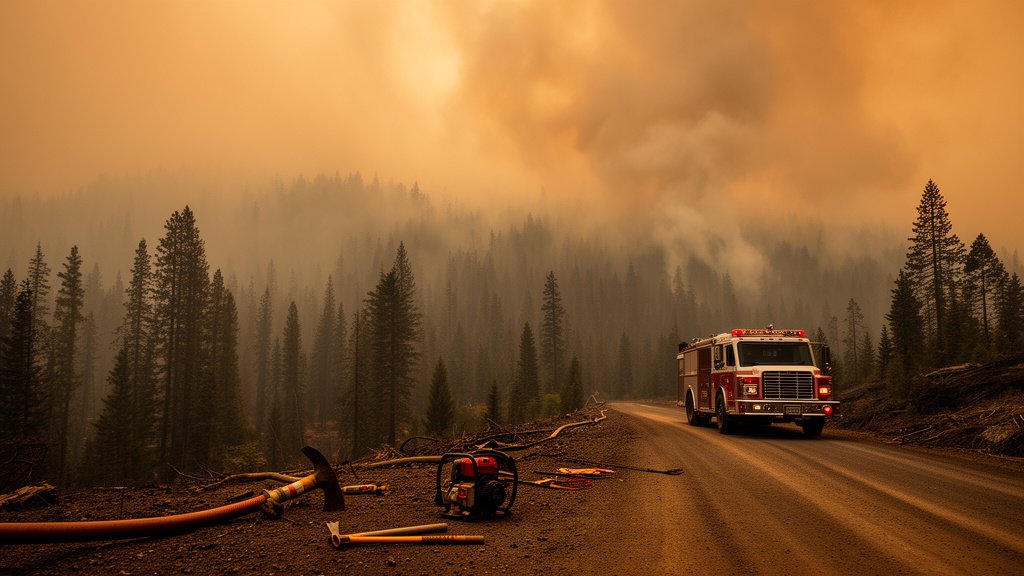
As of July 24, 2026, the state of Oregon finds itself at the center of a worsening wildfire crisis, with current metrics indicating that the 2026 fire season is on a trajectory to become one of the most destructive in the last 30 years. Data confirmed today reveals 30 active large fires currently burning across the landscape, an intense concentration of blazes that has already consumed 577,000 acres. This rapid escalation has necessitated an unprecedented response, with 10,333 personnel—ranging from elite hotshot crews to support logistics teams—deployed to the front lines to contain a season that shows few signs of slowing down.
Key Highlights
- Massive Burn Footprint: 577,000 acres have been scorched as of July 24, 2026, signaling a significant acceleration compared to average mid-summer figures.
- Unprecedented Personnel Deployment: A total of 10,333 firefighting personnel are currently engaged, highlighting the massive logistical strain placed on the Oregon Department of Forestry (ODF) and the National Interagency Fire Center (NIFC).
- High-Intensity Active Fires: There are currently 30 large, active wildfires actively challenging suppression efforts across the state.
- Historic Potential: Current trends suggest 2026 is poised to rank among the most intense fire seasons in three decades, testing the limits of regional containment strategies.
The 2026 Wildfire Surge: A Deep Dive Into the Data
An Unprecedented Surge: Deconstructing the 2026 Data
The sheer volume of acreage lost in the first half of the 2026 season is a sobering figure. By mid-July, the 577,000-acre threshold marks not just a seasonal milestone, but a structural shift in how the Pacific Northwest experiences summer fire cycles. The 30 active large fires are not merely scattered events; they represent a multifaceted threat landscape where fires are burning hotter, faster, and across more rugged terrain than in previous years. Analyzing the satellite telemetry and ground reports, the ODF and the Northwest Interagency Coordination Center (NWCC) have noted that fires are exhibiting extreme behavior, often jumping containment lines within hours of detection. This ‘spotting’ effect—where embers travel long distances to ignite new fires—has made traditional trenching and firebreak strategies significantly less effective, forcing commanders to rely heavily on aerial suppression and resource-intensive containment tactics that require constant personnel rotation.
The Logistical Challenge: Managing 10,333 Personnel
Mobilizing and maintaining 10,333 personnel is a massive undertaking that touches every corner of Oregon’s infrastructure. From the remote fire camps established in the high desert to the support staging areas near the Cascade Range, the logistical burden is unprecedented. This workforce includes structural firefighters, private contractors, National Guard units, and federal resources pulled from across the nation. The deployment is governed by the NIFC’s National Preparedness Level protocols, which are currently operating at a maximum capacity. The challenge for field commanders is not just the physical act of firefighting, but the grueling pace of maintenance for these crews. Exhaustion remains a primary concern; with long, hot shifts and the constant threat of unpredictable fire behavior, the rotation cycle for these 10,333 individuals is being compressed, placing an enormous financial and physical strain on state resources.
Historical Context: 2026 vs. The Decadal Record
When placing 2026 in context against the last thirty years, the data points to a disturbing trend. While 2020 remains the benchmark for catastrophic fire years in Oregon, the 2026 season is displaying a ‘velocity of destruction’ that rivals the early-season starts of 2021. The primary differentiator this year is the convergence of multi-year drought stress on forest timber and early-season heat waves that desiccated surface fuels. In previous decades, the fire season typically peaked in August and September. However, 2026 has effectively ‘shifted the clock,’ with high-intensity fire behavior starting as early as late June. This early onset leaves the state’s resources exposed for a longer duration, creating a ‘double-threat’ scenario where early-season acreage loss compounds with late-season fire risk, potentially pushing final annual burn numbers into territory rarely seen since modern record-keeping began in the early 1990s.
The Environmental Engine: Why the Landscape Is Burning
The science behind the 2026 surge is rooted in a feedback loop between climate volatility and forest health. Oregon’s forests have been stressed by years of cumulative moisture deficits, leading to high levels of ‘fuel loading’—the build-up of dry needles, branches, and deadwood on the forest floor. When ignition sources, whether human-caused or lightning, strike these primed environments, the results are explosive. Furthermore, the atmospheric conditions in 2026 have been characterized by persistent ‘inversion layers’ that trap smoke in the valleys while promoting gusty, erratic winds on the ridgelines. This creates a volatile environment where fire behavior models—the mathematical projections firefighters use to guess where a fire will move next—frequently fail. The intensity is forcing a pivot toward aggressive ‘defensible space’ management, where the focus shifts from saving every acre to protecting critical infrastructure and human settlements, a painful but necessary recalibration of state fire policy.
FAQ: People Also Ask
Q: How does the current personnel deployment compare to previous ‘bad’ fire years?
A: While personnel deployment fluctuates annually, the current number of 10,333 is exceptionally high for a mid-July timeframe, indicating the state is leaning heavily on both regional and national resources to combat the 30 active large fires simultaneously.
Q: What defines a ‘large fire’ in this context?
A: In wildfire management, a ‘large fire’ is typically defined by complexity and size—often exceeding 100 acres in timber or 300 acres in grass/brush—requiring Type 1 or Type 2 Incident Management Teams to oversee suppression operations.
Q: Why is 2026 being compared to a 30-year timeframe?
A: Experts are looking at the 30-year mark because it represents the standard climate normal period. By comparing 2026 to this window, analysts can determine if the current intensity is an anomaly or part of a long-term, accelerating climatic trend in the Pacific Northwest.
Q: Are there specific regions in Oregon at the highest risk?
A: While fire activity is widespread, the current operational focus is heavily concentrated in the central and southern regions of the state, where topography and fuel moisture conditions have created the most volatile fire conditions.