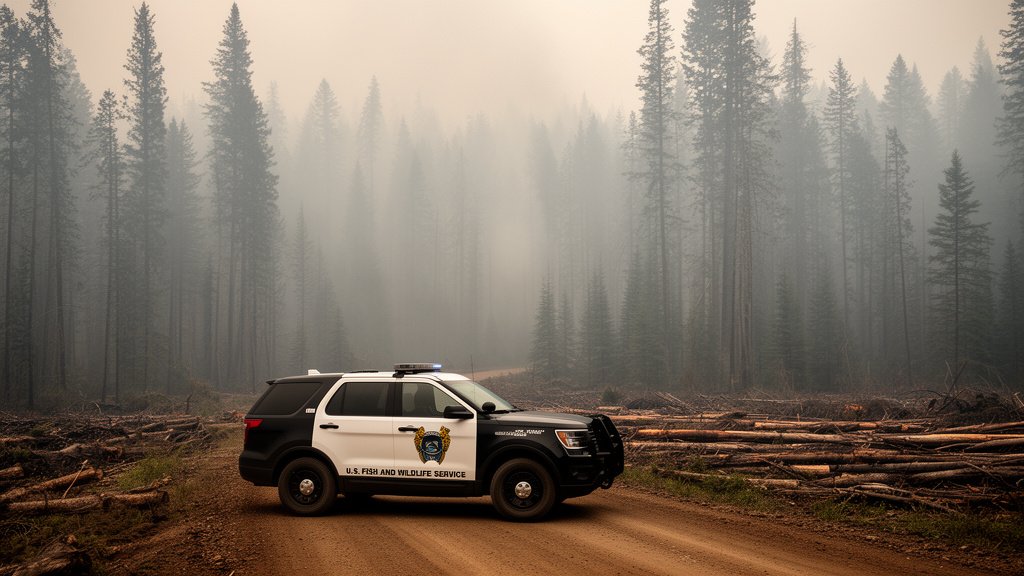
The U.S. Fish and Wildlife Service is mourning the loss of one of its own following a fatal incident on the frontlines of the Railroad South Fire in Oregon. David Taylor, a 38-year-old federal wildlife officer, was killed while performing the critical, often dangerous work of assisting residents in their emergency evacuation efforts. The tragedy underscores the immense risks federal officers undertake during wildfire season, often serving as the vital link between endangered communities and safety. As officials investigate the circumstances surrounding the incident, the agency has expressed profound condolences to Taylor’s family and colleagues.
Key Highlights
- Tragic Loss: David Taylor, 38, a dedicated U.S. Fish and Wildlife Service (USFWS) officer, died while actively assisting in wildfire evacuations.
- Mission Critical: The death occurred during the ongoing response to the Railroad South Fire, a volatile blaze currently threatening local communities in Oregon.
- Official Response: The U.S. Fish and Wildlife Service has confirmed the fatality and is currently working with local incident command to support Taylor’s family and investigate the specific circumstances of the tragedy.
- Risk Reality: The incident highlights the multi-faceted role of federal wildlife officers, who frequently transition from conservation duties to life-saving emergency response roles during catastrophic fire events.
A Final Act of Service: The Railroad South Fire Tragedy
The Railroad South Fire has been characterized by its rapid expansion and unpredictable behavior, driven by dry, dense vegetation and challenging topographical features common in Oregon’s wilderness areas. On the day of the incident, Officer David Taylor was operating in a capacity that required split-second decision-making. Federal wildlife officers in these regions are often among the first personnel on the scene in remote areas, acting as the primary point of contact for civilians who may not realize the speed at which a wildfire can engulf escape routes.
According to preliminary reports, Taylor was instrumental in ensuring that residents located in high-risk zones near the fire’s perimeter were aware of evacuation orders. In the chaotic environment of a wildland fire, communication is often fragmented. Officers on the ground, like Taylor, act as the human element of the Incident Command System, verifying that homes are empty and assisting those who may be struggling to navigate out of the fire’s path. His death in the line of duty is a stark reminder that the protection of natural resources often necessitates the protection of the human populations living alongside them.
The Evolving Role of Federal Wildlife Officers
While the public often associates the U.S. Fish and Wildlife Service with environmental conservation and habitat protection, the reality of the job includes significant law enforcement and public safety components. Federal wildlife officers are sworn law enforcement personnel. During fire seasons, their duties often shift to encompass wildland-urban interface (WUI) mitigation. This involves coordinating with local fire departments, managing traffic flow on narrow logging roads, and conducting search and rescue operations when smoke visibility drops to zero.
Taylor’s service fits into a broader, yet often under-reported, aspect of the agency’s operational mandate. As wildfires in the Western United States become more frequent and more intense, the demand for trained federal personnel to supplement local, state, and county emergency response teams has reached an all-time high. This puts officers in situations that are increasingly beyond the scope of traditional wildlife management, effectively placing them in the center of active, uncontrolled infernos.
The Operational Reality of Oregon Wildfires
To understand the magnitude of this loss, one must examine the topography of the Railroad South Fire. Oregon’s landscape, a complex tapestry of protected wilderness areas and interspersed private property, presents a nightmare scenario for emergency responders. The terrain is often steep, accessible only by logging roads that can quickly become traps.
Experts studying the incident emphasize that the speed of the Railroad South Fire was likely exacerbated by ‘spotting’—a phenomenon where embers are carried by wind far ahead of the main front, igniting new fires. This creates an environment where evacuation routes can be cut off in minutes, not hours. For an officer on the ground, this requires constant situational awareness. Taylor’s actions were consistent with the agency’s long-standing protocol of prioritizing human life above all else, including property or equipment. His legacy will be defined not only by the conservation work he performed but by his ultimate sacrifice in the pursuit of civilian safety.
Psychological and Physical Tolls
Following such a tragedy, the impact on the agency’s morale is profound. The brotherhood and sisterhood among federal law enforcement officers who serve in remote, austere environments are incredibly tight-knit. The U.S. Fish and Wildlife Service has initiated critical incident stress debriefings for staff involved in the Railroad South Fire response.
This incident also brings to light the physical and psychological toll on responders. Fatigue is a constant enemy. When visibility is compromised, the terrain is treacherous, and the fire’s movement is erratic, the margin for error is razor-thin. Officials are currently reviewing safety protocols to determine if adjustments are needed for how wildlife officers are deployed during high-fire-risk days. While the investigation remains ongoing, the consensus among his colleagues is that Taylor acted with courage and professional integrity, placing the welfare of the residents above his own safety.
FAQ: People Also Ask
Q: What is the primary role of a U.S. Fish and Wildlife Service officer during a fire?
A: While their primary mission is protecting natural resources, these officers serve as sworn law enforcement. During wildfires, they pivot to assisting local emergency responders with traffic control, search and rescue, evacuation notifications, and enforcing public safety closures in and around wilderness areas.
Q: Has the cause of the Railroad South Fire been determined?
A: The investigation into the origin and cause of the Railroad South Fire is currently ongoing. Authorities are looking into a variety of factors, including natural causes and human activity, but have not released a definitive finding as of this reporting.
Q: How do authorities manage evacuations in remote Oregon terrain?
A: Evacuations in remote areas are managed through the Incident Command System. This involves close coordination between the U.S. Fish and Wildlife Service, county sheriffs, and fire district personnel to identify safe egress routes and ensure no residents are left behind in high-risk zones.
Q: Will there be a formal memorial service for Officer Taylor?
A: The U.S. Fish and Wildlife Service has stated that details regarding a memorial service for Officer David Taylor will be announced in coordination with his family. The agency is currently focusing on providing support and resources to his immediate family and coworkers during this difficult time.