
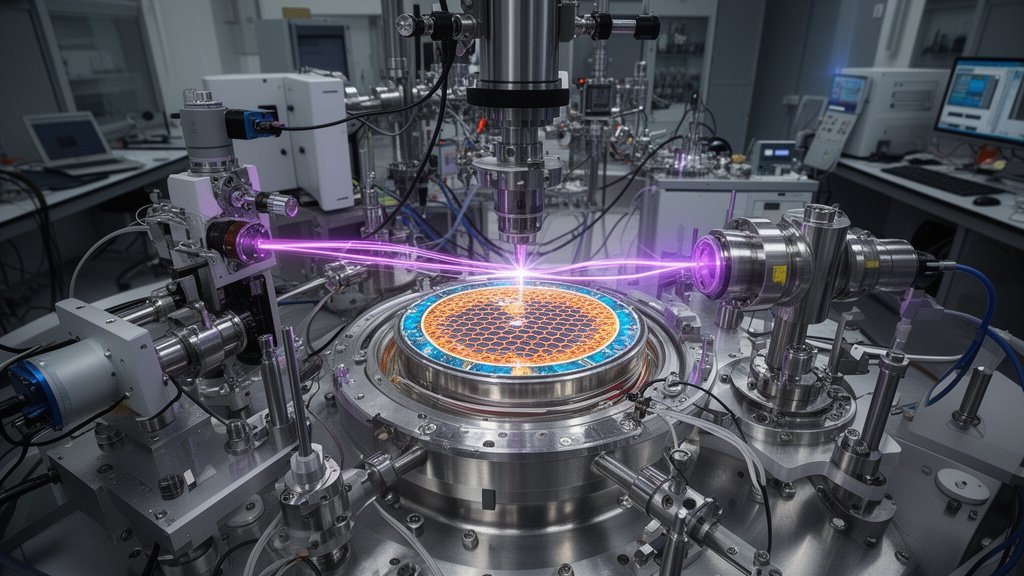
In a milestone achievement for condensed matter physics, researchers have experimentally observed electrons performing ‘seemingly impossible’ jumps across the forbidden energy gaps of graphene. This phenomenon, rooted in Landau-Zener-Majorana transitions, has been captured using high-precision, slow-motion electron imaging, effectively providing a visual roadmap for the next generation of high-speed electronics. By witnessing these elusive transitions, scientists have moved from theoretical modeling to empirical validation, opening new doors for technologies that rely on light-controlled circuitry and quantum-speed information processing.
Key Highlights
- Forbidden Transitions Visualized: Researchers successfully tracked electrons jumping across the ‘forbidden’ energy gap in graphene, a material prized for its unique honeycomb lattice.
- The Landau-Zener-Majorana Mechanism: The study provides definitive evidence of these transitions, where quantum particles overcome energy barriers previously thought to be impassable.
- Imaging Breakthrough: Utilizing advanced, ultra-fast electron spectroscopy, the team slowed down quantum events to a scale where they could be analyzed in real-time.
- Technological Shift: This discovery signals a move toward ultra-fast, light-controlled electronics, potentially bypassing the speed limits of current silicon-based transistors.
Rewriting the Laws of Condensed Matter Physics
For decades, the behavior of electrons in graphene has been a focal point of quantum research. Graphene—a single layer of carbon atoms arranged in a hexagonal lattice—features a unique electronic structure known as the ‘Dirac cone.’ In this structure, the conduction band and valence band meet at a single point, known as the Dirac point. Historically, it was theorized that transitions between these bands were impossible or highly inefficient under normal conditions due to the energy gap. However, the recent capture of these ‘forbidden’ jumps challenges this long-standing assumption, proving that under the right stimulus, electrons can exhibit behavior previously relegated to theoretical impossibility.
The Dirac Cone and the Forbidden Gap
The Dirac cone is what gives graphene its extraordinary electrical conductivity and thermal properties. In standard electronic devices, we rely on semiconductors that have a clear energy gap (a bandgap) to switch the flow of electricity on and off. Graphene’s lack of a traditional bandgap has been both its greatest strength and its primary obstacle for use in standard transistors. By observing electrons as they make these ‘forbidden’ transitions, physicists are essentially identifying the ‘tunneling’ pathways that allow electrons to move from a valence state to a conduction state in ways that defy classical expectations. This is not just a theoretical observation; it is a mechanical insight into how we might control current flow at the sub-atomic level without traditional semiconductor constraints.
The Landau-Zener-Majorana Mechanism Explained
The core of this breakthrough lies in the Landau-Zener-Majorana (LZM) transition. This quantum mechanical phenomenon describes how a system evolves when it is subjected to a time-varying Hamiltonian. In simpler terms, when the environment surrounding an electron changes—such as through an intense laser pulse or a rapidly oscillating electric field—the electron can be ‘pushed’ across the forbidden energy gap. The recent research has finally provided the experimental ‘slow-motion’ footage of this event. By applying precise, short-duration electromagnetic fields, the team forced the electrons to traverse the gap, and the imaging system captured the transition with unprecedented temporal resolution.
Imaging the Invisible: The Slow-Motion Revolution
The difficulty in studying these jumps has always been the speed of the events. Quantum transitions occur on the attosecond or femtosecond scale, far too fast for conventional optical sensors to track. The research team utilized a modified form of photoemission electron microscopy, combined with high-intensity sub-cycle pulses. This effectively created a ‘quantum camera’ capable of freezing the action of electron movement. This methodology is critical; without this imaging breakthrough, the LZM transitions would remain mere mathematical predictions. Seeing them in real-time allows scientists to fine-tune the pulses to manipulate electron behavior on demand, which is the foundational requirement for quantum logic gates.
From Quantum Curiosity to Next-Gen Computing
The implications of this discovery extend far beyond a laboratory curiosity. We are entering an era where electronic hardware must evolve to keep up with the demands of AI and quantum computing. Current silicon chips rely on physical switches that hit speed limits due to heat and electron collision. A device that utilizes light-controlled electronic transitions in graphene could potentially operate at terahertz (THz) frequencies—thousands of times faster than current silicon processors.
Analyzing the Wider Economic and Industrial Impact
If these ‘forbidden’ jumps can be engineered into a reliable, scalable transistor design, the economic impact would be seismic. The global semiconductor industry, which relies on the continued miniaturization and speed enhancement of silicon, faces a ‘brick wall’ as transistors approach the size of a few atoms. Graphene-based optoelectronics could provide the roadmap to bypass this wall. By integrating these quantum-transition devices into existing architectures, manufacturers could potentially create CPUs that require a fraction of the power while delivering exponentially higher throughput. The shift from current-based switching to light-based, quantum-transition switching represents the next ‘Moore’s Law’ for the computing industry.
Challenges in Scaling the ‘Impossible’
Despite the excitement, the path to commercialization remains complex. Creating the laboratory conditions necessary for these LZM transitions is a far cry from mass-producing them in a semiconductor fab. The primary challenges involve material uniformity—ensuring every sheet of graphene has the same atomic-level precision—and the integration of the necessary light-pulse generators into a chip-scale format. Additionally, while the physics is sound, the energy requirements to induce these transitions must be brought down to a level that is manageable for portable consumer electronics. The next decade will likely be defined by a transition from proving this physics is possible to proving that it can be manufactured at scale.
FAQ: People Also Ask
Q: What is graphene and why is it special?
A: Graphene is a two-dimensional material composed of a single layer of carbon atoms arranged in a honeycomb lattice. It is celebrated for its incredible strength, flexibility, and, most importantly, its ability to move electrons at speeds significantly higher than silicon.
Q: What are Landau-Zener-Majorana transitions?
A: These are quantum mechanical transitions where a system moves between two energy levels. In this context, it refers to electrons overcoming a ‘forbidden’ energy barrier in graphene when subjected to a specific time-varying force, allowing them to traverse gaps they normally wouldn’t be able to.
Q: How will this discovery change computing?
A: This discovery provides a potential mechanism for ‘light-controlled’ electronics. By mastering these transitions, engineers could build transistors that switch using light pulses rather than electrical current, potentially enabling processors that operate at terahertz speeds, which are vastly faster than today’s gigahertz-based silicon chips.


