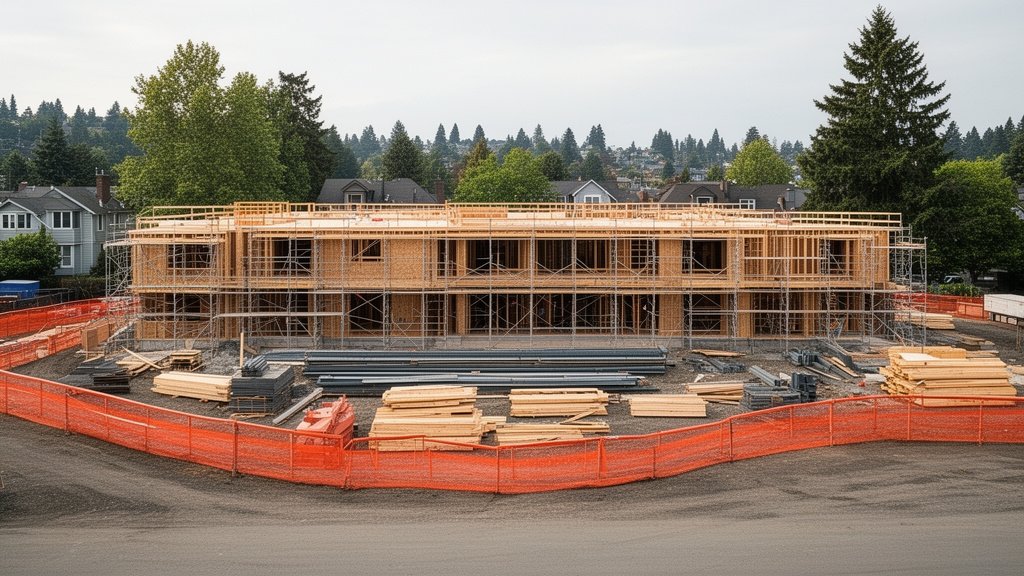
The Oregon Housing Stability Council has officially authorized additional funding for a contentious affordable housing development in North Portland, a move that has pushed the project’s total cost to approximately $1 million per apartment. This decision, covering a 57-unit complex, has reignited a heated statewide debate regarding the efficiency of public housing expenditure, the complexities of construction financing, and the long-term sustainability of state-funded affordable housing initiatives.
Key Highlights
- Unprecedented Costs: The final approved budget puts the cost of construction and development at nearly $1 million per unit for the 57-apartment project, raising questions about market versus public sector efficiency.
- Regulatory Burden: Analysis suggests that a confluence of rising labor costs, strict building code requirements, and land acquisition fees in the Portland metro area have fundamentally distorted the project’s financial viability.
- Fiscal Oversight: Critics of the Oregon Housing Stability Council argue that the approval underscores a systemic failure to cap escalating development costs, demanding a reevaluation of how public funds are allocated.
- The Opportunity Cost: Independent housing advocates emphasize that while the project serves a specific need, the per-unit cost effectively displaces funding that could have theoretically supported significantly more housing units elsewhere in the state.
The Anatomy of a Million-Dollar Apartment
When news broke that a state-backed housing project had reached a per-unit cost rivaling luxury real estate in the heart of the Pacific Northwest, the immediate reaction from taxpayers and housing policy analysts was one of profound sticker shock. However, to understand how a 57-unit affordable housing development in North Portland reached this financial precipice, one must peel back the layers of the current development ecosystem.
The Convergence of Hard and Soft Costs
Affordable housing development is rarely as simple as the cost of bricks and mortar. The current project involves a complicated synthesis of “hard costs”—actual construction, materials, and labor—and “soft costs,” which include permits, system development charges, architectural fees, and the interest on financing. In the Portland metro area, both categories have seen an inflationary spike.
Recent data indicates that labor shortages in the skilled trades have pushed wage requirements higher, particularly for projects utilizing unionized labor, a frequent requirement for state-funded developments. Furthermore, Oregon’s land-use laws, while intended to curb sprawl, have simultaneously created scarcity in buildable land, driving up acquisition prices. When the Oregon Housing Stability Council (OHSC) evaluates these proposals, they are often faced with a binary choice: approve the inflated budget or see the project fail entirely. This has created a “too big to fail” dynamic where the state feels compelled to close the funding gap to ensure the units are delivered, even if the price tag is objectively staggering.
The Regulatory Feedback Loop
Beyond the raw material costs, developers point to a “regulatory feedback loop.” Compliance with modern environmental standards, seismic retrofitting requirements, and complex permitting processes can add years to a project’s timeline. Each month of delay accrues carrying costs on loans, which eventually get capitalized into the final price of the building. For this North Portland development, critics argue that the sheer bureaucratic inertia surrounding the permit approval process has been a primary driver of the cost escalation, effectively turning a standard development project into a fiscal marathon.
Economic Impact and Opportunity Cost
The central argument against such high-expenditure projects is not necessarily that housing should not be built, but rather the question of what could have been.
The Efficiency Equation
If a single unit costs $1 million to bring online, policy analysts question the scalability of such a model. In regions where land is cheaper or regulatory requirements are less exhaustive, that same capital could potentially produce three or four times the number of units. The Oregon Housing Stability Council is now facing pressure to prove that this project provides a unique, irreplaceable value that justifies the high expenditure—such as proximity to essential transit hubs or high-need social services—rather than simply being an example of inefficient capital deployment.
Shifting Market Dynamics
This project serves as a microcosm for the broader Portland housing market. As the city struggles to balance aggressive climate goals with the desperate need for low-income housing, the friction between these two priorities is becoming increasingly expensive. Developers warn that if the state does not streamline the process and find ways to lower the cost of entry, the private sector may continue to retreat from the affordable housing market, leaving the state to bear the increasingly astronomical costs of filling the gap alone.
Future Implications for State Policy
The fallout from this approval will likely force a legislative reckoning in Salem. Lawmakers are already signaling that the next session may focus on “cost containment” measures for state-subsidized projects. This could include capped funding amounts, mandatory competitive bidding overhauls, or legislative pressure to expedite permitting for developments that receive state subsidies.
Moreover, the transparency of the OHSC approval process is under the microscope. Stakeholders are demanding clearer public disclosures regarding how cost overruns are calculated and why certain budget increases are deemed necessary. Without a shift in policy, this project risks becoming a case study in how well-intentioned public policy can collide with the harsh realities of market inflation, resulting in a model that is ultimately unsustainable for taxpayers.
FAQ: People Also Ask
Q: Why does it cost $1 million to build one apartment?
A: The $1 million per unit figure is not just the cost of construction; it includes land acquisition, high-interest financing, architectural fees, legal compliance, system development charges, and often, significant expenses related to project delays and compliance with state-mandated labor and energy codes.
Q: Did the Oregon Housing Stability Council have other options?
A: Theoretically, the Council could have denied the additional funding. However, doing so would likely have resulted in the project stalling indefinitely, losing the current progress, and failing to deliver any of the 57 units, which the state has already prioritized as part of its strategic housing goals.
Q: Is this price tag unique to North Portland?
A: While North Portland has specific land-cost factors, similar high-cost projects have been reported in other major West Coast cities. The trend reflects a broader crisis in affordable housing, where development costs are outpacing wage growth and tax credit subsidies.
Q: Will this affect future state housing budgets?
A: Yes. The optics of this approval have placed immense pressure on the state legislature to implement cost-cap mechanisms. Future projects will likely undergo much more rigorous scrutiny regarding their “cost per door” before receiving final funding approval.