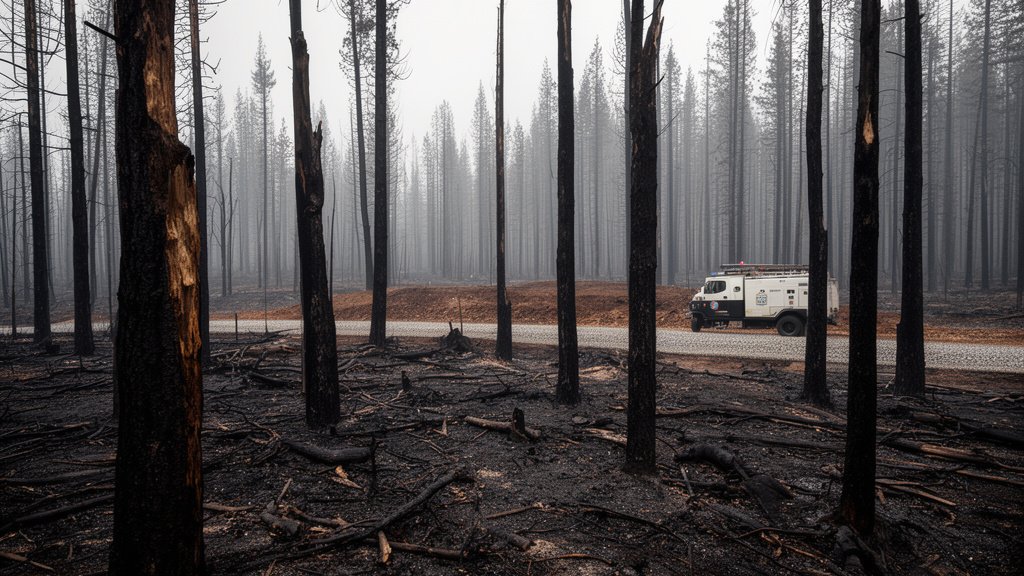
The 2026 wildfire season in Oregon has rewritten the rules of forest management and emergency response, challenging long-held assumptions about the relationship between ignition frequency and total landscape destruction. While the state recorded fewer individual fire starts compared to the previous five-year average, the resulting damage has reached unprecedented levels, establishing 2026 as one of the most destructive years in modern history. The season concluded with more than 2.1 million acres consumed and direct firefighting and recovery costs exceeding $235 million, signaling a profound shift in how climate-driven wildfires behave in the Pacific Northwest.
Key Highlights
- Unprecedented Acreage: A staggering 2.1 million acres were lost, largely due to high-intensity crown fires that resisted initial containment.
- The Financial Toll: Documented direct costs associated with suppression, infrastructure protection, and emergency mobilization exceeded $235 million.
- Ignition vs. Impact: Despite a lower total count of fire starts, the fires that did take hold burned with greater speed and efficiency due to critical fuel moisture deficits.
- Strategic Realignment: The data is forcing the Oregon Department of Forestry (ODF) to pivot toward a ‘maximum initial attack’ strategy to prevent small ignitions from scaling into mega-fires.
The Analytics of Destruction: Anatomy of the 2026 Season
The 2026 season serves as a grim case study in fire behavior under extreme atmospheric conditions. For decades, emergency management agencies, including the Oregon Department of Forestry (ODF) and the Bureau of Land Management (BLM), operated under the assumption that a high volume of small, manageable fires was the primary threat to the landscape. However, 2026 flipped this paradigm. The phenomenon, now being referred to by climate researchers as the ‘Efficiency of Destruction,’ saw fires that ignited in remote, high-altitude terrain transition rapidly from surface fires to crown fires—the most dangerous type of blaze, which moves through the canopy rather than the forest floor.
Why Fewer Fires Caused More Ruin
The paradox of the 2026 season lies in the synergy of meteorological and botanical factors. A prolonged winter drought, followed by a sudden, sustained heat dome in late July, created a ‘flash-curing’ effect on vegetation. In previous years, even if ignition numbers were high, the vegetation often retained enough moisture to slow the spread of smaller fires. In 2026, the fuel moisture levels were at historic lows. Consequently, every spark became a high-probability event for a catastrophic outcome. Firefighters often found themselves stretched thin, not by the sheer number of fires, but by the sheer intensity and speed at which a single ignition could consume 50,000 acres in a matter of hours.
Economic Fallout: The $235 Million Price Tag
The financial impact of $235 million represents only the tip of the iceberg in terms of public expenditure. This figure accounts for direct suppression efforts, aviation fuel for aerial retardant drops, and the mobilization of inter-agency personnel. However, this does not factor in the cascading economic costs: the loss of timber value, the catastrophic impact on the Wildland-Urban Interface (WUI) communities where residential property was lost, and the long-term environmental rehabilitation costs. Insurance actuaries are already citing the 2026 data as a primary reason for shifting risk assessments in Oregon’s rural and semi-rural regions, which will likely lead to higher premiums for homeowners near forested areas.
Climate Catalysts and Fuel Management
Experts are pointing to the compounding effects of climate change as the primary driver behind the shift. The lack of snowpack in the preceding winter months left soil layers parched, creating a feedback loop where the ground could not absorb sporadic summer rain. This dry ground accelerated the drying of fine fuels—grasses and brush—that act as kindling for larger timber. Forestry management policy is now under intense scrutiny. There is a growing consensus that the historical focus on suppression must transition to a more aggressive ‘active forest management’ approach, including more controlled burns, thinning of overgrown timber stands, and the creation of larger, more effective fire breaks around critical infrastructure.
Preparing for the New Normal
The Bureau of Land Management and state officials are currently evaluating the 2026 season to re-engineer their response tactics. The ‘Initial Attack’ protocol—where every effort is made to suppress a fire while it is small—is being reinforced with new technology, including AI-driven satellite monitoring and faster, more agile drone deployment to identify hotspots before they become uncontrollable. This transition is not just about having more personnel, but about having the right data to deploy them before the weather windows close and the ‘fire-weather’ conditions align to trigger another season of mega-fires. The 2026 data is essentially the baseline for a future where fire is no longer an anomaly, but a constant, high-stakes threat.