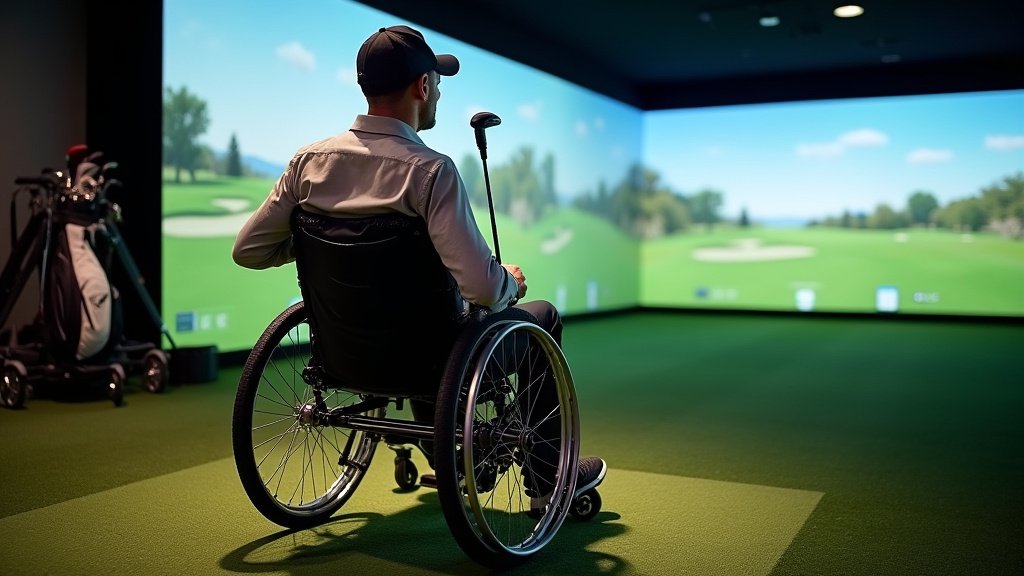
The Moment of Impact: An Unforgettable Surprise
In a poignant intersection of technological innovation and community kindness, the Golf Garage in Phoenix, Oregon, became the setting for a life-changing event. Rob Verdie, a dedicated golfer whose life has been reshaped by the challenges of Amyotrophic Lateral Sclerosis (ALS), was recently the recipient of a surprise that promises to restore not just his ability to play, but his connection to the fairway. The nonprofit organization David’s Chair stepped in to bridge the gap between physical limitation and passion, presenting Verdie with a specialized adaptive golf chair. This equipment is not merely a convenience; it is a vital tool that provides the stability and mobility required to navigate a golf course, allowing Verdie to stand tall and swing with confidence once again.
The atmosphere at the Golf Garage—typically a venue for high-tech indoor simulation—transformed into an emotional hub for local residents and sports enthusiasts as they witnessed the unveiling. For Verdie, the gesture transcends the utility of the chair. It represents a reclaiming of identity, a return to the ritual of the game, and a powerful statement on the importance of adaptive sports in fostering inclusivity for those living with neurodegenerative conditions.
Key Highlights
- Recipient: Rob Verdie, a local Phoenix, Oregon resident, was surprised with a piece of life-changing athletic equipment.
- The Donor: David’s Chair, a nonprofit dedicated to providing adaptive mobility equipment to those with disabilities, facilitated the donation.
- The Technology: The adaptive golf chair is engineered to provide vertical stability, allowing users to safely swing a golf club while remaining fully supported.
- The Venue: The Golf Garage in Phoenix, Oregon, served as the backdrop for the presentation, highlighting the facility’s commitment to community and inclusive sports culture.
Reclaiming the Game: The Intersection of Tech and Spirit
Understanding the Adaptive Golf Chair Technology
At the heart of this story is the sophisticated engineering behind modern adaptive golf chairs. Unlike standard mobility scooters, these specialized units are designed with the specific mechanics of the golf swing in mind. They feature electronic vertical lift capabilities, allowing the user to transition from a seated to a standing position, which is essential for proper club alignment and force distribution. The base is widened and stabilized to ensure safety during the kinetic energy release of a swing, preventing tipping and providing a secure platform. For an individual like Verdie, living with the progressive muscle weakness associated with ALS, this mechanical support eliminates the physical barriers that would otherwise keep them off the course. It turns the act of swinging a club—which can become impossible due to balance and muscle control issues—back into a fluid, enjoyable motion.
The Psychosocial Impact of Maintaining Hobbies
When a diagnosis like ALS is made, patients often face a rapid, involuntary detachment from the hobbies that defined their pre-diagnosis life. The psychological toll of this detachment is profound, often leading to feelings of isolation and loss of agency. By providing this adaptive chair, David’s Chair is doing more than donating hardware; they are offering a therapeutic intervention. Studies in adaptive sports medicine have consistently shown that maintaining participation in recreational activities can significantly improve the mental health of individuals with chronic, progressive illnesses. It preserves social ties, provides cognitive stimulation, and fosters a sense of normalcy in the face of daunting physical changes. Verdie’s return to the Golf Garage is a testament to the fact that with the right community support, the diagnosis does not have to signal the end of one’s active lifestyle.
The Vital Role of Local Community Hubs
Facilities like the Golf Garage in Phoenix, Oregon, are increasingly acting as the “third place” for community members—a vital space between home and work where social bonds are formed. By hosting this presentation, the Golf Garage demonstrated that the future of the golf industry must be inclusive. It is no longer enough for golf facilities to be mere training grounds; they must be accessible spaces that welcome individuals with varying levels of mobility. This event set a precedent for other local businesses to consider how they might audit their spaces for accessibility and partner with nonprofits to host similar events, thereby amplifying the reach of adaptive technologies.
David’s Chair: Building a Legacy of Mobility
The nonprofit behind the donation, David’s Chair, has become a beacon of hope in the Pacific Northwest. Named after the founder’s personal experience with loss and the desire to help others live full lives, the organization focuses on removing barriers for people with ALS, multiple sclerosis, and other mobility-limiting conditions. Their mission is rooted in the belief that mobility is a human right, particularly when it comes to experiencing the outdoors and sports. Their work involves not only purchasing and distributing expensive adaptive equipment but also coordinating the logistics to ensure the recipient is trained and comfortable. The surprise presentation for Verdie was a culmination of weeks of coordination, ensuring that the transition from diagnosis to ‘back on the green’ was as seamless as possible.
Future Implications: Innovation in Inclusive Sports
Looking ahead, the collaboration between private nonprofits and local commercial sports facilities suggests a promising model for the future of disability advocacy. As adaptive technology becomes more refined and cost-effective, we can expect to see a surge in community-led initiatives that normalize the presence of adaptive equipment in public spaces. The success of this event at the Golf Garage serves as a scalable blueprint: local businesses provide the venue and community buy-in, while specialized nonprofits provide the technical expertise and equipment. This synergy is essential for creating an equitable sports landscape where a diagnosis of ALS or other mobility impairments does not equate to the end of one’s athletic journey.
FAQ: People Also Ask
Q: What is David’s Chair and what do they do?
A: David’s Chair is a nonprofit organization that provides specialized adaptive equipment, such as off-road wheelchairs and adaptive golf chairs, to individuals with ALS, MS, and other mobility issues, allowing them to remain active and connected to their communities.
Q: How does an adaptive golf chair assist someone with ALS?
A: An adaptive golf chair provides essential stability and support. It often includes an electronic lift mechanism that allows the golfer to stand up partially, enabling a proper swing motion despite muscle weakness, balance issues, or limited mobility, while ensuring the user remains secure throughout the movement.
Q: Can these chairs be used on standard golf courses?
A: Yes, many adaptive golf chairs are designed to be golf-cart-path accessible and, depending on the model and turf conditions, can often navigate fairways. They are built with specialized tires to minimize impact on the greens and fairways.
Q: Where is the Golf Garage located?
A: The Golf Garage mentioned in this story is located in Phoenix, Oregon, and serves as a local hub for golf simulation and practice, increasingly acting as an inclusive venue for the local golfing community.