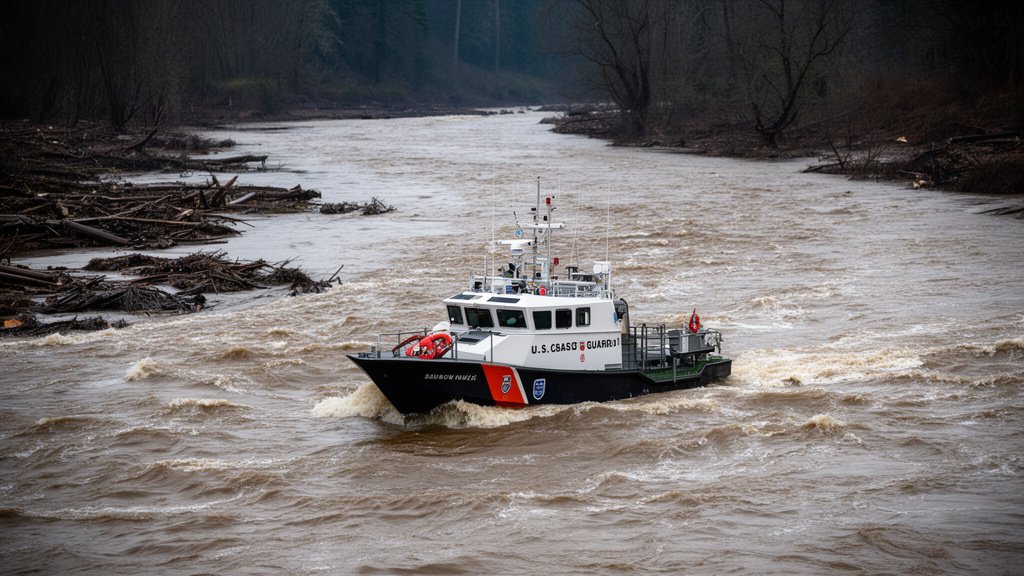
Emergency crews, including the U.S. Coast Guard and Tillamook County deputies, have launched an intensive search for two individuals reported missing in the vicinity of the Savage Road area of Otis, Oregon. The missing persons are believed to have been canoeing on the Salmon River, an area currently subjected to volatile environmental conditions. The search is complicated by severe coastal storm activity and the phenomenon of ‘king tides,’ which have significantly elevated water levels and intensified currents throughout the coastal region, creating a precarious environment for rescue teams and posing severe hazards to anyone on the water.
- Active Search Operations: U.S. Coast Guard and Tillamook County Sheriff’s deputies are actively patrolling the Salmon River area near Savage Road in Otis, Oregon.
- Missing Persons: Two individuals are confirmed missing following reports they were canoeing in the area.
- Environmental Hazards: The region is currently experiencing dangerous king tides and coastal storms, which have severely complicated search efforts.
- Public Safety Warning: Authorities are urging the public to avoid the water and low-lying coastal areas due to the unpredictable and life-threatening nature of the current surge.
Crisis on the Salmon River: The Search for Missing Canoeists
The Pacific Northwest coast is known for its rugged beauty, but the current conditions near Otis, Oregon, have transformed the local waterways into high-risk zones. The search for the two individuals, who were reportedly canoeing when they went missing, is a testament to the dangers posed by the interaction between inland river systems and the Pacific Ocean during extreme weather events.
Understanding the Environmental Backdrop
The Salmon River, which winds through the coastal mountains before emptying into the Pacific Ocean, is highly sensitive to tidal influences. When heavy coastal rainfall—common during Oregon’s winter months—coincides with king tides, the river’s hydrology shifts dramatically. King tides, or perigean spring tides, occur when the moon’s gravitational pull is strongest, creating abnormally high and low tides.
In the context of the Salmon River, these elevated tides can cause water to back up, effectively turning the lower stretches of the river into a turbulent, high-volume basin. For a canoeist, these conditions are treacherous. Even experienced paddlers can find themselves overwhelmed by sudden surges, debris swept down from the upper reaches of the river, and the erratic currents created by the conflict between downstream river flow and incoming tidal force. The current storms have likely exacerbated these conditions, making the riverbanks unstable and the water temperature lethally cold.
The Anatomy of a Search and Rescue Operation
Search and Rescue (SAR) missions in riverine and estuary environments are notoriously difficult. The coordination between the U.S. Coast Guard and local law enforcement, such as the Tillamook County Sheriff’s Office, is designed to bring diverse expertise to a complex problem.
The U.S. Coast Guard often deploys specialized assets such as shallow-water rescue boats and, depending on visibility and wind conditions, helicopter support. These teams utilize thermal imaging and sophisticated radar to scan riverbanks and dense brush that would be impossible to search by foot. Meanwhile, county deputies focus on ground-based efforts, managing road access, interviewing witnesses, and patrolling areas where the river widens or changes course.
One of the primary challenges in this operation is the volatility of the search area. As the tide shifts, the landscape changes—mudflats emerge or disappear, and debris piles shift, potentially obscuring key evidence or locations where victims might have sought shelter. SAR teams must constantly reassess their safety, as the very conditions that endangered the canoeists now pose a threat to the rescue personnel.
Secondary Angles: Why Oregon’s Coast Remains a Danger Zone
To understand the gravity of the Otis search, one must look at the broader context of Oregon’s coastal geography and water safety.
1. The ‘Invisible’ Danger of Coastal Rivers: Many recreationalists view rivers like the Salmon as calm, manageable waterways. However, in the Pacific Northwest, these rivers act as conduits for mountain runoff. When ocean levels rise due to storms, the ‘exit’ for this water is blocked. This hydraulic jam causes rapid, unpredictable water level rises that can catch people off guard within minutes.
2. The Evolution of SAR Technology: Modern SAR efforts are no longer limited to visual spotting. Today, agencies leverage drone technology equipped with high-resolution and infrared cameras. These tools allow rescuers to fly over dense riparian zones where the riverbanks are too steep or unstable for human navigation, providing a vital edge in time-sensitive ‘golden hour’ operations.
3. The Impact of Climate Extremes on Local Economies and Recreation: As coastal storms become more frequent and intense, the local recreational economy in places like Otis faces a reckoning. Local authorities and park services are increasingly forced to implement temporary closure zones during high-tide events. This shift highlights a growing necessity for better public education regarding the specific, localized dangers of king tides, ensuring that residents and tourists alike understand that ‘high water’ means more than just a wet beach—it means a dangerous, high-velocity current.
As the search in Otis continues, the primary focus remains on the survival of the missing canoeists. The combined efforts of the Coast Guard and local deputies represent the critical nature of inter-agency cooperation in the face of nature’s unpredictable power.
FAQ: People Also Ask
1. What are king tides and why are they dangerous for boaters?
King tides are the highest tides of the year, occurring when the sun, moon, and earth are in alignment. For boaters and canoeists, they create unpredictable, high-velocity currents and significantly reduce the clearance under bridges or over obstacles, making river navigation far more hazardous than during normal conditions.
2. Why was the U.S. Coast Guard involved in a river search?
The U.S. Coast Guard has jurisdiction over navigable waterways that connect to the ocean, including rivers that are tidal in nature, like the lower Salmon River. Their specialized equipment—specifically boats designed for turbulent, shallow water—makes them essential partners for local sheriff’s offices in these environments.
3. How long can a SAR operation last in these conditions?
Search and Rescue operations are generally treated as time-sensitive, particularly in cold water environments where hypothermia is an immediate threat. However, the duration of an active search depends on environmental safety; if storms make it impossible for crews to operate safely, the search may pause and resume when conditions allow.
4. What should you do if you see someone in trouble on the water during a storm?
Do not attempt a water rescue yourself, as this often leads to multiple casualties. Instead, immediately call 911, provide an exact location, and maintain visual contact if it is safe to do so. Note the time and the direction of the current, as this information is invaluable to first responders.