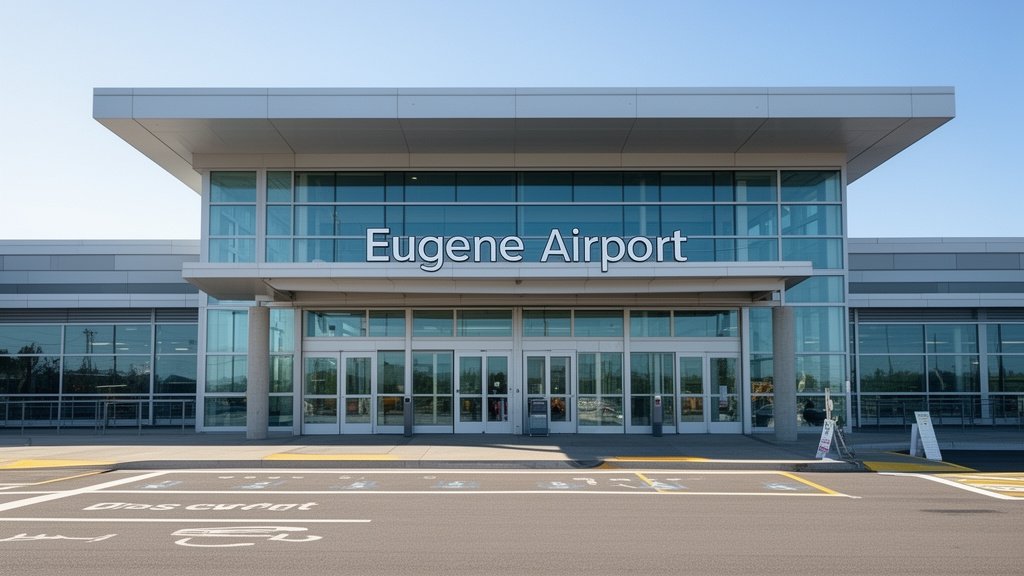
A recent investigative review has exposed significant inaccuracies in the economic impact projections for the proposed expansion of the Eugene Airport (Mahlon Sweet Field). The airport authority had previously touted a massive $3.6 billion boost to the regional economy—a figure that analysts now assert was derived through systematic double-counting of economic activity. This revelation creates a substantial hurdle for the facility as it seeks $91 million in state funding to move the project forward.
Key Highlights
- Inflated Projections: The $3.6 billion economic impact figure is being retracted and scrutinized due to methodological flaws.
- Double-Counting Error: Investigators found that initial studies counted intermediate goods and services multiple times, artificially inflating the total projected output.
- Funding at Risk: The airport’s request for $91 million in state infrastructure funding is currently under intense review by legislative bodies.
- Transparency Concerns: Local advocates and fiscal watchdogs are now calling for a full, independent review of the project’s financial feasibility.
Scrutinizing the Numbers: The Breakdown of a Financial Fallacy
Infrastructure projects of the scale proposed for the Eugene Airport require complex economic impact studies to secure funding. These studies typically use Input-Output (I-O) modeling to estimate how money spent on construction and operations ripples through the local economy. However, the integrity of these models relies entirely on the accuracy of the input data and the correct application of multipliers. The audit revealed that the consultants utilized to justify the expansion failed to properly account for “leakage” and, more critically, engaged in the classic error of double-counting.
The Mechanics of the Error
Double-counting occurs when a specific dollar amount is counted as an expenditure for one sector and then counted again as revenue or output for a secondary sector without adjusting for the initial cost. In the case of the Eugene Airport proposal, the projections likely captured the initial capital expenditure and then failed to net out the costs of materials and labor that were already accounted for in downstream economic benefits. By inflating these figures, the proposal presented an overly optimistic view of the project’s ability to drive long-term regional growth, specifically within the Lane County service sector. The discrepancy suggests that the actual economic impact may be a fraction of the original $3.6 billion claim.
The $91 Million Funding Request
The timing of this audit could not be more precarious for the Eugene Airport authority. With a $91 million request sitting before the Oregon state legislature, the burden of proof has shifted. Legislators are now tasked with determining whether the project is viable based on the corrected economic data or if the proposal needs to be fundamentally restructured. For a project intended to modernize terminal capacity and enhance freight logistics, the loss of credibility regarding its financial justification has turned the expansion from a “clear win” into a point of intense political debate.
Secondary Angles: Context and Implications
1. The Erosion of Public Trust in Infrastructure Spending
This incident highlights a growing tension between regional development authorities and the public. When large-scale projects rely on “best-case scenario” math to secure public funding, it risks eroding trust in essential infrastructure initiatives. If taxpayers and government officials cannot rely on the basic economic projections presented by agencies like airport authorities, it forces the state to implement more rigorous, potentially slower, oversight mechanisms for future developments.
2. The Evolution of Airport Infrastructure in the Pacific Northwest
Eugene Airport, while critical to the region, exists in a competitive landscape alongside other regional hubs. The need for expansion is driven by genuine increases in passenger volume and the demand for increased air freight capability. However, this economic controversy underscores the danger of “growth at any cost.” Planners must balance the necessity of modernization against the reality of regional economic capacity, moving away from hyperbolic projections toward conservative, sustainable growth estimates.
3. The Future of Economic Impact Modeling
The controversy serves as a case study for the Oregon Department of Aviation and similar entities. Moving forward, it is likely that state funding requirements will include a mandatory, independent audit of economic impact studies by non-affiliated firms. By standardizing the methodology for these impact reports, the state can avoid the political fallout of inflated projections and ensure that taxpayer dollars are allocated to projects with genuine, demonstrable return-on-investment potential.
FAQ: People Also Ask
Q: Why was the economic impact figure of $3.6 billion considered inflated?
A: Analysts found that the study used to arrive at this number employed “double-counting,” a technical error where economic activity is counted multiple times in the supply chain, artificially inflating the final projection.
Q: How does this affect the $91 million funding request?
A: The funding request is currently on hold. Legislative committees are now requiring a revised, accurate economic impact assessment before they will move forward with any approval of the $91 million allocation.
Q: Will the Eugene Airport expansion be canceled?
A: Not necessarily. While the funding is in jeopardy, the airport still has a demonstrated need for infrastructure improvements. The most likely outcome is that the project will be rescaled or delayed until the financial data is corrected and re-submitted for approval.