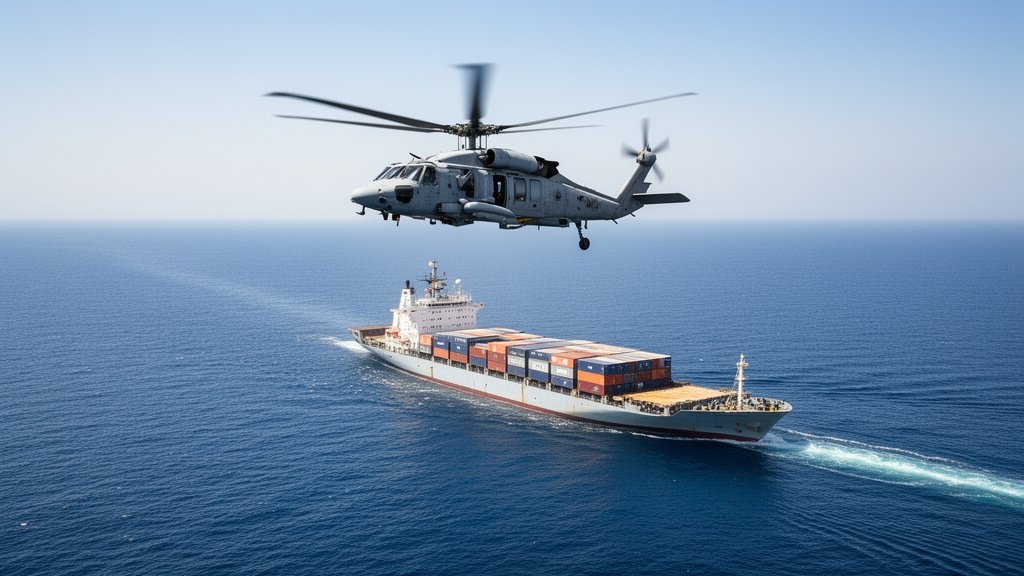
The U.S. Navy executed a high-stakes maritime interdiction operation today in the Strait of Hormuz, utilizing an MH-60 Seahawk helicopter to force a stop to the Panama-flagged cargo vessel M/V Vela Nova. The vessel had been actively attempting to evade an established U.S. Navy blockade. According to military reports, the aircraft deployed two Hellfire missiles in a precision strike aimed at the vessel’s steering gear, effectively immobilizing the ship without causing catastrophic loss of life or sinking the cargo carrier.
Key Highlights
- Precision Interdiction: An MH-60 Seahawk deployed two AGM-114 Hellfire missiles to disable the steering mechanism of the M/V Vela Nova.
- Blockade Enforcement: The action was taken to enforce a U.S.-led maritime blockade in the critical Strait of Hormuz, preventing unauthorized transit.
- No Casualties Reported: The strike was calibrated for surgical impact on the rudder and steering gear, minimizing structural damage to the hull.
- Strategic Chokepoint: The event underscores the escalating tensions in the Strait of Hormuz, a vital artery for approximately 20% of the world’s petroleum consumption.
Maritime Security and Tactical Precision in the Strait
The operation involving the M/V Vela Nova serves as a stark demonstration of modern naval interdiction capabilities. When a commercial vessel ignores multiple directives to halt for inspection, the U.S. Navy’s Rules of Engagement (ROE) allow for incremental escalation of force. The selection of the MH-60 Seahawk—a platform primarily known for anti-surface and anti-submarine warfare—highlights the versatility of the air wing in current maritime security operations.
The Technical Mastery of the Hellfire Strike
The AGM-114 Hellfire missile is designed for high-precision, low-collateral-damage engagements. By targeting the steering gear, the U.S. Navy pilots demonstrated a surgical application of force. Disabling the rudder assembly of a vessel as large as a cargo ship requires precise targeting, as the mechanism is often located at the waterline and obscured by the vessel’s propulsion wake. The successful incapacitation of the M/V Vela Nova without causing a catastrophic spill or sinking the vessel is a testament to the training protocols currently in effect for forward-deployed naval aviation squadrons.
Strategic Chokepoints and Economic Stability
The Strait of Hormuz remains the most significant maritime chokepoint globally. Any disruption to the flow of vessels through these waters triggers immediate volatility in global energy markets. By enforcing a blockade against the M/V Vela Nova, the U.S. Navy is not merely executing a tactical stop; it is signaling the maintenance of international maritime standards. The vessel’s attempt to evade the blockade indicates a challenge to the established maritime protocols in the region. Analysts suggest that the swift neutralisation of this threat is intended to deter other operators from attempting similar unauthorized transits, which could otherwise jeopardize the security of global energy supply chains.
Legal Frameworks and Rules of Engagement
The international legal basis for blockades and maritime interdiction is governed by a complex intersection of the United Nations Convention on the Law of the Sea (UNCLOS) and bilateral naval security agreements. When a vessel refuses to comply with lawful instructions in international waters or within designated security zones, maritime forces are authorized to use force proportionate to the threat level. The M/V Vela Nova incident will likely be scrutinized by international maritime legal experts to determine if the blockade’s enforcement aligns with standard ROE. Historically, these incidents are used to test the resolve of the blocking power, making the precision of the U.S. response vital to maintaining political and military credibility in the region.
The Future of Autonomous and Aerial Patrols
Looking ahead, the role of manned helicopters like the MH-60 may evolve alongside emerging drone technology. While human pilots were required to make the split-second decision to fire in this instance, the U.S. Navy is increasingly integrating autonomous sensor platforms to monitor the Strait. This incident highlights that even with high-tech surveillance, the ‘last mile’ of enforcement—the ability to physically stop a non-compliant vessel—remains a core function of the carrier-based air wing. The M/V Vela Nova case serves as a real-world case study for the necessity of maintaining robust, reactive capabilities in contested waters.
FAQ: People Also Ask
Q: Why was the M/V Vela Nova fired upon?
A: The vessel was attempting to evade a U.S. Navy blockade in the Strait of Hormuz. After failing to comply with orders to halt for inspection, the Navy utilized proportional force to disable its steering gear and bring it to a stop.
Q: What is the significance of the Strait of Hormuz?
A: It is a vital global chokepoint, with roughly 20% of the world’s petroleum passing through it daily. Its security is essential to global economic stability.
Q: Was there any environmental impact from the strike?
A: While the strike damaged the steering gear, the Navy reports that the hull remained intact, and no hazardous spills or environmental threats were generated by the disabling of the vessel.
Q: What does this mean for future commercial shipping in the region?
A: It signals a strict enforcement of U.S. maritime security protocols. Commercial vessels operating in the Strait must expect rigorous adherence to inspection protocols and blockade guidelines to avoid similar tactical engagements.