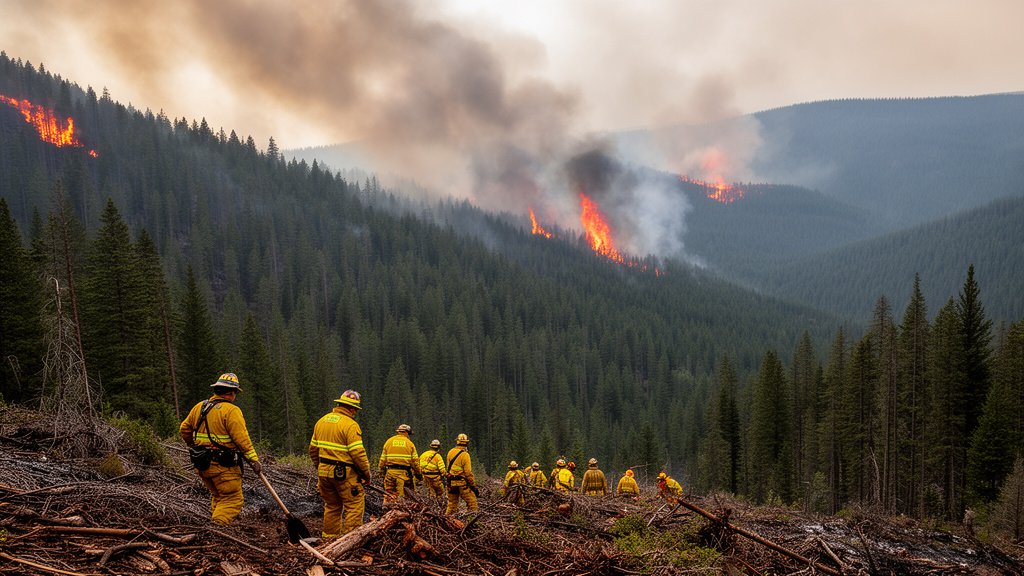
Fire crews currently engaged in the Umatilla National Forest are prioritizing the defense of the vital Mill Creek watershed as the Hagen Fire continues its aggressive growth. As of August 21, the Hagen Fire has expanded to 58,646 acres with 19% containment, while the Paradise Fire remains static at 6,745 acres. With high wind warnings complicating suppression efforts, federal and local incident management teams have shifted resources to construct defensive lines intended to shield the watershed from encroaching flames.
Key Highlights
- Hagen Fire Status: 58,646 acres burned, currently 19% contained.
- Paradise Fire Status: 6,745 acres burned, holding steady.
- Critical Objective: Preventing fire encroachment into the Mill Creek watershed, a primary water source.
- Environmental Factor: High wind gusts are hindering air support operations and testing existing containment lines.
The Strategic Defense of the Mill Creek Watershed
The primary focus for the U.S. Forest Service and supporting interagency crews is not merely containment of the Hagen and Paradise fires, but the protection of the Mill Creek watershed. This area serves as a vital ecological and infrastructural asset, providing essential water resources for the surrounding region. The topography of the Umatilla National Forest, characterized by steep, rugged terrain and dense timber, creates a ‘chimney effect’ that accelerates fire movement when driven by the current high winds.
Tactical Challenges on the Fireline
Incident Command is currently juggling the suppression of two distinct fronts. The Hagen Fire, by virtue of its massive acreage, requires heavy equipment for line construction, including bulldozers and feller bunchers, to clear vegetation and create fuel breaks. However, the high winds noted in the August 21 updates are neutralizing many of these efforts, as embers are capable of spotting across established firelines. When wind speeds exceed 20 mph, aerial suppression—such as water drops from helicopters—becomes significantly less effective and, at times, unsafe for flight crews. This forces ground crews to rely on ‘indirect attack’ methods, which involve burning out sections of forest ahead of the fire to starve it of fuel before it reaches critical infrastructure.
Regional Climate and Fire Season Context
Historically, the Blue Mountains region, which encompasses portions of the Umatilla National Forest, has seen varying fire severity. However, the current trend indicates a lengthening fire season driven by earlier snowpack melts and prolonged summer heatwaves. The current fires are exacerbated by dry understory conditions that have persisted since late July. Experts from the National Interagency Fire Center have noted that fires of this size, once established in these specific watersheds, often require long-term containment strategies that can extend well into the autumn months until the first significant wetting rains arrive. The synergy between the Hagen and Paradise fires creates a complex management environment where resources must be fluidly reallocated to address the most imminent threats to water quality and public safety.
Economic and Ecological Implications
Beyond the immediate fire suppression costs—which can reach millions of dollars daily—the fires pose a long-term threat to the watershed’s ecology. Intense burns can strip vegetation from hillsides, increasing the risk of landslides and sedimentation in water reservoirs during subsequent rain events. This ‘post-fire erosion’ is a major concern for local water authorities. Protecting the Mill Creek watershed is therefore an economic imperative; sediment-choked water requires significantly more complex and expensive treatment processes. Furthermore, the loss of timberland affects the regional forestry economy and wildlife habitats that rely on the old-growth stands characteristic of this portion of the Pacific Northwest.
Future Outlook: What to Expect
As of this update, the Umatilla National Forest remains under high fire danger ratings. Meteorological models for the coming 48 hours show little relief from the gusty winds, suggesting that containment percentages may remain volatile. Residents in downwind communities should remain vigilant for smoke advisories and potential evacuation orders, should the wind shift the fire’s trajectory toward developed areas. The incident management team is focusing on reinforcing ‘anchors’—stable locations where firelines meet natural barriers—to ensure the safety of ground crews. The success of these efforts in the next few days will be the deciding factor in whether the Mill Creek watershed avoids the most severe impacts of the fire.
FAQ: People Also Ask
Q: Why is the Mill Creek watershed considered a priority?
A: The Mill Creek watershed is a critical water supply for municipal and agricultural use in the region. Protecting it prevents severe water contamination from ash, debris, and sedimentation, which would be difficult and costly to treat.
Q: How does wind affect fire containment progress?
A: Wind drives fire movement through spot fires (where embers ignite new areas ahead of the main fire) and increases oxygen flow to the flames. High winds also make aerial water drops dangerous and inaccurate.
Q: Is the Hagen Fire under control?
A: At 19% containment, it is not fully controlled. Containment refers to the construction of a physical line—either natural or man-made—around the fire perimeter that limits its growth. The remaining 81% is currently active.
Q: What should residents near Umatilla National Forest do?
A: Residents should monitor official U.S. Forest Service and local county sheriff alerts for evacuation status, maintain a ‘go-bag,’ and stay updated on smoke levels, which can impact air quality significantly.