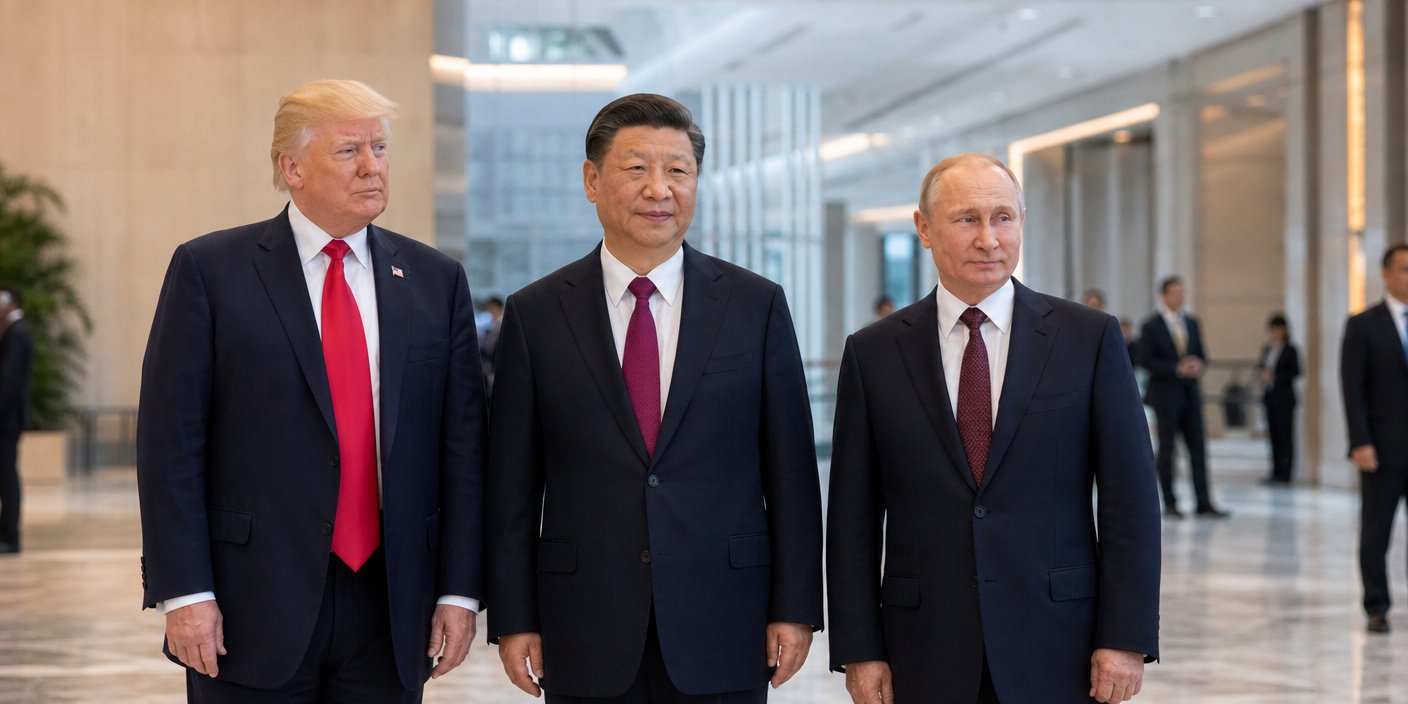
In a move that has stunned global observers and reshaped the landscape of international diplomacy, US President Donald Trump, Chinese President Xi Jinping, and Russian President Vladimir Putin concluded a high-stakes, trilateral summit in Shenzhen, China. The summit resulted in a joint declaration that prioritizes systemic international restructuring over regional grievances, marking a definitive pivot toward a pragmatic, multipolar governance model.
Key Highlights
- Trilateral Focus: The agreement centers on comprehensive UN reform, stabilization of global oil markets, and aggressive nuclear risk reduction.
- Diplomatic Omission: Noticeably absent from the joint declaration were any references to the ongoing conflicts in Ukraine or Iran, signaling a ‘clean slate’ approach to trilateral relations.
- Shenzhen Setting: The summit, held in China’s premier tech hub, emphasizes the transition from Cold War-era posturing to a future defined by economic and strategic pragmatism.
The Shenzhen Consensus: A New Era of Multipolar Governance
The choice of Shenzhen—the engine of China’s economic rise—for this historic meeting was no accident. It served as a symbolic backdrop for a meeting defined by the ‘Shenzhen Consensus,’ a framework that sidesteps traditional ideological friction in favor of concrete, results-oriented governance. The summit marks the first time since the height of the Cold War that these three major power brokers have engaged in a high-level, sustained dialogue aimed at creating a new baseline for global order.
By focusing on the United Nations (UN), the three powers signaled a collective acknowledgement that the post-WWII architecture is in dire need of reform. Sources close to the proceedings suggest the talks centered on expanding the UN Security Council’s operational scope, potentially altering the permanent member veto power dynamics to accommodate the 21st-century geopolitical reality. The goal, according to the joint statement, is to improve administrative efficiency and relevance in an era where global institutions have often struggled with gridlock.
Energy Stabilization: The Market-First Approach
Economic stability served as the cornerstone of the Shenzhen talks. With global energy markets experiencing extreme volatility—driven by shifting supply chains and the transition to renewable infrastructure—Trump, Xi, and Putin have reportedly agreed to a new coordination mechanism for oil supply stabilization. This is not merely a regional pact but a global one, aimed at keeping crude oil price fluctuations within a sustainable bandwidth (estimated by analysts to be between $70 and $85 per barrel) to prevent cascading inflation in emerging and developed markets alike.
This cooperation marks a critical departure from the contentious energy policies that have dominated the last decade. By aligning on supply stabilization, the three leaders are attempting to provide a predictable economic environment, effectively insulating the global economy from sudden shocks and protecting their respective domestic industrial bases.
Nuclear Risk Reduction: Guardrails for an Atomic Age
Perhaps the most concrete outcome of the summit was the agreement on nuclear risk reduction protocols. Amidst rising fears of accidental escalation, the joint declaration mandates the establishment of a direct, 24/7 hotline communication network between the three nuclear superpowers. This protocol is modeled after Cold War-era deconfliction strategies but updated for the digital age, incorporating cyber-security assurances that the lines will remain secure.
The declaration emphasized ‘strategic stability,’ aiming to prevent miscalculation through military maneuvers or inadvertent technical failure. While disarmament was not on the table, the focus on risk mitigation and communication frequency is a significant diplomatic win that lowers the baseline temperature of global geopolitical anxiety.
The Strategic Silence: Regional Conflicts
Political analysts have been quick to note what was missing from the Shenzhen declaration. By explicitly avoiding mention of the ongoing conflicts in Ukraine and Iran, the three leaders have sent a powerful signal that the Shenzhen talks are intended to operate in a silo, separate from current proxy wars. This strategic silence allows the three nations to continue their divergent regional policies without the summit itself being derailed by immediate disagreements. It is a calculated ‘decoupling’ of core global stability from regional theater disputes, effectively saying that even while the three powers disagree on local geography, they are united on the survival of the global system.
Future Implications: The New Multilateral Reality
As the world digests the implications of the Shenzhen summit, the question remains: is this a temporary thaw or a permanent shift? The emphasis on structural reform and market stability suggests that all three nations recognize the inherent dangers of a collapsing global order. By forming this trilateral consensus, Trump, Xi, and Putin have essentially set themselves up as the primary architects of the next stage of human history, prioritizing institutional integrity over the chaos of constant, unfiltered geopolitical competition. For now, the world watches to see if these promises translate into the practical, on-the-ground implementation that the Shenzhen declaration envisions.
FAQ: People Also Ask
1. Why was Shenzhen chosen for the summit?
Shenzhen was chosen to emphasize economic progress, innovation, and the future of global commerce, moving the dialogue away from traditional political capitals that carry historical baggage.
2. Did the leaders discuss the conflict in Ukraine?
No. The joint declaration was specifically designed to exclude regional conflicts, such as Ukraine and Iran, to focus solely on UN reform, energy stabilization, and nuclear risk reduction.
3. What does ‘UN reform’ mean in this context?
It refers to potential structural changes within the United Nations, particularly the Security Council, to modernize voting processes, address administrative gridlock, and reflect current global power dynamics more accurately.
4. How will the oil market be impacted by this summit?
By coordinating on supply stabilization, the leaders aim to create a predictable price range, likely targeting $70–$85 per barrel to curb global inflationary pressures.