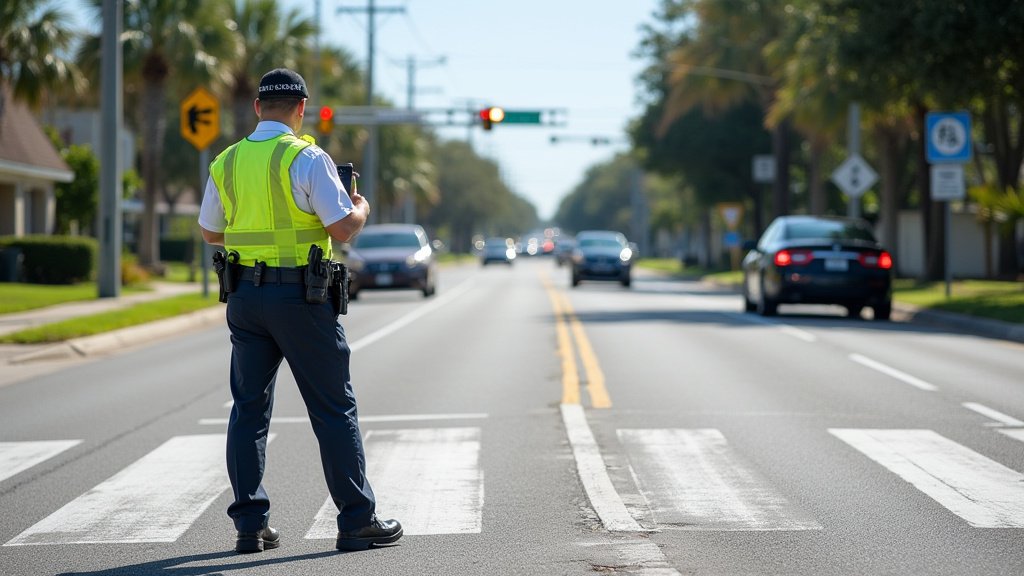
St. Johns County has officially launched the ‘Best Foot Forward’ pedestrian safety initiative, a strategic, data-driven program designed to combat rising pedestrian traffic incidents. By leveraging high-visibility enforcement and targeted education, the program aims to drastically improve driver compliance at crosswalks across the region. This launch marks a significant escalation in efforts by the North Florida Transportation Planning Organization (TPO) and local municipal partners, including the Florida Department of Transportation (FDOT), to transform roadway safety into a measurable and accountable metric rather than a passive goal.
Key Highlights:
- The ‘Best Foot Forward’ initiative focuses on measurable data, specifically tracking driver yielding rates at high-traffic crosswalks.
- The program is a collaborative effort involving the North Florida TPO, the Florida Department of Transportation (FDOT), and St. Johns County law enforcement.
- Strategy includes a dual approach: high-visibility enforcement operations to catch non-compliant drivers and strategic education campaigns to inform the public of right-of-way laws.
- The initiative aims to align St. Johns County with broader regional Vision Zero goals to eliminate traffic-related fatalities.
The Strategic Pivot: Reclaiming Roadway Safety in St. Johns County
The implementation of the ‘Best Foot Forward’ program in St. Johns County arrives at a critical juncture for North Florida infrastructure. As the county experiences rapid residential and commercial growth, the friction between vehicle traffic and pedestrian activity has reached a breaking point. For years, the approach to pedestrian safety often relied on reactive measures—installing a sign here or a beacon there after an incident occurred. ‘Best Foot Forward’ flips this script, treating safety as an active operational challenge that requires consistent, evidence-based management.
The Mechanics of ‘Best Foot Forward’
At its core, the program is not merely about awareness posters; it is about behavioral economics. The model is built on the proven concept that driver behavior changes when they perceive a high probability of enforcement. Local law enforcement officers are deployed in high-visibility operations, specifically targeting drivers who fail to yield to pedestrians in marked crosswalks. These enforcement waves are coupled with educational outreach that clarifies the legal obligation of drivers to yield to those in the crosswalk—or even those approaching it—as defined by Florida law.
The Anatomy of Compliance
The program relies on rigorous data collection. Before and after enforcement waves, the North Florida TPO tracks ‘yielding rates.’ By quantifying the percentage of drivers who stop for pedestrians, the county can create heatmaps of dangerous intersections. This data allows for precision resource allocation. Instead of spreading enforcement thin across the county, teams can focus their efforts where yielding rates are statistically lowest, creating the maximum possible deterrent effect with the resources available.
Collaborative Governance: TPO, FDOT, and Local Law Enforcement
The success of this initiative relies on a three-tier governance structure. The North Florida TPO provides the regional planning framework and the data analytics required to monitor success. The Florida Department of Transportation (FDOT) provides engineering support and funding for infrastructure tweaks, such as refreshed pavement markings or improved lighting at crosswalks. Finally, the St. Johns County Sheriff’s Office and local law enforcement agencies provide the ‘teeth’ of the program through active enforcement. This synergy is intended to break down the silos that often plague municipal safety projects.
Strategic Implications for the Future of North Florida
Beyond the immediate tactical goal of reducing injuries, the ‘Best Foot Forward’ initiative serves as a litmus test for urban planning in rapidly developing regions. We must look at the broader context of why this matters and how it shapes the future.
Historical Context: From Passive Awareness to Active Enforcement
Historically, pedestrian safety campaigns were often toothless. They focused on ‘share the road’ messaging which rarely translated to changed driver habits. ‘Best Foot Forward’ represents a generational shift. It acknowledges that public messaging is useless without enforcement. By moving away from purely passive awareness campaigns and toward active, metrics-based policing, the county is signaling a change in the ‘social contract’ of the road. It suggests that, in St. Johns County, the pedestrian is no longer an inconvenience to be navigated around, but a priority road user with a guaranteed right of way.
Tourism, Commerce, and the Pedestrian Experience
St. Johns County, home to the historic district of St. Augustine, faces unique pressures. A large percentage of the local economy is driven by tourism and foot traffic. Dangerous roads and low yielding rates create a perception of risk that discourages pedestrian activity. By making crosswalks safer, the county is not just saving lives—it is protecting its economic engine. A more walkable St. Augustine is, by definition, a more profitable one. The ‘Best Foot Forward’ campaign directly supports the long-term viability of the local tourism economy by ensuring that visitors feel secure walking between landmarks.
Future Outlook: Scaling the Model
Looking toward the future, this initiative acts as a proof-of-concept. If St. Johns County can demonstrate a statistically significant increase in driver yielding rates over the next 12 to 24 months, the North Florida TPO is expected to push for an expansion of this model into surrounding counties. Furthermore, the data collected will likely inform future ‘Smart City’ infrastructure projects. Future intersections could incorporate AI-driven monitoring or automated lighting that detects pedestrians and alerts drivers, essentially hard-coding the safety measures that ‘Best Foot Forward’ is currently trying to encourage through behavioral enforcement.
FAQ: People Also Ask
Q: What is the primary goal of the ‘Best Foot Forward’ campaign?
A: The primary goal is to increase driver yielding rates at marked crosswalks, thereby reducing pedestrian-involved accidents and fatalities through a combination of high-visibility enforcement and public education.
Q: How does the program measure success?
A: Success is measured using quantitative ‘yielding rate’ data. The North Florida TPO and its partners conduct observational studies before and after enforcement operations to calculate the percentage of drivers who legally yield to pedestrians.
Q: Is ‘Best Foot Forward’ solely focused on ticketing drivers?
A: No. While high-visibility enforcement is a key component, the program is a balanced initiative that includes significant public education efforts to ensure drivers understand their legal obligations under Florida law regarding crosswalk right-of-way.