Southwestern Japan is in the grip of a major disaster recovery effort following a powerful 7.1 magnitude earthquake that struck on Monday, causing widespread infrastructure damage and claiming at least 18 lives. The disaster has forced local authorities to pivot from general search-and-rescue operations to a specialized, high-stakes mission at a local shopping mall, where a secondary explosion has significantly complicated the situation for first responders.
Key Highlights
- Magnitude 7.1: The earthquake originated in southwestern Japan, with tremors felt across multiple prefectures.
- Confirmed Casualties: The current death toll stands at 18, with local officials warning that numbers could rise as search operations continue.
- Critical Incident: A secondary explosion occurred at a prominent shopping mall, trapping survivors under debris and creating a hazardous environment for rescuers.
- Emergency Response: Units from the Japan Self-Defense Forces (JSDF) and local fire departments are working in tandem to stabilize the blast site.
- Infrastructure Alert: The Japan Meteorological Agency (JMA) continues to monitor for aftershocks, urging residents to remain vigilant.
The Crisis at the Core: A Structural Nightmare
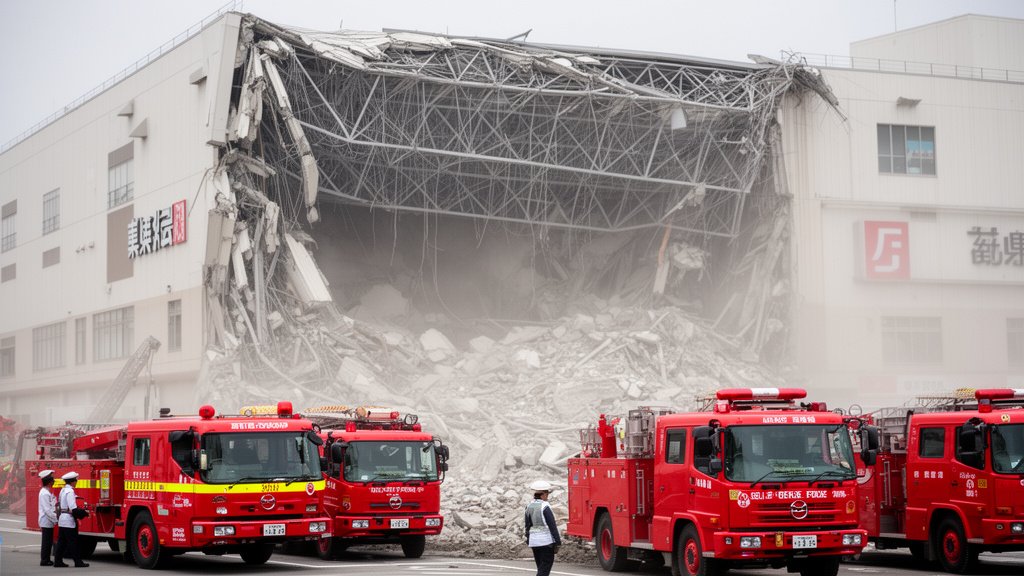
The epicenter of the tragedy shifted rapidly from the initial seismic event to the structural integrity of local commercial zones. The most harrowing aspect of this earthquake involves the collapse of a large-scale shopping mall. According to preliminary reports from the scene, the structural failure of the building led to a secondary explosion—most likely caused by a ruptured natural gas line within the facility’s utility infrastructure.
This secondary event has severely hampered rescue efforts. Rescuers are now contending not only with the unstable remains of the building, which was compromised by the 7.1 magnitude quake, but also with pockets of fire and potential gas leaks. The Japan Self-Defense Forces have deployed heavy lifting equipment and thermal imaging technology to locate survivors who may be buried beneath the wreckage of the commercial structure. The scene is characterized by twisted steel, shattered glass, and thick clouds of dust, making visibility for search teams extremely low.
The Anatomy of the Secondary Explosion
In seismic events, secondary explosions are a known, albeit catastrophic, phenomenon. When buildings like large shopping malls suffer primary structural damage from tectonic shifting, utility lines—specifically high-pressure gas conduits—are often sheared or severed. In this instance, the delay between the primary quake and the explosion suggests a lingering gas buildup, which eventually reached an ignition source. For engineering experts, this highlights a critical weakness in modern retail architecture: the intersection of rigid building codes for earthquakes and the flexibility required for utility piping. Addressing these vulnerabilities will undoubtedly become a central pillar of the post-disaster investigation.
Emergency Response Logistics
The coordination of rescue operations is being managed at the prefectural level, with the JSDF serving as the primary tactical force. Because the shopping mall is a high-traffic area, the uncertainty regarding the exact number of patrons present at the time of the quake makes the rescue operation a race against time. Specialized search-and-rescue (SAR) teams are utilizing acoustic sensors to listen for cries or rhythmic tapping from beneath the rubble. The priority is to establish a secure perimeter to prevent further collapse and to suppress any lingering fire hazards that threaten to ignite debris.
Regional Economic and Social Impact
Beyond the immediate humanitarian tragedy, the destruction of a major regional shopping center deals a significant blow to the local economy. In many of these southwestern regions, such malls serve as both essential service hubs—providing groceries and medical supplies—and social centers. Their sudden closure ripples through the supply chain, disrupting local commerce and leaving communities without access to critical goods. Recovery will require not just physical reconstruction but the restoration of psychological and social stability for the affected population.
Historical Context: Lessons Learned and Forgotten
Japan is no stranger to seismic activity, and the nation maintains some of the most rigorous building codes in the world. However, events like this serve as a stark reminder that even with advanced engineering, the unpredictability of tectonic forces combined with secondary infrastructure failure poses a lethal threat. Comparing this event to the 2016 Kumamoto earthquakes or the 2024 Noto Peninsula quake provides a historical baseline. Analysts are looking at whether the seismic intensity was underestimated in building vulnerability assessments, or if the specific age of the shopping mall’s infrastructure contributed to its failure. The lessons learned here will likely dictate future updates to national safety protocols regarding the integration of utility lines in large-scale commercial real estate.
FAQ: People Also Ask
Is it safe to be in commercial buildings in the region right now?
Local authorities have issued a stern warning for residents to avoid entering damaged structures. While the main quake has passed, structural integrity is compromised, and aftershocks could trigger further collapses.
How are the authorities coordinating the rescue at the shopping mall?
The Japan Self-Defense Forces (JSDF) are leading the effort, coordinating with local police and fire departments. They have divided the site into quadrants to maximize the search area coverage using specialized dogs and vibration sensors.
Why was there an explosion after the earthquake?
While investigations are ongoing, the most likely cause is a ruptured natural gas pipeline. Seismic activity often shears utility lines, allowing gas to leak into enclosed spaces, which then ignites when it comes into contact with sparks or exposed electrical wires.
Will the death toll increase?
Authorities have stated that as the recovery effort at the shopping mall progresses, the discovery of further victims is a grim possibility. The count remains fluid as debris is removed and accounted for by the local prefecture.