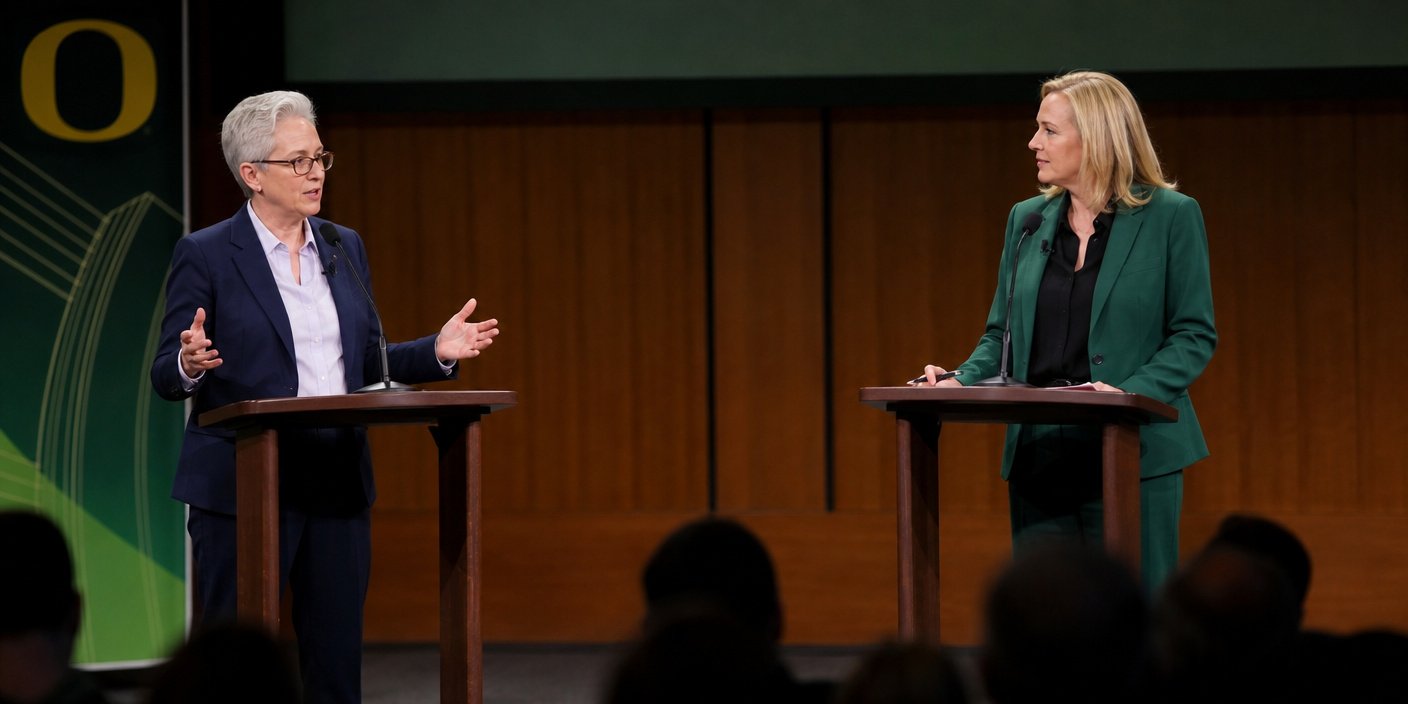
The 2026 Oregon gubernatorial campaign shifted into high gear this week as incumbent Governor Tina Kotek and Republican challenger Christine Drazan took the stage at the University of Oregon for their first face-to-face debate. The event, marked by sharp exchanges and persistent interruptions, underscored the widening ideological chasm between the two candidates as they vie for leadership of a state navigating complex crises in housing, public safety, and economic stability. From the outset, the stage at the University of Oregon was set for a confrontation that went beyond routine policy discussions, reflecting a high-stakes battle for the direction of Oregon’s future.
The Collision of Political Visions
The debate served as a vivid microcosm of the broader political polarization currently defining Oregon. Governor Tina Kotek, representing the Democratic platform, emphasized a continuation of her administration’s policies, focusing on systemic investments in state-run social programs, ambitious housing development initiatives, and environmental preservation efforts. Kotek’s rhetoric centered on the theme of ‘resilience and continuity,’ arguing that the state’s current legislative trajectory is laying the necessary groundwork for long-term growth, despite the admitted frustrations with the pace of change.
Conversely, Christine Drazan launched a full-scale critique of the current administration’s record. Positioning herself as the candidate of ‘correction and accountability,’ Drazan focused her fire on what she termed ‘fiscal mismanagement’ and an ‘ineffective bureaucratic approach’ to the state’s most pressing issues. The Republican challenger utilized the platform to draw sharp contrasts on tax policy, public safety enforcement, and the regulatory environment that she claims has stifled small business growth across the Pacific Northwest.
Economic Policy and State Spending
A primary point of contention was the state’s budget and fiscal management. Drazan criticized the rising cost of state government operations, advocating for a significant audit of spending and a shift toward tax relief for middle-class families. She argued that the current surplus funds have been misallocated toward legacy programs that fail to deliver tangible results. Kotek retorted by highlighting the necessity of these investments, framing them as essential ‘safety nets’ that prevent deeper societal fractures during periods of economic uncertainty. The Governor pointed to recent legislative wins in industrial infrastructure as proof that her fiscal strategy is stimulating job creation, a claim that Drazan immediately sought to debunk with counter-statistics regarding the cost of living and stagnant wage growth in key sectors.
Housing and Infrastructure Strategies
The housing crisis, arguably the most volatile issue for Oregon voters, took center stage as the candidates dissected their opposing strategies for urban development and affordability. Kotek reiterated her commitment to streamlining the land-use process to accelerate multi-family housing production, pushing back against Drazan’s suggestions that current regulatory frameworks remain the primary barrier to supply. Drazan called for a dismantling of several long-standing land-use protections that she argued artificially inflate property values, preventing young families from entering the market. The intensity of this exchange was palpable, with both candidates frequently speaking over one another as they debated the role of state intervention versus private-market solutions in stabilizing the housing market.
Public Safety and Community Trust
Public safety served as the emotional climax of the evening. Drazan leaned heavily into the argument that public trust in state institutions has eroded, citing concerns over rising property crime and the perceived lack of support for local law enforcement agencies. She demanded a more aggressive ‘law and order’ platform, promising to reallocate state resources to bolster police presence in high-need districts. Kotek pivoted the discussion toward a holistic approach, emphasizing that true public safety requires investing in mental health services, drug rehabilitation programs, and community-based interventions. She accused her opponent of leveraging fear rather than proposing structural, evidence-based solutions, creating a tense atmosphere as the moderators attempted to steer the discussion toward the final closing remarks.
Secondary Angles: The Path Forward
1. The Influence of the Independent Voter: As the 2026 election cycle progresses, both campaigns are hyper-aware that the winner will likely be decided by the shrinking but critical bloc of independent and swing voters. The rhetoric in this debate suggests a pivot from base-mobilization to a more aggressive pursuit of this moderate center, who have shown increasing dissatisfaction with the status quo.
2. Historical Context of the 2026 Cycle: Unlike the 2022 election, which featured a three-way dynamic, the 2026 race is shaping up to be a tighter, more direct binary choice. This structural change explains the heightened ‘feistiness’ of the debate; with fewer third-party spoilers expected to pull votes, every exchange and verbal misstep carries amplified significance.
3. Economic Forecasts and Voter Sentiment: Beyond the rhetoric, the state’s economic outlook remains cautious. Observers will be closely watching whether the specific policy proposals debated tonight—specifically regarding taxation and industrial investment—resonate with the business community or are viewed as purely performative posturing before the general election in November.
FAQ: People Also Ask
Q: What were the defining moments of the first 2026 Oregon gubernatorial debate?
A: The debate was defined by heated disagreements over the state’s housing strategy and fiscal spending priorities. Both Kotek and Drazan frequently interrupted one another, highlighting their fundamental distrust of each other’s policy records.
Q: Why was the debate held at the University of Oregon?
A: The University of Oregon was selected as the venue to engage a younger demographic and to provide a neutral, academic setting that could host a large audience, reflecting the high public interest in the upcoming election.
Q: How do Kotek and Drazan differ on public safety?
A: Governor Kotek advocates for a holistic approach, focusing on mental health and social service infrastructure. Christine Drazan proposes a more traditional ‘law and order’ approach, prioritizing increased funding and support for law enforcement agencies to address crime.
Q: When is the general election for the Oregon Governor’s seat?
A: The general election is scheduled for November 2026. This debate represents the start of the final phase of campaigning, with more debates expected to be scheduled in the coming months.