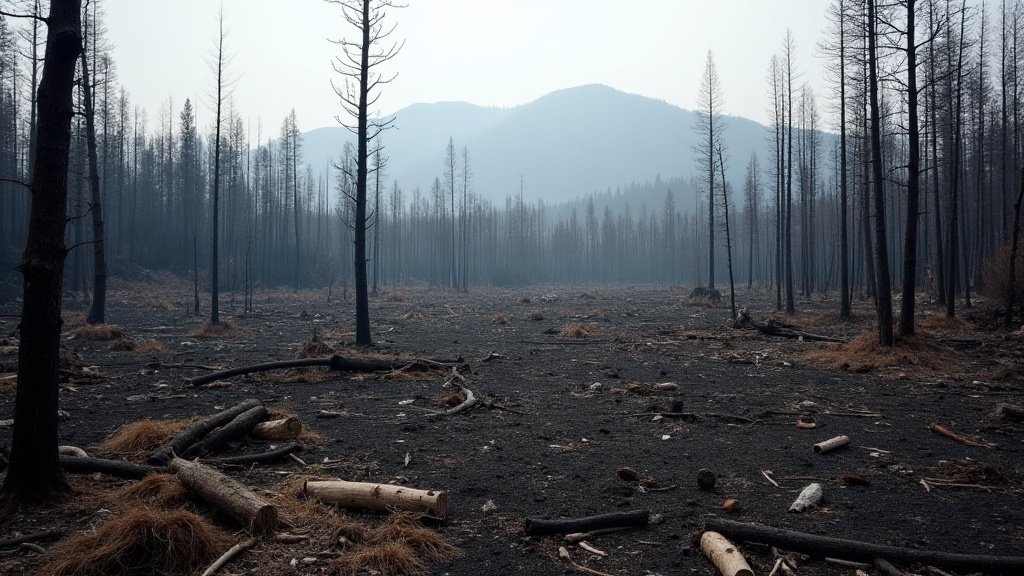
Public forest management in Oregon is currently trapped in a perilous cycle of reaction rather than prevention. While the necessity of firebreaks and forest thinning is universally acknowledged by ecologists and policymakers alike, the operational reality on the ground tells a different, more cynical story: the heavy machinery only moves once the smoke is already rising. The recent aftermath of the McCully Fire in Baker County serves as a poignant, if frustrating, case study for this national problem.
The Anatomy of the Reactive Paradox
The McCully Fire, which scorched significant acreage in Baker County, highlighted a recurring pattern that has become synonymous with Western wildfire management: the activation of mitigation efforts only after the public—and political—pressure reaches a fever pitch. In the wake of the containment of the McCully Fire, local authorities and federal agencies suddenly found the resources, the streamlined permitting, and the public mandate to clear firebreaks and perform fuel reduction in areas that had been designated as ‘high risk’ for years.
This phenomenon is not merely an operational failure; it is a structural defect in how public forest management is funded and prioritized. When a forest is ‘healthy’ or merely ‘at risk,’ it occupies a lower tier of bureaucratic urgency. The National Environmental Policy Act (NEPA) processes, environmental assessments, and competing regional interests often paralyze preventive work for years. However, once a fire occurs, those barriers are bypassed through emergency declaration protocols. The result is a system that effectively incentivizes disaster as a prerequisite for maintenance.
The Economic Cost of Waiting
The economic arguments for shifting to a proactive model have been established for decades, yet they fail to penetrate the legislative budgeting process. Studies conducted by the U.S. Forest Service (USFS) and various independent forestry researchers consistently demonstrate that for every dollar spent on proactive fuel reduction—such as prescribed burning, mechanical thinning, and the creation of shaded fuel breaks—between $2 and $7 are saved in long-term suppression costs and damages.
When we analyze the McCully Fire specifically, the costs were not limited to the active suppression efforts. They extended to the destruction of timber resources, the long-term degradation of watershed health, and the immediate economic impact on Baker County tourism and infrastructure. By waiting for the wildfire to provide the impetus for clearing deadwood and creating firebreaks, Oregon is essentially choosing to pay the ’emergency tax’ of wildfire suppression rather than the ‘maintenance investment’ of responsible stewardship. This is fiscal irresponsibility masked as environmental caution.
Bureaucratic Gridlock and the WUI Crisis
A primary factor in this gridlock is the complexity of the Wildland-Urban Interface (WUI). As communities expand into forested areas, the management of these spaces becomes a tangle of private, state, and federal jurisdictions. Each agency carries different mandates, and the hesitation to perform proactive clearing often stems from legal liability concerns. If a controlled burn or a thinning operation disrupts a habitat or alters a local micro-ecosystem, the agency is vulnerable to litigation. If they do nothing and the forest burns, they are often shielded by the ‘act of nature’ defense.
This legal landscape essentially forces land managers to play it safe by doing nothing. The McCully Fire exposed that the only time these liabilities are outweighed by the necessity of action is during an active catastrophe. We are witnessing a failure of governance where public safety is held hostage by regulatory risk-aversion, requiring an actual disaster to ‘unlock’ the legal and financial levers needed to protect our forests.
Secondary Angle: The Historical Context of Suppression
To understand why we are here, one must look at the ‘fire suppression’ culture of the 20th century. For decades, the explicit policy was to put out every fire by 10:00 AM the following day. This created a massive accumulation of fuel in our forests—a literal tinderbox of overgrown brush and dead timber that was never cleared because the forests were being ‘protected.’ We are currently paying the price for that century of misguided stewardship. Today, modern management is attempting to pivot toward ‘prescribed fire’ and ‘resilience,’ but they are fighting against both the physical reality of overstocked forests and the cultural inertia of a public that fears fire rather than understanding its role in forest health.
Secondary Angle: Ecological Stewardship vs. Emergency Response
The irony of the reactive model is that it is often ecologically destructive. Emergency firebreaks cut during a blaze are rarely planned with ecological precision; they are bulldozed for speed and immediate safety. This creates long-term soil erosion, introduces invasive species, and fragments wildlife habitats in ways that a carefully planned, proactive thinning project would not. By waiting for the emergency, we are not only losing the forest to fire, but we are also sacrificing the long-term ecological health of the land to the blunt instruments of emergency response.
Secondary Angle: The Future of Funding
Is there a way out of this cycle? Some legislative bodies are beginning to discuss ‘resilience bonds’ and ‘forest health trust funds’ that would ring-fence money specifically for proactive maintenance, shielding it from being cannibalized by emergency suppression budgets. For these to work, however, there must be a fundamental change in the ’emergency’ definition. If we continue to view fire as an ‘event’ rather than an ongoing process of forest evolution, we will remain trapped in the McCully Fire paradigm, waiting for the next match to be struck before we bother to clear the path.