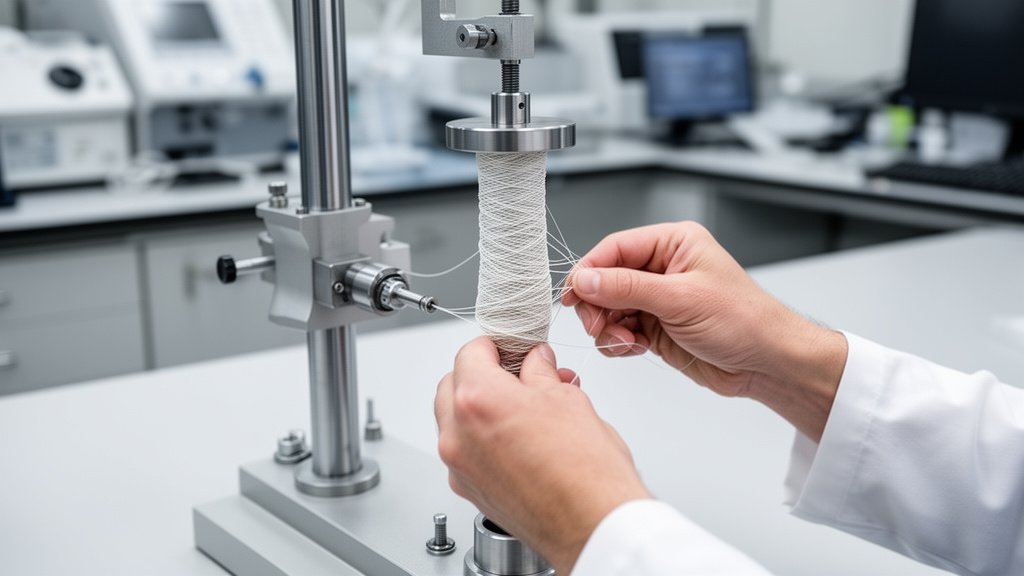
MIT engineers have developed a novel type of recyclable elastic yarn that matches the strength and stretchiness of traditional spandex-based materials, potentially solving a major sustainability challenge in the fashion industry. This innovation, rooted in advanced materials science, addresses a critical bottleneck in the circular fashion economy: the inability to effectively recycle fabrics containing elastane (spandex) once they reach the end of their lifecycle.
Key Highlights
- Material Performance Parity: The new fiber replicates the vital mechanical properties of commercial spandex, including high elasticity and tensile strength, without requiring the standard chemical structure that prevents recycling.
- True Circularity: Unlike traditional spandex, which is notoriously difficult to separate from other fabrics like cotton or polyester, this new material is designed to be dissolved and re-spun into new fibers.
- Sustainability Impact: The innovation targets the core of the “fast fashion” waste crisis, where blended synthetic garments typically end up in landfills or incinerators due to separation complexities.
- Advanced Polymer Engineering: The breakthrough utilizes a semi-crystalline elastomer architecture, balancing physical durability with chemical solubility.
The Future of Fabric: A New Standard for Sustainability
The global fashion industry has long been defined by a linear model: produce, consume, and discard. While cotton and polyester have enjoyed relatively mature recycling infrastructures, elastane—the polymer responsible for the stretch in leggings, jeans, and activewear—has remained a persistent “unrecyclable” hurdle. MIT’s recent development represents a paradigm shift, moving the textile industry closer to a true circular economy where clothing can be repeatedly broken down into its original raw materials.
The Spandex Problem: Why Fashion is Stuck
To understand the magnitude of this discovery, one must look at the chemistry of modern apparel. Elastane, sold under trade names like Lycra and Spandex, is a block copolymer. It is essentially a polyurethane-urea, characterized by its long-chain polymer structure that provides incredible “snap-back” capabilities.
However, this very structure is the industry’s greatest weakness. When elastane is blended into fabrics, it is woven tightly with other fibers like cotton or nylon. During traditional mechanical recycling, which involves shredding textiles, these blends become contaminants. Because elastane cannot be easily separated from other fibers, it renders the entire batch of recycled material lower in quality, often resulting in “downcycling”—where fabric is converted into low-value products like insulation or rags rather than new clothing. This failure to recycle has led to millions of tons of blended textiles being diverted to landfills annually.
Engineering the Future: How the MIT Innovation Works
MIT researchers, operating at the intersection of material science and textile engineering, approached the problem by fundamentally redesigning the molecular architecture of the fiber. Instead of relying on the complex, cross-linked polyurethane-urea structures that define current spandex, the team developed a semi-crystalline elastomer.
This material provides the necessary crystalline domains that act as physical cross-links. These domains are responsible for the fiber’s “memory” and stretch, ensuring it snaps back to its original shape after being pulled. However, unlike traditional spandex, this material is designed with a chemical “switch.” The researchers engineered the polymer chains to be robust under normal use—withstanding heat, sweat, and washing cycles—but susceptible to controlled chemical solvents that allow the material to dissolve back into a liquid state. Once dissolved, the material can be precipitated out, cleaned, and re-spun into new, high-quality fiber, creating a closed-loop system.
Bridging the Performance Gap: Strength Meets Sustainability
In the past, sustainable alternatives to synthetic fibers have often suffered from “performance compromise.” Previous attempts at biodegradable or recyclable elastomers were often too fragile, lacked the necessary elasticity, or degraded too quickly in the wash. The MIT team’s rigorous testing indicates that their material matches the mechanical metrics of traditional spandex, including the all-important tensile strength and elongation-to-break ratio. This is vital for industrial adoption. Fashion brands are notoriously risk-averse; they will not adopt a material that fails the “consumer stress test” of daily wear. By ensuring the yarn performs as well as traditional alternatives, the barrier to market entry is significantly lowered.
The Path to Industrial Integration and Economic Impact
The economic implications of this breakthrough are profound. Currently, the cost of sorting and processing textile waste is one of the highest expenditures in the recycling sector. If a garment is made with a mono-material or compatible material system, the recycling process becomes significantly cheaper and faster. If this new fiber can be produced at scale and integrated into existing textile manufacturing machinery—a key goal of the researchers—it could fundamentally alter the economics of supply chains. Brands could eventually transition to “cradle-to-cradle” manufacturing, where their own products are the raw materials for their next season’s collections, decoupling fashion growth from virgin material extraction.
Regulatory and Market Outlook
As governments worldwide, particularly in the European Union, tighten regulations on textile waste and mandate Extended Producer Responsibility (EPR), the demand for such technologies will skyrocket. The fashion industry is under increasing pressure to substantiate sustainability claims. A proprietary fiber that is objectively recyclable provides a verifiable solution to greenwashing, offering brands a path to compliance that is grounded in hard science rather than marketing. While the transition will not happen overnight, the existence of this technology provides the industry with the missing piece of the puzzle to finally turn the tide on textile waste.
FAQ: People Also Ask
Is this fiber fully biodegradable?
No, this innovation focuses on “recyclability,” which is different from biodegradability. The goal is to keep the material in a circular loop by dissolving and re-spinning it, rather than letting it break down in the environment, which could potentially release microplastics.
Will this increase the cost of my clothing?
While production costs are currently higher for new, innovative materials, the goal of the MIT research is to ensure compatibility with existing industrial spinning machinery. As production scales to meet demand, the manufacturing cost is expected to decrease, likely reaching price parity with conventional high-quality synthetic fibers.
Can existing recycling facilities process this material?
This fiber is designed to be “recyclable-ready.” However, widespread adoption will require existing recycling facilities to update their chemical processing capabilities. The design intent is for the material to fit into future “chemical recycling” infrastructure, which is currently being built out by major industry players worldwide.
How does this affect the ‘feel’ of the fabric?
Initial reports suggest that the fiber’s tactile properties—often referred to as ‘hand feel’ in the fashion industry—are highly comparable to existing spandex. It retains the softness and drape necessary for high-end activewear, ensuring that consumers will not notice a difference in comfort or style.