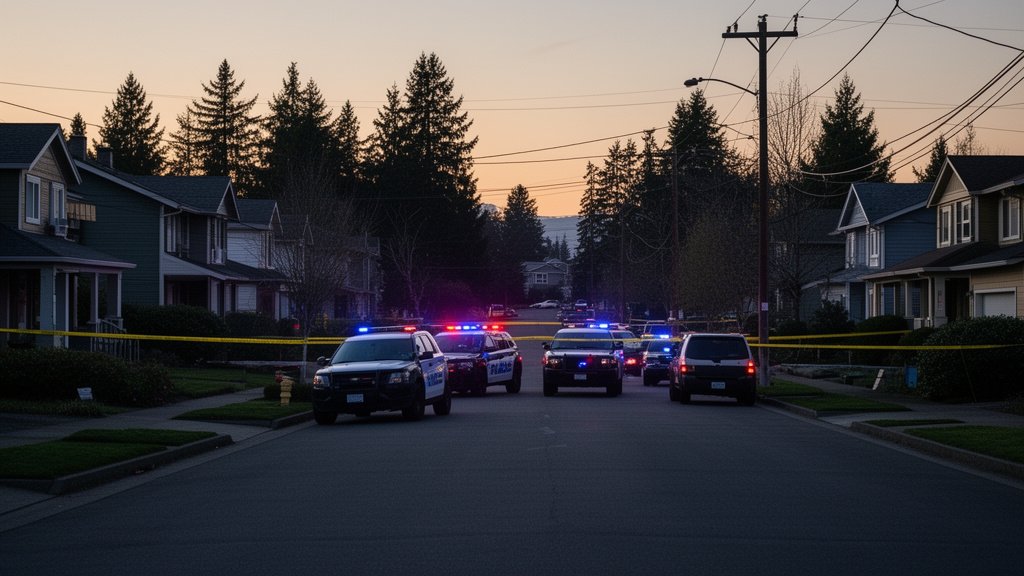
A high-stakes operation conducted by the U.S. Marshals Pacific Northwest Violent Offender Task Force culminated in tragedy yesterday in Portland’s Hazelwood neighborhood. The incident, which centered on the apprehension of a suspect connected to a Gresham homicide, resulted in an officer-involved shooting that left the suspect deceased. During the chaotic confrontation, the Portland Police Bureau sustained a profound loss: the death of K9 Kylo, a beloved and highly trained member of the department.
Key Highlights
- A fugitive suspected in a Gresham homicide was killed during a confrontation with the U.S. Marshals Pacific Northwest Violent Offender Task Force.
- The incident occurred in Portland’s Hazelwood neighborhood, prompting a significant law enforcement response and area lockdown.
- Portland Police K9 Kylo was killed in the line of duty during the apprehension, sparking an outpouring of grief from the local law enforcement community.
- An independent investigation is currently underway to determine the exact sequence of events, in line with standard protocols for officer-involved critical incidents.
A City in Mourning: The Hazelwood Shooting Aftermath
The apprehension of violent fugitives is a cornerstone of the U.S. Marshals Service’s mission, yet the operation in Hazelwood serves as a harrowing reminder of the inherent volatility such mandates carry. The incident began when the Pacific Northwest Violent Offender Task Force—a collaborative multi-agency effort—tracked the suspect to the East Portland neighborhood. What was intended as a routine capture of an individual wanted in connection with a homicide investigation in Gresham escalated rapidly into an officer-involved shooting.
The Anatomy of the Task Force
Understanding the nature of the Pacific Northwest Violent Offender Task Force is essential to grasping the gravity of this event. These task forces are specialized units composed of local, state, and federal law enforcement officers. Their specific objective is to locate and apprehend the most dangerous offenders—individuals who have demonstrated a propensity for violence and are often armed. Because these officers are specifically tasked with handling high-risk individuals, their encounters are statistically more likely to involve resistance or use-of-force scenarios compared to standard police patrol interactions. This context is critical: the presence of federal marshals signals that the suspect was considered a significant threat to public safety.
The Sacrifice of K9 Kylo
The death of K9 Kylo has reverberated far beyond the walls of the Portland Police Bureau. In law enforcement culture, police dogs are not merely equipment; they are sworn officers and partners. They are trained to track, protect, and apprehend, often placing themselves directly in the line of fire to shield their human handlers and fellow officers. K9 Kylo’s death in the Hazelwood neighborhood has been met with expressions of deep sorrow from police agencies across the region. These animals perform high-risk duties—such as clearing buildings or pursuing armed suspects—that would otherwise expose human officers to even greater danger. The loss of Kylo is viewed by the department not as the loss of a tool, but as the loss of a comrade-in-arms. Vigils and tributes are being organized, reflecting the deep bond that exists between these K9 units and the broader policing community.
The Gresham Connection
While the shooting occurred in Portland, the genesis of the conflict was rooted in the neighboring jurisdiction of Gresham. The suspect was the subject of an active investigation related to a recent homicide in Gresham. This highlights the fluidity of criminal investigations in the Portland metropolitan area. Criminal activity does not adhere to municipal boundaries, and the cooperation between the Gresham Police Department and federal task forces is a testament to the integrated nature of regional law enforcement. The homicide investigation will now likely see procedural shifts, as authorities look to recover evidence and interview witnesses who may have had contact with the suspect, even as the focus temporarily shifts to the officer-involved shooting protocols.
Investigative Protocols and Public Transparency
In the wake of the shooting, the Oregon State Police, in conjunction with the Multnomah County District Attorney’s Office, has launched an independent investigation. This is standard procedure for any officer-involved critical incident. It ensures that the use of force is reviewed by parties outside of the involved agencies to maintain public trust and verify that all actions taken were within the scope of legal and departmental policy. The investigation will examine body-worn camera footage, radio communications, and forensic evidence from the scene. Transparency remains the priority for city officials, who are navigating the delicate balance of providing timely information to a concerned public while protecting the integrity of the ongoing investigation.
Secondary Angles: Community and Safety
1. K9 Training Evolution: This tragedy will likely trigger internal reviews within the Portland Police Bureau regarding K9 deployment strategies. Are there new tactical methods or protective technologies that could mitigate the risk to K9 officers in high-stakes encounters?
2. The Urban Task Force Model: The reliance on federal task forces for local homicide investigations raises questions about the allocation of resources. As metropolitan crime rates fluctuate, how does the integration of federal support impact local police staffing and response times?
3. Neighborhood Safety and Trauma: Residents in Hazelwood were abruptly confronted with a high-intensity police operation. The long-term impact of such events on neighborhood trauma and community-police relations is a significant area of concern for city leadership, necessitating a focus on community outreach and support services.
FAQ: People Also Ask
What is the purpose of the U.S. Marshals Violent Offender Task Force?
The task force is a multi-agency coalition designed to locate and apprehend the most dangerous fugitives in the region. They bridge the gap between local law enforcement and federal resources to execute high-risk warrants.
What happens during an investigation into an officer-involved shooting?
An independent agency (often the Oregon State Police in this region) investigates the incident to ensure objectivity. They gather forensic evidence, interview witnesses, and review surveillance or bodycam footage, which is then presented to the District Attorney’s office for legal review.
How are police K9s classified in law enforcement?
Police K9s are treated as sworn officers. They undergo rigorous certification and training. Their deaths in the line of duty are treated with the same solemnity and funeral honors as the loss of human officers.
Is there a danger to the public when these task forces operate?
Task forces operate with the intent of minimizing public risk. However, because they are pursuing armed and dangerous suspects, the risk of encounter in residential or public areas is an unfortunate reality of the mission.