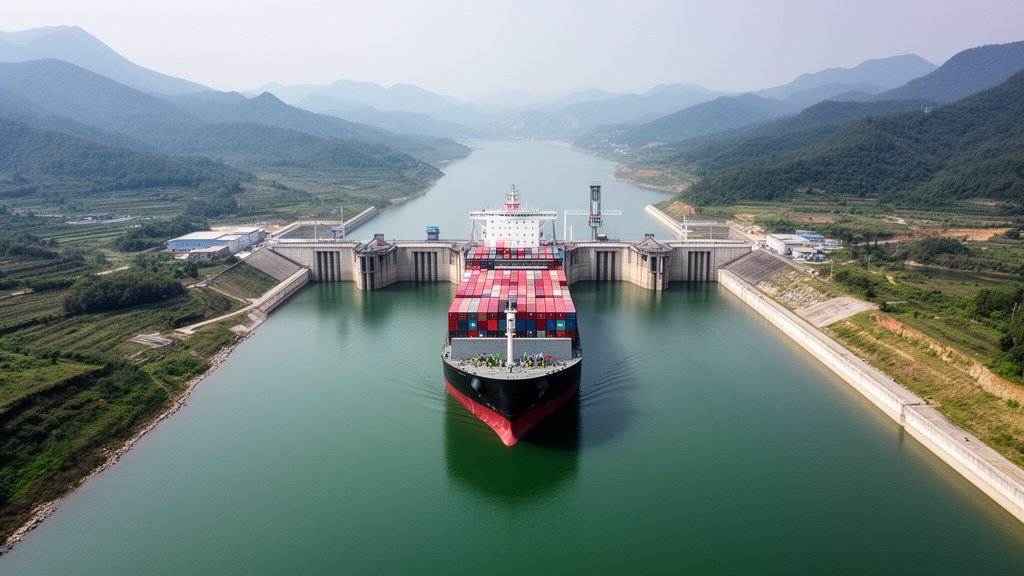
The inauguration of the Pinglu Canal marks a seismic shift in China’s logistical infrastructure, successfully bridging the hinterland of southern China with the global maritime trade network. Spanning an impressive 134 kilometers, this monumental waterway acts as the inaugural modern river-to-sea canal in the country, effectively linking the vital Xijiang River network directly to the Beibu Gulf. By establishing this fluid connection, Beijing is significantly shortening trade routes for the Guangxi Zhuang Autonomous Region and the surrounding western provinces, creating an efficient maritime exit that bypasses traditional, more circuitous land-based transport. This strategic infrastructure project stands as the centerpiece of the ‘New International Land-Sea Trade Corridor,’ a massive initiative designed to integrate China’s manufacturing heartland more seamlessly with the rapidly expanding markets of Southeast Asia.
Key Highlights
- Unprecedented Connectivity: The 134km canal creates the first modern river-to-sea link, directly connecting the Xijiang River system to the strategic Beibu Gulf, enabling massive cargo throughput.
- Trade Corridor Backbone: Serving as a flagship project for the ‘New International Land-Sea Trade Corridor,’ the canal is expected to drastically reduce transport distances and logistics costs for goods originating in China’s western hinterland.
- Regional Economic Growth: The infrastructure is positioned to transform the Beibu Gulf into a high-capacity logistics hub, facilitating smoother, faster trade exchanges with ASEAN nations.
Engineering the Arteries of Commerce: The Pinglu Canal
A Milestone in Hydraulic Engineering
The Pinglu Canal is not merely a transport route; it is an engineering marvel that addresses one of the most persistent geographic challenges in southern China: the elevation difference between the inland river networks and the coastal seas. Historically, goods moving from inland areas like Nanning toward the coast had to rely on a complex, often congested, combination of rail and road transport, or navigate long, arduous downstream river routes that lacked the capacity for large-scale shipping. The construction of the canal involved sophisticated water-saving lock systems designed to manage significant elevation changes, allowing vessels to traverse the terrain with efficiency that was previously unimaginable. This engineering approach signifies a departure from traditional canal designs, utilizing cutting-edge hydraulic tech to ensure the canal remains operational throughout the year, regardless of seasonal variations in river flow.
Unlocking Economic Potential for Western China
The economic implications of this project are profound. By providing a direct, reliable, and high-capacity waterway to the Beibu Gulf, the canal effectively lowers the barrier to entry for export-oriented industries located in the interior provinces. Historically, companies in these regions faced higher logistics costs compared to their counterparts on the eastern seaboard, where access to major ports like Shanghai or Ningbo is abundant. The Pinglu Canal serves as an equalizer, leveling the playing field by providing a cost-effective exit strategy for manufactured goods. Experts project that this route will become a preferred choice for manufacturers of heavy machinery, electronics, and agricultural products seeking to tap into international markets. As supply chains continue to diversify, the canal offers a robust alternative to land-locked logistics, reducing both fuel consumption and carbon footprints associated with long-haul trucking.
A Geopolitical Game Changer: The Land-Sea Corridor
Beyond the immediate logistics benefits, the Pinglu Canal plays a critical role in the broader ‘New International Land-Sea Trade Corridor’ initiative. This corridor is integral to China’s strategic push to bolster trade ties with the Association of Southeast Asian Nations (ASEAN). As regional trade volumes between China and its southern neighbors continue to climb, the need for integrated, multimodal logistics networks has become paramount. The canal acts as a physical anchor for this corridor, ensuring that products flowing from the hinterland have an uninterrupted path to the deep-water ports of the Beibu Gulf. These ports are increasingly becoming gateways for trade with Vietnam, Thailand, Malaysia, and beyond. By funneling trade through this modernized corridor, China is effectively hardening its economic ties with Southeast Asia, ensuring that the regional supply chain is tightly knit and highly responsive to demand.
Environmental Stewardship and Future Infrastructure
The construction of the Pinglu Canal has also been a focal point for modern sustainable development practices. Large-scale infrastructure projects in the 21st century must balance economic growth with ecological responsibility, and the development of the canal has incorporated rigorous environmental monitoring and mitigation strategies. This includes the management of water quality, protection of aquatic ecosystems, and the integration of ‘smart’ monitoring technologies that track ship emissions and environmental impacts in real-time. As the canal transitions into full operational status, its success will serve as a template for future inland waterway developments. The project demonstrates a commitment to the ‘green’ logistics transition, as inland waterway transport remains one of the most energy-efficient methods for moving bulk freight. The focus will now shift to the continuous improvement of the canal’s digital management systems, ensuring that throughput capacity remains optimized for the coming decades of economic growth.
FAQ: People Also Ask
Q: What is the primary purpose of the Pinglu Canal?
A: The primary purpose is to create a direct, modern river-to-sea trade link between the Xijiang River and the Beibu Gulf. It aims to reduce logistics costs, improve shipping efficiency for China’s inland regions, and strengthen economic integration with Southeast Asian markets via the New International Land-Sea Trade Corridor.
Q: How long is the Pinglu Canal?
A: The Pinglu Canal spans approximately 134 kilometers, making it a major infrastructure project designed to bridge the gap between inland river networks and coastal maritime hubs.
Q: Which region does this project benefit the most?
A: While it supports national trade goals, the project is most immediately transformative for the Guangxi Zhuang Autonomous Region and western inland provinces, which previously lacked a direct, high-capacity waterway link to the sea.
Q: Why is this canal considered a ‘modern’ river-to-sea link?
A: It is termed ‘modern’ because it incorporates advanced engineering, including automated, water-saving lock systems and digital traffic management, which were not available in the construction of earlier, historical canals in the region.