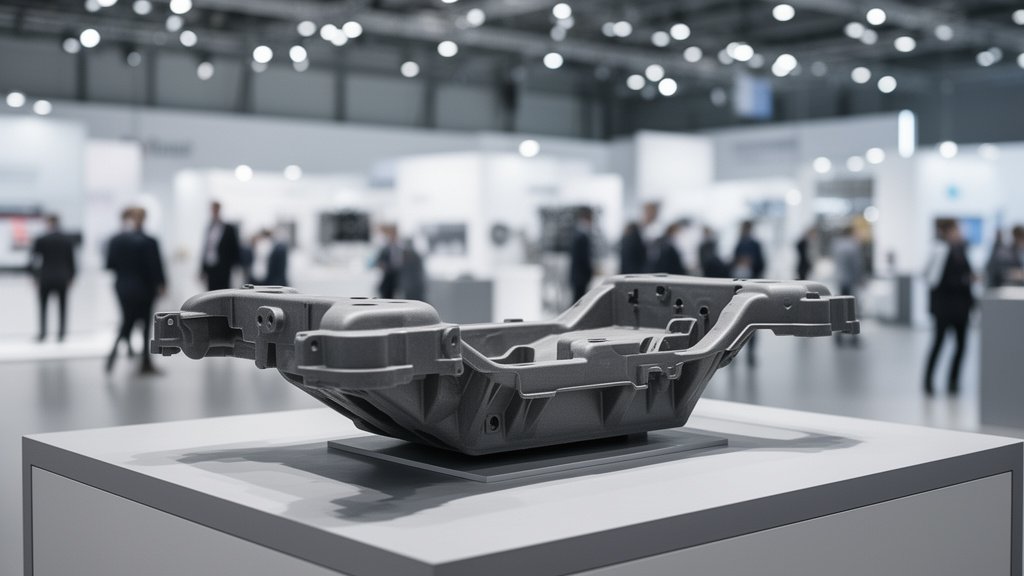
At the Fakuma 2026 exhibition in Friedrichshafen, BASF has effectively dismantled the long-standing industry paradox that forced manufacturers to choose between environmental sustainability and high-performance technical capabilities. By unveiling a suite of next-generation material solutions—anchored by the debut of the Ultramid H33 L thermoplastic polyamide—BASF is signaling a structural shift in how the plastics industry approaches the transition to a circular economy. For engineers and procurement leaders navigating the intersection of lightweight automotive design and high-voltage electronics, the announcements at Fakuma represent a fundamental recalibration of what is technologically possible.
Key Highlights
- Launch of Ultramid H33 L: A groundbreaking thermoplastic polyamide engineered to provide superior mechanical strength while maintaining a reduced carbon footprint.
- Lightweight Automotive Innovation: BASF’s new material grades specifically target mass reduction in chassis and structural components, directly supporting EV range efficiency.
- High-Voltage Safety: Advanced dielectric properties in the new lineup ensure safety in high-voltage battery management systems and power electronics.
- Sustainable Production Cycles: Integration of recycled feedstock and biomass-balanced production processes as a standard, rather than an add-on, in BASF’s 2026 material portfolio.
Engineering the Future: The Material Revolution
The central narrative at the BASF booth at Fakuma 2026 is not merely about incremental improvement but about the complete integration of lifecycle thinking into the molecular design of polymers. For years, the industry consensus was that sustainable or recycled materials often carried a performance penalty—reduced heat resistance, lower tensile strength, or compromised dimensional stability. The introduction of Ultramid H33 L challenges this assumption head-on.
The Chemistry of Resilience
Ultramid H33 L represents a masterclass in modern polymer chemistry. By optimizing the polymerization process and refining the crystalline structure, BASF has produced a grade of polyamide that retains the structural integrity required for heavy-duty industrial applications while significantly lowering the Global Warming Potential (GWP) compared to traditional, fossil-based equivalents. This is not just a laboratory curiosity; it is a commercially scalable solution designed for immediate adoption in injection molding processes across Europe and North America.
Addressing the Automotive Dilemma
One of the most pressing challenges for the automotive sector is the ‘weight-range equation.’ As electric vehicles (EVs) become the dominant architecture, the weight of the vehicle directly dictates battery requirements and operational range. BASF’s new lightweight automotive designs leverage the high stiffness-to-weight ratio of their latest polyamides to replace metal components in vehicle frames, cooling systems, and battery casings. The material’s ability to withstand the extreme thermal cycling inherent in EV battery packs makes it a critical enabler of more efficient, longer-range mobility.
High-Voltage Electronics and Sustainability
Beyond structural engineering, BASF is addressing the surge in demand for materials that can withstand the unique stresses of high-voltage electronics. As vehicles move from 400V to 800V architectures, the demands on plastic connectors, housings, and busbars have become extreme. The new material solutions showcased at Fakuma 2026 offer exceptional electrical insulation and flame retardancy, meeting stringent safety standards without relying on traditional halogenated additives. This allows manufacturers to meet safety regulations while simultaneously hitting internal corporate targets for the use of sustainable plastics.
The Strategic Pivot: Sustainability as Performance
BASF’s presence at Fakuma 2026 underscores a broader economic reality: sustainability is no longer a marketing checkbox, but a core component of supply chain resilience. Companies that fail to transition to low-carbon, circular-ready materials face increasing regulatory pressure, particularly under the EU’s evolving plastic waste directives. By offering materials that are ‘circular by design’—meaning they are easier to recycle and contain higher percentages of post-consumer recycled (PCR) content—BASF is effectively future-proofing its clients against upcoming environmental legislation.
Historical Context and Evolution
Comparing the landscape of 2026 to the industry trends of the early 2020s, the speed of adoption for bio-based and recycled polymers has accelerated drastically. The shift is driven by a ‘triple threat’ of pressures: volatile petrochemical prices, rigid environmental regulations, and the competitive demand for more efficient, sustainable products. BASF’s current strategy reflects an understanding that resilience in 2026 means having the flexibility to adapt to these constraints without slowing down technical innovation.
Future Predictions
Looking toward 2030, the adoption of high-performance polyamides that utilize mass-balanced feedstocks is expected to become the industry standard. As production scales, the cost premium for these materials—often a barrier to entry—will likely continue to compress, leading to near-total market penetration in sectors where weight, heat resistance, and sustainability are non-negotiable.
FAQ: People Also Ask
Q: What makes Ultramid H33 L different from previous polyamide versions?
A: Ultramid H33 L is designed with a specific focus on balancing high mechanical performance with a lower carbon footprint. Unlike earlier versions, it is optimized for high-temperature stability and superior processability, allowing it to serve as a drop-in replacement for traditional materials while aligning with modern sustainability benchmarks.
Q: How does BASF’s new portfolio impact the automotive industry?
A: It enables OEMs to reduce vehicle weight—critical for EV range—while providing the necessary electrical isolation required for high-voltage battery systems. This helps automotive manufacturers meet their decarbonization goals without sacrificing safety or structural durability.
Q: Is this technology available for immediate integration?
A: Yes, the material solutions presented at Fakuma 2026 are intended for immediate commercialization. BASF is currently coordinating with manufacturing partners to integrate these grades into existing production lines, ensuring that the transition to more sustainable materials does not require re-tooling or significant operational downtime.