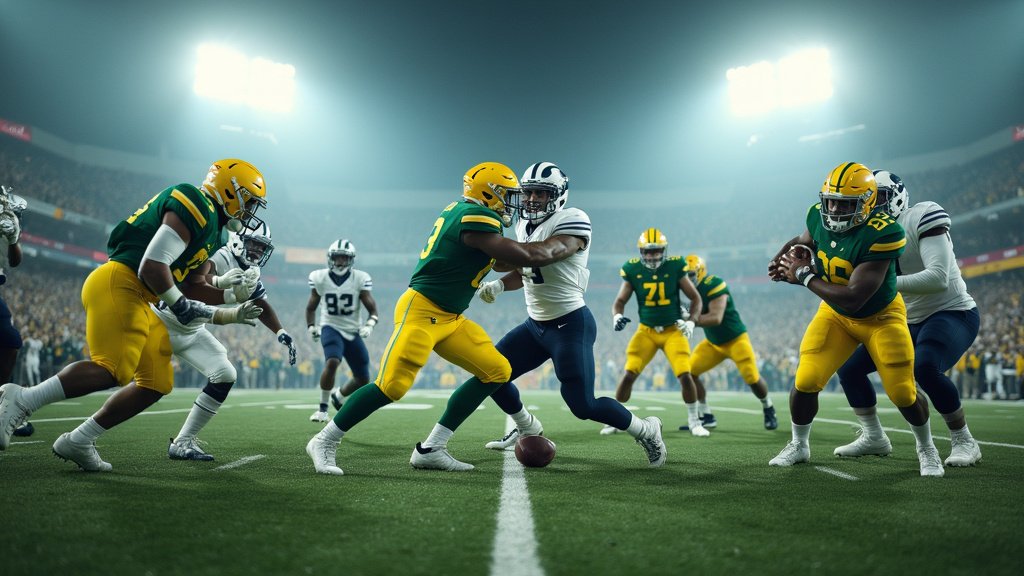
Marist Catholic High School in Eugene, Oregon, has dismissed head football coach Zach Loboy following a highly controversial 63-0 victory over Cottage Grove. The game, which was abruptly terminated at halftime, drew significant scrutiny due to the lopsided nature of the competition against an opponent fielding a roster of only 16 players. School administrators cited the decision to continue running up the score against a compromised team as the primary driver behind the termination of Loboy’s tenure.
Key Highlights
- The Incident: Marist Catholic led Cottage Grove 63-0 at halftime before the game was halted.
- The Roster Disparity: Cottage Grove entered the match with a critically low roster of only 16 available players.
- Administrative Action: Marist Catholic High School officials fired head coach Zach Loboy, citing sportsmanship concerns.
- The Controversy: The decision to continue scoring aggressively against an undersized team violated the school’s standards of conduct and ethics in athletics.
Ethical Boundaries in High School Athletics
The firing of Zach Loboy serves as a stark reminder of the often-unspoken ethical code governing high school sports. While the primary objective of any football game is to win, the context of youth athletics necessitates a nuanced approach to competition. When one team—in this case, Marist Catholic—finds itself in a position of overwhelming dominance against a significantly depleted opponent, standard coaching protocols often dictate a shift toward developmental tactics.
Instead of continuing to exploit a mismatch, coaches are generally expected to rotate younger players, limit passing plays, and run the clock. By choosing to push for a 63-0 lead by halftime, the coaching staff at Marist Catholic ignored the delicate balance between competitive spirit and the duty of care owed to opposing student-athletes. This incident raises profound questions about the culture of victory at all costs and whether winning at the expense of an opponent’s dignity and physical well-being aligns with the values of an educational institution.
The Administrative Perspective
For administrators at Marist Catholic High School, the decision to part ways with Loboy was framed as a necessity to preserve the school’s reputation and alignment with its core mission. High school programs are not merely training grounds for collegiate athletes; they are extensions of the classroom where character, integrity, and empathy are intended to be taught alongside X’s and O’s.
When a blowout reaches such a extreme margin in the first half, it suggests a lack of oversight regarding the opponent’s situation. The reality of a 16-player roster means the opposing team is likely facing exhaustion, high injury risk, and a lack of depth. By failing to intervene—or by actively encouraging the continued scoring—the coaching staff failed a leadership test. School leadership determined that the brand and the culture of the program required a reset, indicating that the coaching staff’s judgment was fundamentally misaligned with the institutional goals of the athletic department.
Impact on the Opposing Squad
The situation involving Cottage Grove highlights the vulnerability of smaller or struggling programs. In high school football, maintaining a roster is a perennial challenge, and schools often face seasons where attrition, injury, or lack of interest leave them with thin lineups. When these teams are forced to compete against highly structured, deep-roster programs, the disparity can be stark.
However, there is an unwritten ‘gentleman’s agreement’ in prep football across the United States: if you are up by five or six touchdowns before the half, you do not throw the ball deep, you do not run trick plays, and you actively try to move the clock to end the game as quickly and safely as possible. Continuing to play as if the game were tied sends a message that the opponent is irrelevant. For the 16 players from Cottage Grove, the experience of a 63-0 halftime deficit is not just a loss on the scoreboard; it is a demoralizing event that can drive players away from the sport entirely, further compounding the struggle of small-school athletics.
The Future of Sportsmanship Mandates
This incident may force a broader conversation within the Oregon School Activities Association (OSAA) and other athletic governing bodies. While mercy rules and ‘running clocks’ exist to mitigate lopsided scores, they often trigger only after specific thresholds are met—frequently in the second half.
There is a growing argument for stricter, proactive sportsmanship mandates that empower referees to force clock-management earlier or allow coaches to shorten quarters by mutual agreement before the game begins. However, these are mechanical fixes for a human problem. True sportsmanship requires the coach on the sidelines to recognize the human element of the game. The firing of a head coach is an extreme measure, but it underscores that for Marist Catholic, the lesson to be taught to their players—that empathy and respect for the opponent are paramount—outweighed the result of any individual game.
FAQ: People Also Ask
1. Why was the football game terminated at halftime?
The game was ended early because the score had become extremely lopsided (63-0) by halftime, and the opposing team (Cottage Grove) was already struggling with a limited roster of only 16 players. This mismatch prompted significant ethical concerns.
2. Is running up the score a common reason for firing a coach?
It is rare for a head coach to be fired solely for a high score, but this incident highlights that when a lopsided score is combined with a lack of regard for a compromised opponent, it can lead to immediate administrative intervention.
3. What is the role of the Oregon School Activities Association (OSAA) in these cases?
The OSAA sets general guidelines for competition and sportsmanship, but individual school districts and private institutions like Marist Catholic maintain the authority to enforce their own codes of conduct and employment standards for their coaching staff.
4. How do schools typically handle blowout games in high school football?
Common practices include ‘running the clock’ (where the game clock does not stop for incomplete passes or out-of-bounds plays), substituting younger players to gain experience, and running basic, conservative offensive plays to avoid further scoring.