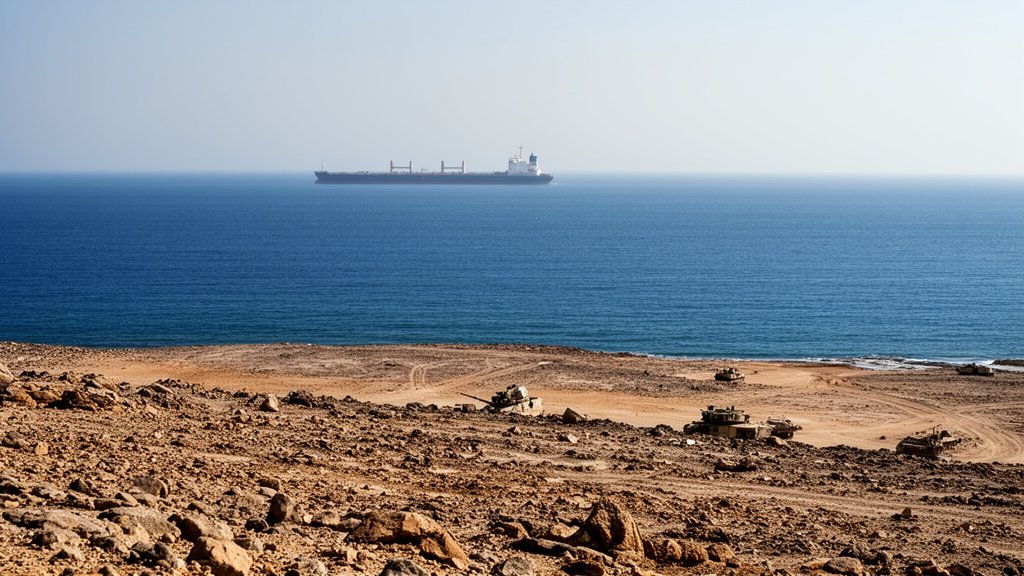
US forces successfully conducted a targeted strike on Iranian rocket launchers stationed on Larak Island early this morning, August 31, 2026, in a decisive preemptive action to thwart a planned mining operation in the vital Strait of Hormuz. Intelligence gathered by CENTCOM had indicated that the Iranian Revolutionary Guard Corps (IRGC) was finalizing preparations to deploy sea mines into the shipping lanes, an act that would have threatened global energy supplies and maritime security. While the strike successfully neutralized the immediate threat on the island, the regional geopolitical landscape has rapidly deteriorated, with Iran launching retaliatory ballistic missile strikes against US military installations in Jordan and the United Arab Emirates (UAE). This escalation marks the most significant military confrontation between the two powers in years.
Key Highlights
- Strategic Strike: US military assets destroyed Iranian rocket launchers on Larak Island to prevent the mining of the Strait of Hormuz.
- Preemptive Intelligence: The operation followed high-confidence surveillance reports confirming an imminent threat to commercial shipping vessels.
- Iranian Retaliation: The IRGC responded with a coordinated ballistic missile volley targeting US-affiliated military sites in Jordan and the UAE.
- Market Volatility: Global oil markets are bracing for potential supply chain disruptions as the waterway remains a critical chokepoint.
- Heightened Alert: CENTCOM has increased readiness levels across the Middle East as diplomatic channels struggle to contain the widening conflict.
The Strategic Chokepoint: Conflict in the Strait of Hormuz
The operation on Larak Island represents a critical pivot point in Middle Eastern security. The Strait of Hormuz is widely considered the world’s most important oil chokepoint, with roughly 21 million barrels of oil passing through the narrow waterway daily. By attempting to deploy sea mines, Iranian forces were seeking to exert direct leverage over global energy markets, a move that would have caused immediate, catastrophic spikes in energy pricing and endangered hundreds of commercial vessels.
The Intelligence-Led Strike
According to defense analysts familiar with the operation, the decision to strike was made under strict rules of engagement designed to minimize collateral damage while ensuring the complete neutralization of the IRGC’s deployment capability. Satellite imagery and drone surveillance had monitored the movement of specialized equipment and personnel onto the island for 48 hours prior to the strike. US commanders, operating under the authority of CENTCOM, concluded that the risk of allowing the mining to proceed outweighed the risks of direct engagement. The precision strike, utilizing advanced tactical aviation, neutralized the launchers precisely before the mines could be loaded onto small, fast-attack boats, which are notoriously difficult to track in the busy maritime traffic of the Persian Gulf.
Escalation: The Retaliatory Barrage
Following the strike, the IRGC launched a retaliatory offensive, signaling a departure from the “shadow war” tactics seen in previous months. Ballistic missiles were fired from Iranian soil toward US military bases in Jordan and the UAE, signaling a clear intention to strike back at the regional infrastructure supporting US operations. Early reports indicate that advanced air defense systems—specifically Patriot and THAAD batteries deployed in these nations—successfully intercepted the majority of the incoming projectiles. However, the audacity of the retaliation has caught international observers by surprise, indicating that Iran possesses a more resilient and responsive command-and-control structure than previously modeled in war-gaming scenarios.
Global Energy Market Vulnerabilities
As of August 31, 2026, the energy sector is reacting to the news with extreme caution. Futures for Brent Crude saw an immediate upward trend, with analysts projecting continued volatility until the safety of the Strait of Hormuz can be verified by international observers. The risk here is not merely one of temporary disruption but of a systemic shift; if Iran continues to demonstrate the intent to weaponize the Strait, insurance premiums for global shipping will rise, effectively adding an “escalation tax” to every barrel of oil transported through the region. This economic pressure is expected to force an emergency response from G7 nations, who have already begun quiet diplomatic efforts to stabilize the maritime corridors.
The Future of Regional Deterrence
Moving forward, the focus shifts to the efficacy of the US “Defense-in-Depth” strategy. The fact that the Iranian response was wide-ranging—targeting two distinct nations simultaneously—suggests a highly coordinated effort to test the limits of US air defense coverage. Military planners are now tasked with re-evaluating the current posture of regional bases. Questions remain regarding whether the existing defensive perimeter in the Middle East is sufficient to withstand a sustained, multi-front campaign, or if additional assets will need to be repositioned to the region immediately.
FAQ: People Also Ask
1. Why is Larak Island strategically important?
Larak Island is located at the narrowest point of the Strait of Hormuz. Its proximity to the main shipping lanes makes it an ideal location for land-based anti-ship missiles and staging grounds for small-boat mining operations, which threaten the global flow of oil.
2. Was there damage to US military bases in Jordan and the UAE?
While the IRGC launched ballistic missiles at these locations, initial reports from CENTCOM indicate that air defense systems intercepted the majority of the threats. Damage assessments are ongoing, but there are no reports of mass casualties at this time.
3. Will the price of gas increase due to this conflict?
Oil and gas markets often react to geopolitical instability in the Strait of Hormuz with immediate price hikes due to fear of supply chain disruptions. While local gas prices often take time to reflect wholesale market changes, analysts expect upward pressure on energy costs globally in the coming days.
4. Is this the start of a wider war?
Diplomatic efforts are currently underway to prevent further escalation. Both the US and Iran have signaled that they are operating within calculated thresholds, but the situation remains highly volatile, and the risk of miscalculation remains high.