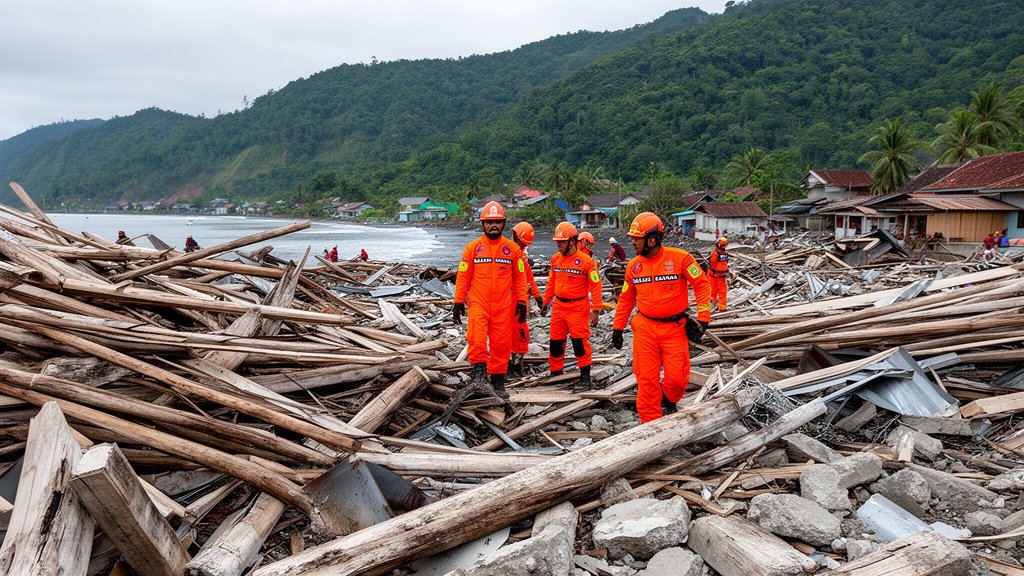
The Indonesian archipelago is reeling today after a powerful 7.7-magnitude earthquake struck off the coast of Flores Island, resulting in widespread destruction and a tragic death toll of at least 40 people. Local authorities and emergency services have launched urgent search and rescue missions as the full extent of the damage to residential and public infrastructure continues to emerge. The tremor, which occurred in a region historically prone to significant seismic activity, has reignited critical conversations regarding disaster preparedness and building resilience within the Pacific Ring of Fire.
Key Highlights
- Immediate Impact: A 7.7-magnitude quake struck off the coast of Flores Island, causing severe structural damage and claiming at least 40 lives.
- Ongoing Operations: National Search and Rescue Agency (Basarnas) teams are currently scouring collapsed buildings to locate survivors.
- Regional Vulnerability: The incident underscores the persistent dangers posed by the complex tectonic fault lines surrounding Indonesia.
- Emergency Response: Regional authorities are coordinating with central government agencies to provide immediate medical aid and shelter for displaced residents.
The Aftermath of the Flores Earthquake: A Community in Crisis
The 7.7-magnitude seismic event that rocked Flores Island serves as a grim reminder of the geological volatility inherent to the Indonesian region. As the dust settles, the primary focus for the Indonesian government, led by the disaster mitigation coordination of the Badan Meteorologi, Klimatologi, dan Geofisika (BMKG), is the preservation of life. While the official death count stands at 40, rescue officials warn that this number could rise as teams penetrate deeper into the debris of rural villages where traditional, non-seismic resistant housing structures were hardest hit.
Geological Context and Tectonic Volatility
Indonesia remains one of the most seismically active nations on earth, situated directly atop the Pacific Ring of Fire. This region is characterized by the complex interaction of the Eurasian, Pacific, and Indo-Australian tectonic plates. The earthquake in Flores is specifically attributed to the subduction zone activity characteristic of the region, where the Indo-Australian plate pushes beneath the Eurasian plate. This geological friction leads to high-energy releases that manifest as devastating earthquakes. Unlike urban centers in Jakarta, which have seen increased enforcement of modern building codes, the remote islands of the Flores region often rely on older structures that lack the necessary reinforcement to withstand high-magnitude tremors.
The Socio-Economic Toll and Infrastructure Resilience
The economic impact of this disaster is expected to be profound for the local communities, which primarily rely on agriculture and fishing. When critical infrastructure—such as transport links, local markets, and homes—is destroyed, the recovery timeline is measured in years rather than months. The loss of 40 lives is not just a statistical tragedy; it represents a significant disruption to the social fabric of the affected villages. Furthermore, the destruction of infrastructure limits the mobility of emergency responders. As local roads are damaged or obstructed by landslide debris, the logistical challenge of moving heavy equipment and medical supplies to the epicenter increases significantly.
The Evolving Role of Search and Rescue (Basarnas)
The National Search and Rescue Agency (Basarnas) has deployed specialized units to coordinate the rescue operations. These teams face a race against time, as the structural integrity of remaining buildings is compromised by aftershocks. The current phase of operations is critical: locating survivors under the rubble of toppled concrete and timber structures. Technology is playing an increasing role in these efforts, with the use of thermal imaging drones and vibration sensors helping responders navigate the dangerous, unstable landscape. However, the manual nature of the clearing process—often requiring digging through heavy, reinforced masonry—remains the biggest bottleneck for humanitarian access.
Towards Future Mitigation Strategies
As the region begins the long process of reconstruction, the discourse is shifting toward long-term disaster mitigation. Urban planners and engineers are calling for a strict modernization of building codes in eastern Indonesia. The focus is not merely on building stronger structures, but smarter ones. This includes the implementation of base-isolation systems for public buildings and the creation of disaster-resilient community centers that can double as emergency shelters during seismic events. Education on early warning systems, particularly regarding the potential for secondary tsunami events following undersea tremors, remains a vital component of public safety in the Flores region.
FAQ: People Also Ask
Why does Indonesia experience so many earthquakes?
Indonesia is located along the Pacific Ring of Fire, a 40,000-kilometer arc of intense seismic and volcanic activity caused by the constant movement and collision of multiple tectonic plates.
What are the main challenges for rescue teams in Flores?
Rescue teams face significant hurdles including damaged road networks, unstable structural debris, and the potential for dangerous aftershocks that can further collapse partially damaged buildings.
Are there expected aftershocks following a 7.7-magnitude quake?
Yes. Following a high-magnitude seismic event, geological settling often leads to a series of aftershocks, which can range from minor tremors to powerful jolts that further threaten the structural integrity of the area.
How can international observers help?
International aid often arrives through coordination with the Indonesian government and established NGOs. Financial contributions to reputable organizations focused on disaster relief in Indonesia are generally the most effective way to provide immediate support.