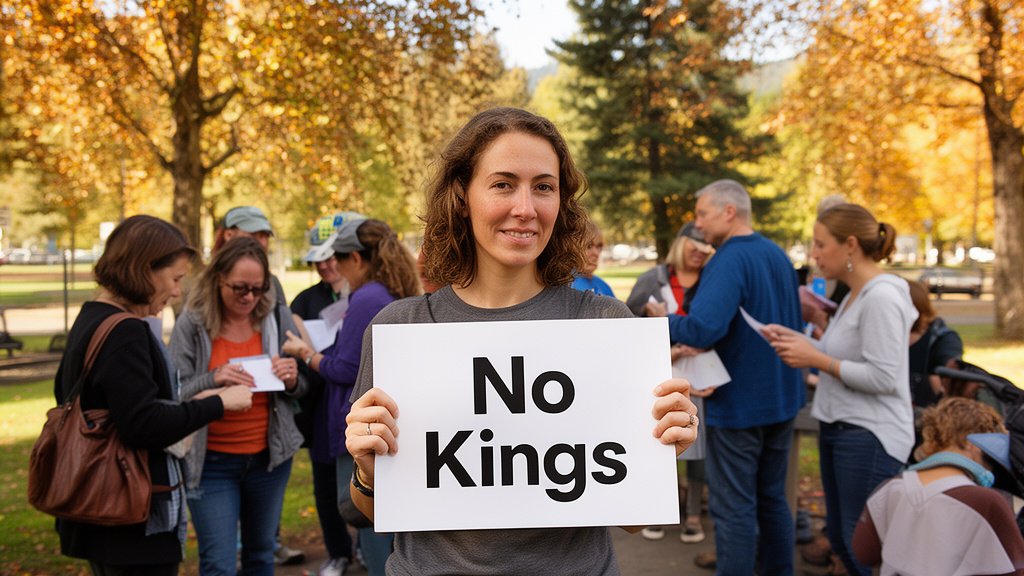
Small but spirited crowds participated in ‘No Kings: Vote Early’ rallies across Southern Oregon cities including Medford, Jacksonville, Ashland, and Grants Pass on October 17th, focusing on voter participation ahead of the November 3rd general election. These events, which punctuated the regional political landscape, highlighted a concerted grassroots effort to mobilize voters through early participation, emphasizing the urgency of civic duty in a high-stakes electoral cycle.
Key Highlights
- Regional Mobilization: Rallies occurred simultaneously across the Rogue Valley and Southern Oregon hubs, specifically Medford, Jacksonville, Ashland, and Grants Pass.
- Early Voting Focus: The primary objective of the events was to encourage constituents to cast their ballots early rather than waiting for Election Day on November 3rd.
- Thematic Messaging: Participants utilized the ‘No Kings’ slogan to frame the election as a fundamental defense of constitutional norms and democratic participation.
The Pulse of Civic Engagement in the Rogue Valley
The October 17th rallies across Southern Oregon represented a unique convergence of grassroots political energy and logistical voter mobilization. While the individual gatherings in Medford, Jacksonville, Ashland, and Grants Pass were characterized by smaller attendance numbers than mass-scale urban protests, the spirit of the participants was described as exceptionally spirited and focused. In an era where digital noise often overwhelms local political discourse, these physical gatherings served a specific function: to transform ideological concern into concrete action.
The Strategic Importance of the I-5 Corridor
Southern Oregon, anchored by the I-5 corridor, remains a critical region for statewide election outcomes. By targeting Medford—the region’s economic engine—alongside historic Jacksonville, the academic center of Ashland, and the independent spirit of Grants Pass, organizers utilized a multi-city approach. This geographic diversity suggests an understanding that localized, small-group interactions are often more effective at driving voter turnout than a single, large-scale event. The rallies were not merely protests; they were voter education hubs designed to demystify the mail-in ballot process, which is central to Oregon’s election system.
Analyzing the ‘No Kings’ Political Narrative
The slogan ‘No Kings: Vote Early’ carries significant weight in the current political climate. By invoking the anti-monarchical roots of American democracy, the messaging creates an urgent call to action regarding the balance of power. For those attending, the slogan serves as a reminder of the checks and balances necessary to maintain a republic. This narrative effectively bridges the gap between abstract constitutional theory and the immediate, practical reality of a November 3rd deadline. It frames the act of casting a ballot not just as a civic checkbox, but as a preventative measure against the consolidation of executive power.
The Logistics of Early Participation
Beyond the rallying cries, a critical component of the October 17th events was the dissemination of practical voting information. In Oregon, the mail-in ballot system is robust, but it requires active participation to ensure validity. Organizers and volunteers used these events to inform attendees about the specific dates for ballot drops, the necessity of signature verification, and the importance of tracking ballots through official county websites. By focusing on the ‘Vote Early’ component, these events aimed to alleviate the logistical pressure on the electoral system that occurs in the final 48 hours of an election.
Historical Context: Oregon’s Electoral Evolution
To understand the significance of these rallies, one must look at the historical evolution of Oregon’s voting behavior. Oregon pioneered the vote-by-mail system, and its citizens are accustomed to a slower, more deliberate voting period rather than the single-day ‘election day’ sprint common in other states. However, the ‘No Kings’ events signify a shift: voters are moving away from the convenience of mail-in voting as a passive activity and towards treating it as an urgent, public, and collective event. This demonstrates a psychological shift where voters are seeking community validation for their electoral choices.
Future Predictions: The Role of Grassroots Micro-Events
Looking ahead, it is likely that we will see more of these ‘micro-events’ rather than massive rallies. The benefits are clear: reduced logistical overhead, higher potential for direct engagement between organizers and potential voters, and the ability to tailor messaging to specific local municipalities. If the turnout numbers from the November 3rd election show a marked increase in early voting in the Rogue Valley, it will likely provide a blueprint for future political campaigns across the Pacific Northwest. The success of this model will be measured not by the size of the crowd on the street, but by the volume of ballots received in the days preceding the election.
FAQ: People Also Ask
What does the ‘No Kings’ slogan refer to in the context of this election?
The ‘No Kings’ slogan is a rhetorical device used by organizers to highlight the importance of checks and balances in government, urging voters to participate early as a way to exercise democratic authority over executive power ahead of the November 3rd election.
Why was Southern Oregon specifically targeted for these rallies?
Southern Oregon, particularly the I-5 corridor cities like Medford and Ashland, represents a vital region for voter turnout. Organizers targeted these areas to mobilize local communities and ensure that the regional voting bloc is fully represented in the final election tally.
Does Oregon’s vote-by-mail system make ‘Vote Early’ events necessary?
Yes, while the system is designed for convenience, experts note that early voting helps prevent system bottlenecks at the last minute and ensures that voters have time to address any issues with ballot signatures or delivery before the deadline.
Were there official representatives at these events?
The events were primarily characterized as grassroots-led, focusing on community-based mobilization rather than top-down candidate-driven campaigning, emphasizing the power of the individual voter.