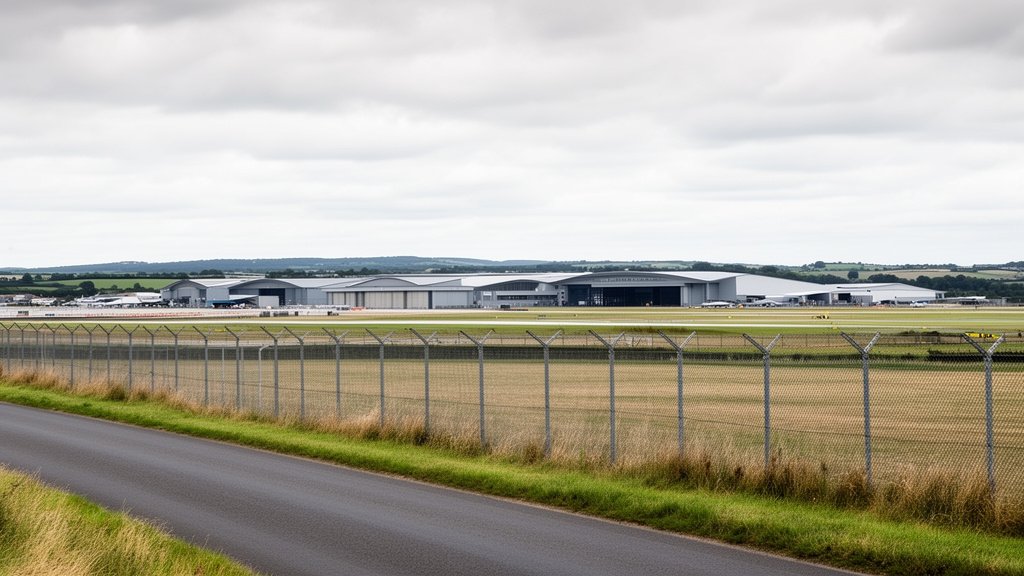
Gloucestershire Police have confirmed the arrest of an individual in connection with the discovery of potential explosive materials near the perimeter of RAF Fairford, a critical military installation utilized extensively by the United States Air Force. The investigation, which centered on the Whelford area, has drawn significant attention due to the base’s role in supporting U.S. bomber task force operations and the sensitive nature of the materials discovered. Authorities have moved to secure the site, emphasizing that public safety remains the priority as the investigation proceeds.
Key Highlights
- Police Action: Gloucestershire Constabulary confirmed an arrest related to the possession of a suspected explosive substance.
- Strategic Location: The incident occurred near RAF Fairford, a key facility for USAF bomber task force deployments in the UK.
- Ongoing Investigation: A specialized team remains in the Whelford area to investigate the site and secure the perimeter.
- Public Safety: Authorities have stated there is currently no wider threat to the public, though the incident has prompted a temporary increase in security awareness.
Security Breach: The Investigation at RAF Fairford
The quiet landscape of the Cotswolds was interrupted by a significant security operation as police descended upon the Whelford area to address reports involving potential explosives. While RAF Fairford is a facility familiar with heightened security protocols, the nature of this particular incident has underscored the ongoing challenges of maintaining perimeter security for one of the most strategically important air bases in Europe. For the local community in Gloucestershire, the sight of police cordons and specialized officers is an anomaly, yet one that highlights the intersection of rural civilian life and high-stakes geopolitical military operations.
The Incident at Whelford
Local reports and official police statements indicate that the arrest was the result of a coordinated response to suspicious activity. The discovery of potential explosive materials necessitated the involvement of Explosive Ordnance Disposal (EOD) units, a standard procedure when dealing with unknown substances near critical infrastructure. The suspect, a 40-year-old male, was taken into custody under suspicion of possessing an explosive substance. While the investigation remains in its early stages, the primary focus for Gloucestershire Police has been to ensure the immediate vicinity is safe and to determine the intent behind the possession of the materials found at the site.
This incident is not merely a local police matter but has implications for the Ministry of Defence (MoD) and their American counterparts. Any breach or attempted breach near a facility hosting U.S. assets triggers immediate inter-agency cooperation. The proximity to the perimeter fence—a boundary that stretches for miles across rural farmland—presents a persistent security challenge for the base commanders, who must balance the necessity of an open, operational runway with the requirement to protect billions of dollars in military assets and personnel.
Strategic Importance of RAF Fairford
To understand the gravity of the public interest in this story, one must recognize the importance of RAF Fairford itself. The base is not merely an auxiliary airfield; it serves as a cornerstone of the U.S. Air Force’s Global Strike Command strategy in Europe. It is the primary UK operating location for the USAF’s heavy bomber fleets. Whether it is B-52 Stratofortresses, B-1B Lancers, or the sophisticated B-2 Spirit stealth bombers, Fairford is the staging ground for mission-critical training exercises and strategic deterrence operations across the European theater.
Because of this, the base is frequently a focal point for military observers and geopolitics watchers. During periods of heightened international tension, the activity at Fairford accelerates, making it a high-profile location. Any security incident, even one involving a localized arrest near the perimeter, is scrutinized for its potential impact on operational security (OPSEC). The military, in conjunction with civilian authorities, ensures that threats to the base are neutralized quickly to avoid any disruption to the U.S. military’s ability to project power from British soil.
The Future of Perimeter Security
This event raises questions about the modernization of perimeter security in an era where smaller, cheaper, and more portable technology is increasingly being utilized by unauthorized actors. As the MoD and USAF evaluate the incident, discussions surrounding drone surveillance, sensor integration, and rapid-response capabilities are likely to intensify. Protecting a sprawling base that borders public footpaths and rural roads requires a delicate touch; one cannot turn every mile of fence into an impenetrable fortress without disrupting the local community.
However, the balance between civilian freedom of movement and the safety of a high-value military target is being tested. Local residents, who are accustomed to the presence of large aircraft and military personnel, may see a tightening of access routes and a more visible police presence in the coming months. The challenge for authorities will be to maintain this high-security posture without alienating the community that surrounds the base.
Psychological and Economic Impact
Beyond the tactical and security implications, there is a tangible impact on the local area. RAF Fairford is a major employer and a distinct part of the local identity. Incidents of this nature introduce a level of uncertainty that can ripple through the community. Residents often value the quiet, low-crime environment of the region, and a security alert involving explosives introduces a stark contrast to their day-to-day lives.
Furthermore, the economic interdependence between the base and the local economy cannot be ignored. Businesses in Fairford, Lechlade, and surrounding villages often cater to base personnel. A disruption to operations—or an increase in security-related restrictions—can filter down to the local service economy. Local authorities and base commanders will need to communicate transparently with community leaders to prevent panic and ensure that the incident is viewed as an isolated security event rather than a systemic failure of local safety.
As the investigation continues, all eyes remain on the courts and the findings of the forensic team regarding the materials seized. The case serves as a sober reminder that even in the most secure regions, the threat of unauthorized access and the possession of dangerous materials requires eternal vigilance from both civilian law enforcement and military security services.
FAQ: People Also Ask
1. What is the current status of the RAF Fairford investigation?
Gloucestershire Police have made an arrest and the investigation is ongoing. The area has been secured, and specialized teams have analyzed the materials found. Authorities report that the immediate risk has been mitigated.
2. Is RAF Fairford a U.S. or U.K. base?
RAF Fairford is owned by the United Kingdom’s Ministry of Defence but is used extensively by the United States Air Force under a bilateral agreement. It serves as a key operating location for the USAF’s bomber task force.
3. Was there any damage to the airfield or military assets?
There have been no reports of damage to the airfield, military aircraft, or base infrastructure. The incident appears to have been contained at the perimeter and did not result in an active breach of the base’s secure zones.
4. Why is the U.S. military present at RAF Fairford?
Fairford provides essential infrastructure for the U.S. Air Force to conduct strategic training exercises and bomber deployments across Europe, enhancing NATO interoperability and rapid response capabilities.