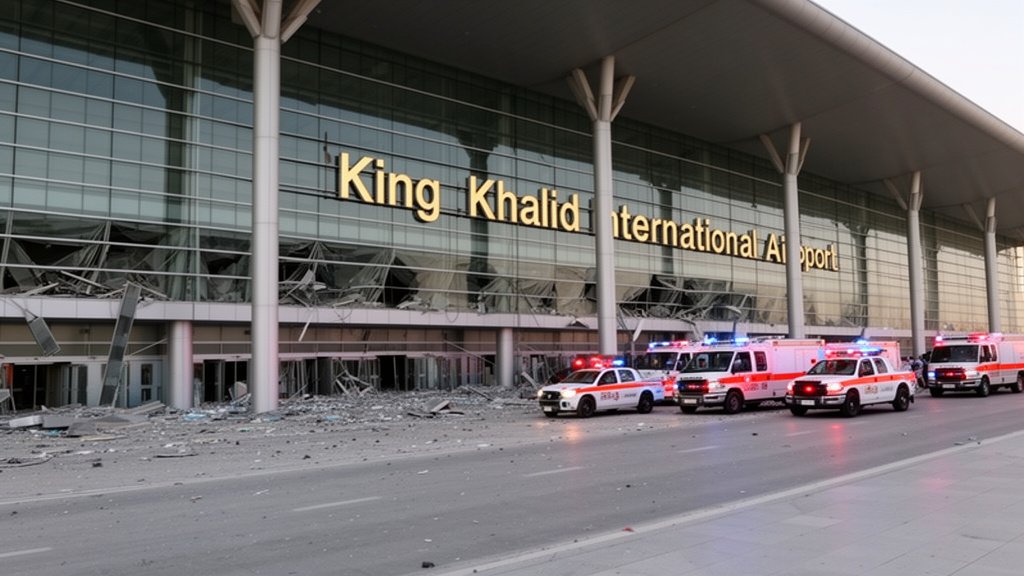
In a grave escalation of regional hostilities, a targeted Houthi strike on the King Khalid International Airport in Riyadh has resulted in a significant loss of life and a promise of decisive retaliation from the Saudi-led coalition. The attack, which struck a passenger terminal, claimed 12 lives and left more than 300 individuals injured, marking one of the most operationally significant and violent incursions on Saudi soil in recent years. Authorities have confirmed the casualties are comprised of a mix of airport staff, passengers, and ground crew, casting a pall over the Kingdom’s primary aviation hub and triggering an immediate military mobilization.
Key Highlights
- Casualty Figures: The assault resulted in 12 confirmed fatalities and over 300 injuries, necessitating a mass-casualty response from Riyadh medical services.
- Primary Target: The attack specifically targeted a passenger terminal at King Khalid International Airport, severely damaging civil infrastructure.
- Coalition Mandate: The Saudi-led coalition has officially vowed a “firm” response, signaling an impending expansion of military operations against Houthi-controlled territories.
- Regional Security: This event marks a critical turning point in aviation security protocols and the ongoing proxy conflict in the Middle East.
The Strategic Aftermath of the Riyadh Assault
The attack on King Khalid International Airport is not merely a tactical strike but a profound strategic disruption. By targeting one of the busiest and most vital hubs in the Middle East, the Houthi movement has demonstrated an increased willingness to disregard international norms regarding civilian infrastructure. The use of advanced weaponry—consistent with recent intelligence reports on the proliferation of long-range missiles and drone capabilities in the region—suggests a significant shift in the conflict’s technological landscape.
Assessing the Military Escalation
The “firm” response promised by the Saudi-led coalition implies a move toward intensified air campaigns and possibly localized ground interventions. Historically, such pledges are followed by a surge in precision strikes against Houthi command-and-control centers. However, military analysts warn that such escalations carry the risk of expanding the conflict zone. The coalition is currently tasked with balancing the imperative of deterrence with the necessity of safeguarding regional trade routes, which are heavily dependent on Saudi airspace. The precision of this attack on a civilian terminal suggests a breach in early-warning radar systems, a vulnerability that Riyadh must now address urgently.
Humanitarian and Economic Consequences
Beyond the immediate tragedy of 12 deaths and 300 injuries, the economic ripple effects are already being felt. The suspension of operations at King Khalid International Airport, even for a limited duration, forces a recalibration of regional air traffic management. Insurance premiums for aviation in the Gulf Cooperation Council (GCC) states are expected to spike, and the broader psychological impact on travelers cannot be overstated. From a humanitarian perspective, the local hospitals in Riyadh were pushed to their limits, highlighting the strain that such high-casualty events place on metropolitan emergency infrastructure. The medical response, while rapid, has underscored the need for enhanced disaster preparedness in high-value strategic targets.
Geopolitical Implications and Regional Stability
This incident provides a flashpoint for regional powers. The international community, including major global superpowers, has issued widespread condemnation, calling for an immediate de-escalation. However, the coalition’s vow of retaliation suggests that the window for diplomatic resolution is rapidly narrowing. The attack is viewed by many as an attempt to leverage civilian suffering to extract political concessions. Consequently, the coalition’s leadership is under immense pressure to demonstrate strength without triggering a wider regional conflagration. This balancing act remains the defining challenge for Riyadh’s foreign and defense policy in the coming fiscal quarter.
Technical Analysis of the Threat
The sophistication of the strike indicates a significant improvement in Houthi targeting capabilities. Integrating satellite-aided guidance and stealthier delivery mechanisms allows such groups to bypass traditional perimeter defense systems. The Saudi-led coalition’s response will likely involve a multi-layered approach: deploying advanced anti-missile defense batteries, expanding the exclusion zones, and conducting intensive counter-intelligence operations to identify the launch sites and supply chains facilitating these incursions. The integration of artificial intelligence in threat detection will likely become a primary focus of the coalition’s revised security strategy.
FAQ: People Also Ask
1. What is the current status of King Khalid International Airport?
The airport has initiated emergency protocols. While priority flights were diverted following the incident, authorities are working to normalize operations as quickly as possible. Travelers are advised to check directly with their airlines for status updates.
2. How did the Houthi movement gain the capability to strike Riyadh?
Intelligence reports suggest a long-term proliferation of missile and UAV technology, often facilitated by external backers. This allows for sophisticated, long-range strikes that were previously considered beyond the operational reach of the group.
3. Will the Saudi-led coalition’s ‘firm’ response impact the broader Yemen conflict?
Yes. A military retaliation of the scope suggested by the coalition will likely intensify combat operations across the border, potentially altering the current tactical stalemate in Yemen.
4. Is travel to Riyadh safe following this attack?
Travel security assessments are currently being updated by international aviation authorities. Travelers should monitor official government travel advisories and maintain high situational awareness when in the region.