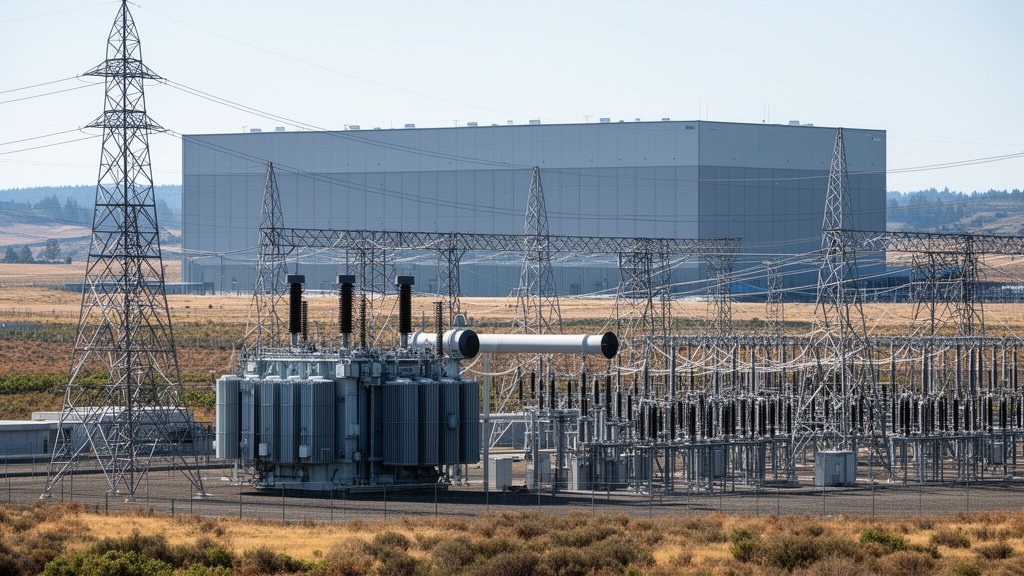
Pacific Power has officially shifted its regulatory stance, mandating that new large-scale data centers cover the entirety of their infrastructure expansion costs. Following negotiations with the Oregon Public Utility Commission (OPUC), this move signals a departure from traditional cost-spreading models, ensuring that residential ratepayers are no longer financially liable for the energy capacity spikes required by the booming tech sector. This policy redefines the economic relationship between utility providers and hyperscale digital infrastructure.
Key Highlights
- Direct Assignment Policy: New “large-load” data center operators must directly finance the infrastructure upgrades and project costs their facilities necessitate.
- Ratepayer Protection: The mandate effectively halts the “cost-shifting” mechanism that previously allowed infrastructure expansion costs to be socialized across the general ratepayer base.
- OPUC Oversight: The Oregon Public Utility Commission facilitated the agreement to ensure that industrial energy expansion does not destabilize residential energy pricing.
- Industry Precedent: This move aligns with a growing national trend where utilities are recalibrating grid planning to accommodate the explosive power demands of AI and cloud computing infrastructure.
The New Economics of Energy Infrastructure
The fundamental premise of electrical utility regulation has historically centered on the concept of the “average user.” Utilities like Pacific Power—a subsidiary of PacifiCorp—were designed to manage steady, predictable growth across a broad population. However, the modern surge in artificial intelligence and cloud computing has introduced a new class of energy consumer: the hyperscale data center. These facilities possess power requirements that dwarf those of traditional industrial or commercial clients, often demanding hundreds of megawatts in a single location.
Dismantling the Cost-Shifting Paradigm
For years, the costs of expanding the grid—such as installing new transmission lines, upgrading substations, and bolstering transformers—were rolled into the utility’s general “rate base.” While this model works for incremental growth, it creates a significant economic vulnerability when a single “large-load” customer requires infrastructure projects that cost hundreds of millions of dollars.
Previously, those costs would be amortized and charged to every customer in the service area. Critics and consumer advocacy groups have long argued that this is essentially a subsidy provided by households and small businesses to global technology corporations. Pacific Power’s new agreement with the OPUC effectively ends this practice through “direct assignment.” Under this framework, the data center operator is no longer just a customer paying for electricity; they are now financially responsible for the specific physical infrastructure required to bring power to their facility. If a data center needs a new substation to handle its load, the data center pays for that substation, not the utility’s wider customer base.
The Role of the Oregon Public Utility Commission
The OPUC’s involvement is critical in maintaining grid equity. By formalizing this agreement, the Commission has established a regulatory buffer, ensuring that economic development in the tech sector does not come at the expense of energy affordability for Oregonians. This is particularly relevant given the state’s climate goals and the increased strain on the Western Interconnection grid.
The negotiation process involved reconciling the necessity of economic development with the mandate to keep utility costs stable. The resulting policy creates a transparent pathway for tech companies seeking to establish roots in Oregon, forcing them to internalize their true cost of operations. It is a pragmatic application of the “user pays” principle, which aligns with modern regulatory strategies currently being explored in Washington, Idaho, and other states grappling with similar industrial energy booms.
Why Data Centers Are Changing the Grid
To understand the magnitude of this decision, one must look at the specific energy demands of current data centers. A modern hyperscale data center can operate at a capacity comparable to a small city. When multiple facilities are sited within the same region, they can quickly exhaust existing local distribution capacity.
This creates a secondary issue: grid stability. When a utility is forced to upgrade infrastructure rapidly to accommodate massive loads, the construction process itself can disrupt services and accelerate the aging of existing equipment. By forcing data centers to pay for these upgrades upfront, Pacific Power is also securing a funding stream for grid modernization that the utility would otherwise have to finance through debt or rate hikes. This effectively turns the data center’s energy-intensive needs into a catalyst for infrastructure improvement rather than a drain on existing resources.
Future Outlook for Tech-Energy Synergy
The long-term implications for the Pacific Northwest are profound. Oregon has long been an attractive destination for data centers due to its mild climate, renewable energy availability, and proximity to major fiber backbones. This new cost-allocation rule is unlikely to deter investment entirely, as data center operators prioritize reliability and scale above all else. Instead, it will filter out projects that cannot justify their infrastructure overhead, favoring developments that are economically sustainable.
Furthermore, this agreement could serve as a template for other utilities under the PacifiCorp umbrella. As the AI “gold rush” continues to demand massive amounts of electricity, the pressure on the grid will only increase. By proactively setting these rules, Oregon is positioning itself to manage this transition with fiscal discipline. The policy is not merely a revenue protection strategy; it is a blueprint for how modern electrical grids can support rapid industrial scaling without abandoning the primary duty of providing affordable, reliable power to citizens.
FAQ: People Also Ask
Q: How does this change affect the average residential energy bill?
A: It prevents future rate increases that would have otherwise been necessary to fund the massive infrastructure upgrades required by new data centers, effectively keeping residential costs more stable than they would have been under the old system.
Q: What constitutes a “large-load” customer under the new rules?
A: While specific definitions vary, these rules generally target entities—primarily hyperscale data centers—that request power connections or capacity expansions significantly exceeding standard industrial thresholds, often involving specific dedicated transmission and substation requirements.
Q: Will this discourage tech companies from building in Oregon?
A: Industry analysts suggest that while this increases the upfront “entry fee” for data centers, it also provides greater regulatory certainty. Companies seeking reliable, long-term power access often prefer a clear cost-allocation structure over the risks of uncertain rate hearings and grid congestion.
Q: Is Pacific Power the only utility adopting this approach?
A: No. Many utilities across the United States, including those in high-growth states like Virginia and Texas, are moving toward similar “direct assignment” models to shield residential ratepayers from the unprecedented energy demands of the modern data center boom.