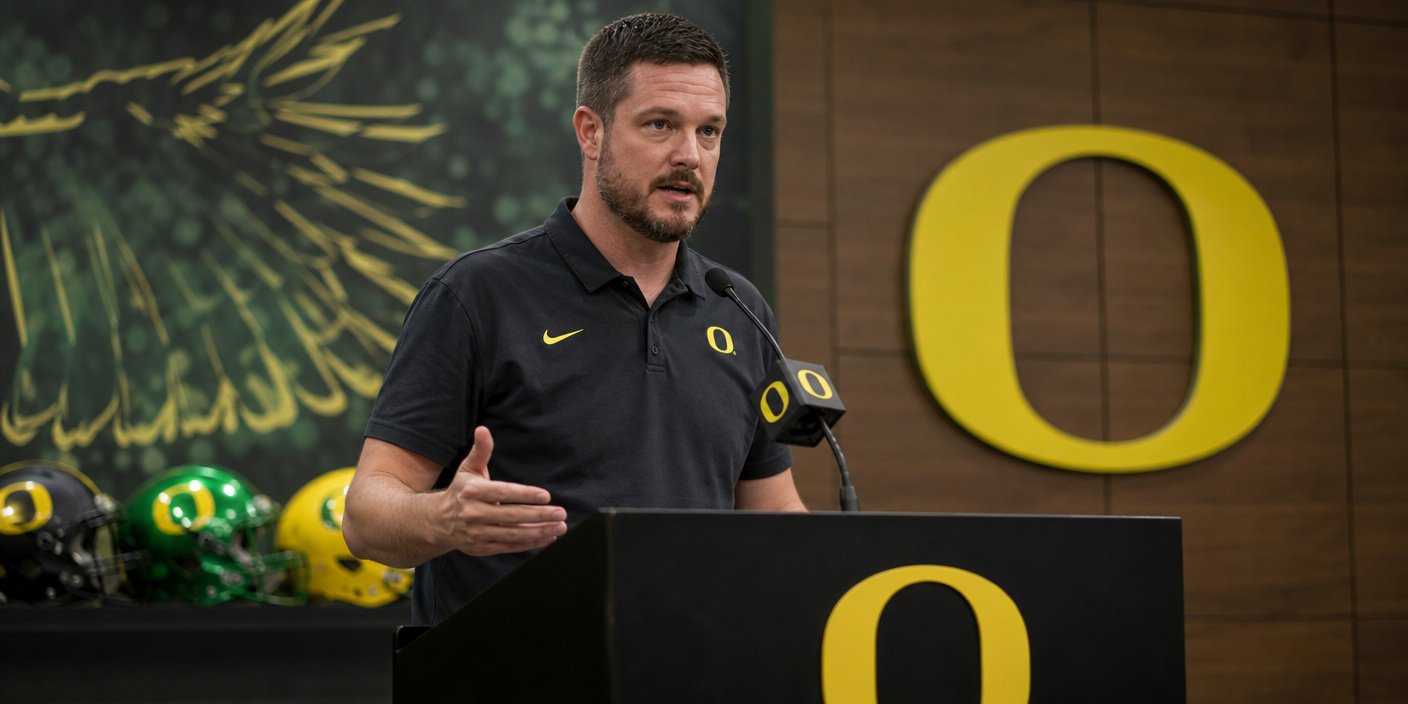
Oregon’s 2026 campaign has hit a significant turbulence point as head coach Dan Lanning officially confirmed that starting offensive guard Trent Ferguson will be sidelined for the remainder of the season. The injury, sustained during the high-stakes clash against Oklahoma State, removes a critical cornerstone of the Ducks’ interior protection and forces an immediate tactical pivot for a coaching staff looking to maintain momentum in the second half of the season.
Key Highlights
- Season-Ending Diagnosis: Head Coach Dan Lanning confirmed the severity of Trent Ferguson’s knee injury, ruling him out for the duration of the 2026 season.
- Strategic Void: Ferguson’s departure leaves a vacancy at the starting offensive guard position, a role critical to the Ducks’ pass-protection schemes and interior run-blocking.
- Immediate Impact: The team must now shuffle the roster and adjust communication protocols along the offensive line ahead of the upcoming conference stretch.
Navigating the Trenches: Ferguson’s Absence Reshapes the 2026 Oregon Offense
The loss of an offensive lineman of Trent Ferguson’s caliber is never merely a “next man up” situation; it is a fundamental shift in the geometry of an offense. In the modern, high-tempo landscape of college football, the interior offensive line—specifically the guard position—functions as the cerebral engine room for both the passing game and the rushing attack. When a veteran starter like Ferguson exits the rotation, the ripples are felt from the snap count through to the quarterback’s blindside protection.
The Tactical Shift: Adjusting Protections
Ferguson was not just a blocker; he was an on-field communicator. In Oregon’s complex offensive system, the guards are responsible for identifying blitz packages, managing the “A-gap” threats, and adjusting the slide protection in real-time. Without his experience, the remaining linemen must absorb a higher cognitive load.
Defensive coordinators in the upcoming games will undoubtedly look to exploit this transition. Expect to see more aggressive interior blitzing and “stunt” packages—where defensive tackles cross paths to confuse the offensive line—designed specifically to test the chemistry between the newly inserted guard and the center. The Ducks’ offensive line coach will need to prioritize simplifying the protection calls in the immediate short term to ensure the quarterback isn’t facing unblocked pressure while the new rotation finds its rhythm. The challenge isn’t just physical; it is a mental hurdle that the entire offensive unit must clear simultaneously.
Roster Depth: Who Steps Up?
This injury forces the spotlight onto the depth chart, a testing ground that separates championship contenders from the rest of the pack. Oregon’s recruiting machine has prioritized depth, and now that investment must pay dividends. The coaching staff is likely evaluating a mix of redshirt freshmen and seasoned utility backups who have been taking reps in practice but have lacked meaningful game experience.
While the raw talent in the reserve unit is undeniably high, the nuances of the position—the precise hand placement in a power-run scheme, the subtle anchor against a bull-rushing nose tackle—are learned through the fire of live competition. The staff will likely implement a rotation strategy over the next two games, allowing two or three candidates to prove their reliability before settling on a permanent starter for the final stretch of the regular season. The goal is to avoid a “weak link” scenario that defensive fronts can target repeatedly.
The Psychological Impact and Leadership Vacuum
Beyond the tactical spreadsheets, there is an intangible element of leadership that Ferguson brought to the field. He was a veteran presence who could settle the line after a negative play or a sack. Losing that voice mid-game against Oklahoma State clearly impacted the flow of the offense, and the team will need to manufacture that leadership from other quarters. Seniors on the offensive line must now step up to bridge the gap, ensuring that morale remains high despite the adversity.
This is a defining moment for the 2026 Ducks. Adversity in the middle of a season has a way of either fracturing a team or forging an unbreakable bond. For Oregon, the success of the remainder of their season hinges on how quickly they can stabilize the interior front and protect their quarterback, turning a devastating individual injury into a collective resolve that keeps their postseason aspirations firmly in their own hands.
FAQ: People Also Ask
1. How long will Trent Ferguson be out for the Ducks?
Trent Ferguson has been ruled out for the remainder of the 2026 season due to the knee injury he suffered during the game against Oklahoma State.
2. Who will likely replace Ferguson in the starting lineup?
Coach Dan Lanning has not named a definitive starter to replace Ferguson, but the team is expected to utilize a rotation of backups and reserve players to evaluate their performance in upcoming practices and games before cementing a starter.
3. How does this injury impact Oregon’s offensive strategy?
Losing a starting offensive guard disrupts the communication and protection schemes along the line. The team will likely simplify their protection calls and focus on building chemistry between the center and the new guard to mitigate potential vulnerabilities in pass protection.