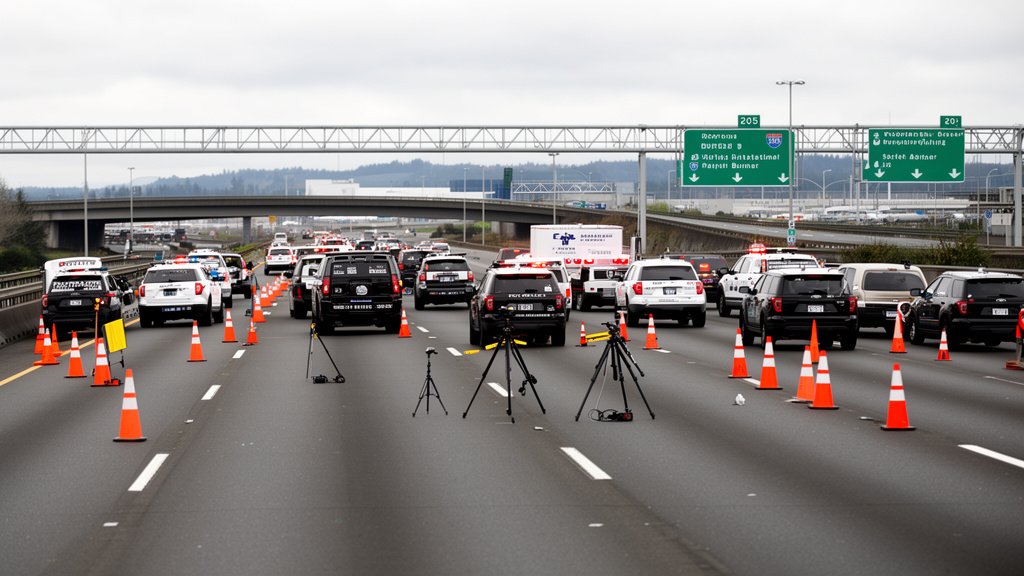
Portland traffic faced significant disruptions today as authorities closed the northbound lanes of Interstate 205 at Northeast Airport Way. A single-vehicle crash resulted in severe consequences, with first responders extracting a trapped driver before transporting them to a local hospital with life-threatening injuries. The Portland Police Bureau’s Major Crash Team has assumed control of the scene to conduct a comprehensive reconstruction and investigation.
Key Highlights
- Critical Incident: A serious, single-vehicle collision occurred on northbound I-205 at the junction of Northeast Airport Way.
- Emergency Response: First responders successfully extricated a trapped driver; the individual was transported to a local medical facility with life-threatening injuries.
- Investigation: The Portland Police Bureau’s Major Crash Team (MCT) was deployed to the scene to conduct forensic reconstruction, a standard protocol for high-severity collisions.
- Commuter Impact: The closure of the northbound lanes created a significant bottleneck near Portland International Airport (PDX), with authorities enforcing detours during the active investigation phase.
Understanding the Dynamics of Major Highway Investigations
The closure of a major arterial highway like Interstate 205 is never a decision taken lightly by law enforcement. When the Portland Police Bureau’s Major Crash Team (MCT) arrives on the scene, the priority shifts from immediate traffic flow to forensic preservation. In the case of the recent crash at Northeast Airport Way, the complexity of the investigation—compounded by the need for technical extrication—necessitated the full shutdown of the northbound lanes.
The Role of the Major Crash Team (MCT)
Unlike standard patrol units, the Major Crash Team is comprised of specialized investigators trained in the physics of vehicle collisions. Their primary objective is to recreate the moments leading up to the impact. This involves high-precision mapping, scanning the road for skid marks, analyzing debris fields, and examining the vehicle’s mechanical integrity. When a driver is trapped, the team must often work in tandem with fire and rescue units, delaying their forensic work until the medical and extrication phases are finalized. The presence of the MCT signals that the injuries involved are severe or life-threatening, requiring a higher burden of evidence collection for potential legal proceedings or detailed incident reporting.
Infrastructure and Geometric Challenges
Interstate 205, particularly the stretch near Northeast Airport Way, is a high-traffic corridor serving as a vital link between the Portland metro area and Portland International Airport. The geometry of this junction, which involves complex weaving patterns for traffic entering and exiting the airport, introduces inherent risks. From an infrastructure perspective, this area requires heightened driver vigilance. Frequent lane changes and merging traffic increase the probability of conflict points. Engineers and urban planners often analyze crash data from such specific locations to determine if road improvements—such as better signage, lighting, or lane realignment—can mitigate future risks. While this specific investigation focuses on the immediate cause of the single-vehicle collision, the data collected will inevitably feed into long-term safety evaluations for the PDX transit corridor.
The ‘Golden Hour’ in Medical Logistics
When a driver is trapped in a vehicle, the ‘Golden Hour’—a critical window where prompt medical intervention significantly increases the probability of survival—becomes the operational focus. The extrication process, which involves hydraulic tools to remove doors or roof panels, is time-consuming and delicate. Coordinating this rescue while managing the secondary risks of a high-speed highway environment is a monumental task for Portland Fire & Rescue and responding medical units. The subsequent transport to a trauma center requires clear routing, which is why highway closures are expanded beyond the immediate crash site. By establishing a secure perimeter, responders create the necessary space to operate efficiently, ensuring the patient reaches definitive care without the delays inherent in heavy congestion.
Economic and Commuter Consequences
Beyond the tragedy of the individual incident, such closures highlight the fragility of Portland’s regional logistics network. I-205 is a primary trucking route. A closure at this junction disrupts regional supply chains, delaying the delivery of goods and creating ripple effects through local traffic patterns as thousands of commuters are diverted onto surface streets. These events serve as a stark reminder of the interconnectivity of urban transportation systems. As investigators continue to process the scene, the emphasis remains on transparency and public safety, balancing the need to reopen infrastructure with the obligation to conduct a thorough, legally defensible investigation into how such a critical incident occurred.
FAQ: People Also Ask
What is the purpose of the Major Crash Team (MCT) in Portland?
The MCT is a specialized unit within the Portland Police Bureau that responds to collisions involving critical, life-threatening injuries or fatalities. They are responsible for forensic reconstruction, which includes documenting evidence that standard traffic units may not have the resources or training to process.
Why are highways closed for several hours after a crash?
Highways are closed to protect the integrity of the crime scene and the safety of investigators. Forensic mapping, debris collection, and vehicle stabilization take time. Removing a vehicle involves documentation of its final resting position, which is essential evidence for determining the cause of the crash.
How does a single-vehicle crash require such a large investigation?
A single-vehicle crash with life-threatening injuries must be investigated to determine if the cause was medical, mechanical, environmental, or related to driver impairment or behavior. The investigation must rule out external factors, such as road hazards or mechanical failure, to provide a complete factual account for insurance and legal purposes.
When is traffic usually restored after an investigation?
Traffic restoration is contingent on the completion of the scene investigation. Once the MCT completes their forensic data collection, the damaged vehicle is towed, and road debris is cleared by Department of Transportation crews. This process typically takes several hours, depending on the severity of the incident.