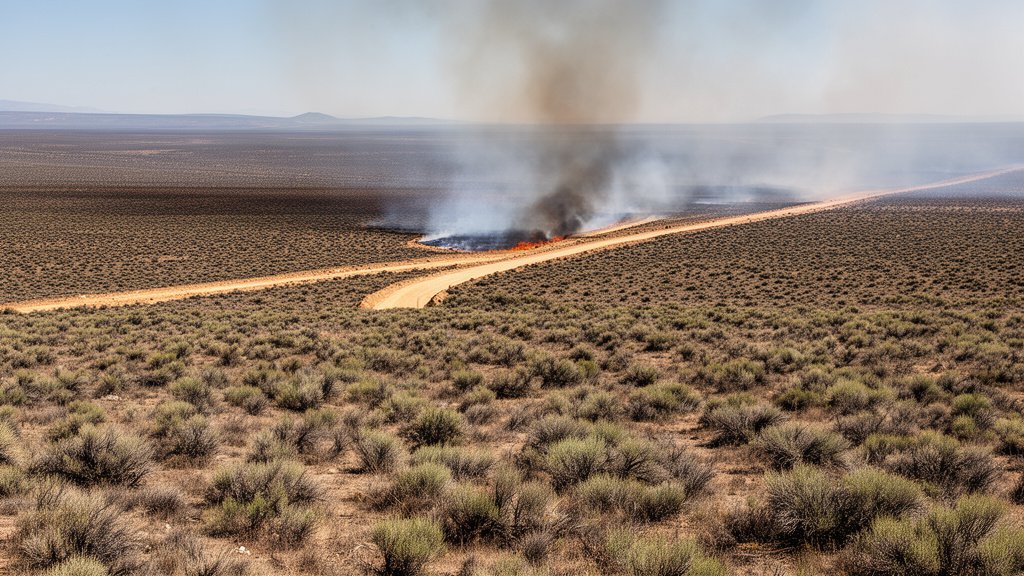
The Goose Fire, a rapidly emerging wildfire situated within the rugged landscape of Malheur County, Oregon, has officially been added to the registry of active federal incidents as of August 16, 2026. Burning approximately 300 acres of Bureau of Land Management (BLM) territory, the blaze serves as a critical flashpoint in what has already proven to be an exceptionally volatile 2026 wildfire season. Federal firefighting assets, coordinated through multi-agency incident command, are currently prioritizing containment strategies to prevent the fire from encroaching on local rangelands and vital infrastructure.
The Geography of the Malheur Conflict
The ignition of the Goose Fire underscores the unique environmental challenges inherent to Malheur County. This region is characterized by vast stretches of sagebrush-steppe and Great Basin desert scrub, an ecosystem that, when dried by extreme summer heat, acts as highly combustible fuel. Unlike the dense timber fires often seen in the Cascade Range, rangeland fires like the Goose Fire exhibit rapid rates of spread due to high winds and low relative humidity levels common in high-desert environments.
As of this afternoon, incident commanders are managing the fire’s growth by leveraging the region’s natural topographical breaks, such as rocky outcroppings and established gravel roadways. However, the unpredictability of wind shifts in the Malheur basin remains the primary variable in suppression efforts. The BLM has mobilized ground crews, including hotshot teams and heavy equipment operators, to establish containment lines, which involve stripping vegetation down to mineral soil to create a firebreak.
Strategic Suppression and Containment Methodology
In the context of federal land management, the term “containment” refers to the percentage of the fire perimeter that has been successfully enclosed by a line of control. A 300-acre fire, while modest in comparison to historical mega-fires, is currently in a critical “initial attack” phase.
Fire suppression strategy for the Goose Fire follows a three-tiered approach:
1. Initial Attack: Rapid deployment of smokejumpers and engine crews to halt the fire’s forward momentum.
2. Perimeter Hardening: Utilizing aerial support, specifically SEATs (Single Engine Air Tankers), to apply retardant on the flanks of the fire, cooling the fuel load and slowing the advance.
3. Extended Attack: If containment is not achieved within the first 24 to 48 hours, command structures will shift to a Type 3 or Type 2 incident management team, scaling up resources to include bulldozer lines and additional water tenders.
The Bureau of Land Management (BLM) is leading the operation, working in close coordination with local ranching interests who provide vital “on-the-ground” situational awareness regarding livestock locations and water sources—essential assets for ensuring the safety of local commodities.
The 2026 Wildfire Season: A Broader Context
This incident is not an isolated event but rather a manifestation of broader climate pressures facing the Pacific Northwest. Throughout the 2026 season, Oregon has faced sustained periods of extreme heat and a lack of late-spring precipitation, which has left fine fuels (grasses and shrubs) in a state of extreme desiccation.
Experts note that the timing of the Goose Fire—mid-August—coincides with the historical peak of wildfire risk in Eastern Oregon. The atmospheric conditions contributing to the fire’s ignition are part of a larger trend of “flash droughts,” where short-term moisture deficits exacerbate existing long-term aridity. For residents of Malheur County, the Goose Fire is a reminder of the heightened vigilance required during the late-summer months, where a single lightning strike or human-caused spark can lead to rapid acreage expansion within hours.
Risk Management and Future Projections
Looking ahead, the outlook for the Goose Fire remains dependent on the interaction between diurnal wind patterns and moisture levels. Meteorological models for Eastern Oregon suggest that overnight humidity recovery—where dew points rise and fuel moisture levels increase—will be the primary factor in allowing firefighters to gain the upper hand. If these conditions persist, incident commanders expect to significantly increase the containment percentage over the next 48 hours. However, with seasonal heat waves forecasted to continue, the overall fire danger rating for the Malheur District remains at ‘High,’ meaning fires are likely to start easily and spread rapidly if left unchecked.
FAQ: People Also Ask
What is the current containment status of the Goose Fire?
As of August 16, 2026, the Goose Fire is in its initial stages of management. ‘Containment’ figures are dynamic and subject to change based on real-time aerial reconnaissance and ground-level reporting from the BLM incident command.
How does the BLM manage fires in Malheur County?
The BLM utilizes a ‘full suppression’ strategy for most fires in this region to protect public and private interests. This involves a mix of aerial retardant drops, manual handline construction, and the use of heavy machinery to create firebreaks in the sagebrush.
Why are 300 acres considered significant in this area?
In the high desert environment of Malheur County, fires can travel across thousands of acres in a single day due to light, flashy fuels and high winds. A 300-acre start is treated with immediate urgency to prevent it from growing into a multi-thousand-acre incident that threatens local rangelands, infrastructure, and ecological habitats.
How can residents get updates on the Goose Fire?
Residents should monitor the official BLM Oregon/Washington social media channels, local emergency management alerts, and the InciWeb information system, which serves as the primary portal for federal wildfire data and evacuation notices.