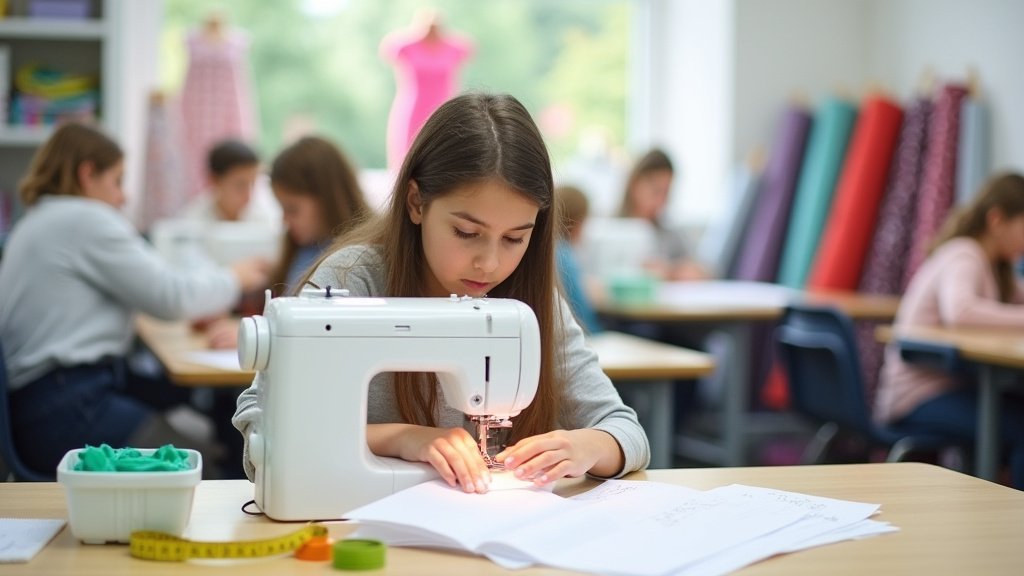
In the humming classrooms of Central Oregon Community College (COCC), a different kind of curriculum is taking hold—one measured in yards of fabric, precise stitch counts, and the confidence of a child who just finished their first garment. The youth sewing and fashion design camps, which welcome students aged 10 to 15, have become a quiet, vibrant hub for creative development in the region. Led by Qristy Kurtz, the founder of the nonprofit Fashion Workshop, these sessions are doing more than teaching students how to thread a needle; they are instilling a sense of agency, spatial reasoning, and artistic identity in the next generation of Central Oregonians.
Key Highlights
- Educational Partnership: The camps are a strategic collaboration between Central Oregon Community College and the nonprofit Fashion Workshop, bringing professional-grade sewing instruction to a youth-accessible environment.
- Target Demographic: Designed specifically for ages 10 to 15, the program focuses on the critical developmental window where children shift from consuming media to creating physical products.
- Skill-Based Curriculum: Beyond basic sewing, the curriculum emphasizes fashion design principles, material science, and the patience required for intricate craftsmanship.
- The ‘Creative Education’ Mission: Qristy Kurtz emphasizes that fashion is a gateway to broader STEAM (Science, Technology, Engineering, Arts, and Math) concepts, fostering problem-solving skills that apply far beyond the sewing machine.
The Architecture of Creativity: Stitching New Futures
The perception of sewing has shifted dramatically in the last decade. Once categorized strictly as a domestic chore or an antiquated hobby, the craft is now being reclaimed as a vital form of self-expression and industrial design. At the heart of this shift in Bend, Oregon, is the collaborative energy between COCC and the Fashion Workshop. By providing a dedicated space for students to interact with the mechanics of fashion, the program effectively treats sewing not as a relic of the past, but as a toolkit for the future.
The Mechanics of Empowerment
When a student aged 10 sits down at a sewing machine, they are engaging in a complex series of cognitive tasks. They must calculate seam allowances, visualize the transition from a two-dimensional fabric pattern to a three-dimensional object, and manage the tension of the thread. This is high-level spatial reasoning disguised as fun. Qristy Kurtz has structured these camps to leverage that complexity. By stripping away the pressure of professional quotas, the program allows children to experiment. If a seam goes crooked, it is not a failure; it is a design feature or an opportunity to learn how to repair and modify. This iteration process is the foundation of innovation in any field, from software engineering to architecture.
Fashion as a Vehicle for STEAM
While the camps fall under the umbrella of ‘arts and crafts’ in many casual conversations, the reality of the instruction is deeply rooted in STEAM. The fabric requires an understanding of biology (natural fibers) or chemistry (synthetic blends). The pattern-making process is fundamentally geometry—measuring, grading, and scaling shapes to fit the human form. By participating in these camps, students are unknowingly sharpening their mathematical and logical skills. This intersection is crucial. In an increasingly digital world, these students are learning to marry the virtual concepts they see on social media with the tangible reality of physical production.
The Cultural Context of ‘Slow Fashion’
One of the most profound secondary angles of the COCC camps is the implicit critique of ‘fast fashion.’ By teaching students how to make their own clothes, Kurtz is helping to cultivate a new generation of consumers who understand the labor, time, and resources that go into garment production. This is an essential lesson in environmental stewardship. When a child spends hours sewing a tote bag or a skirt, they develop an intrinsic value for the item. They are far less likely to discard it after one wear. This ‘slow fashion’ philosophy is arguably the most important long-term impact of the program, fostering a sustainable mindset that will ripple out into the community as these students grow older.
The Economic and Community Impact
Regional development relies on more than just large corporations; it relies on the micro-economies of hobbyists, artisans, and small business owners. By nurturing a crop of young designers, Central Oregon is slowly building a pipeline of creative talent. Some of these participants may go on to study at fashion institutes, while others might become engineers who retain the dexterity and patience learned in these classrooms. The partnership between a public institution like COCC and a specialized nonprofit like Fashion Workshop serves as a replicable model for other communities. It shows that localized, high-quality vocational education does not require a massive budget—it requires a skilled instructor, the right tools, and a community willing to value the creative process.
FAQ: People Also Ask
What are the primary goals of the Fashion Workshop camps at COCC?
The camps aim to provide youth with tangible sewing skills, foster creativity, and teach the fundamentals of design, all while promoting patience and problem-solving through hands-on work.
Are these camps suitable for complete beginners?
Yes, the programs led by Qristy Kurtz are specifically designed to cater to various skill levels, ensuring that participants aged 10-15 receive appropriate guidance regardless of their prior experience with sewing machines.
How does sewing education relate to modern STEAM learning?
Sewing involves geometry, measurement, and material science. It teaches spatial awareness and mechanical troubleshooting, which are essential skills for engineering, architecture, and industrial design.
Can these skills lead to a career in fashion design?
Absolutely. By introducing children to the tools and processes of fashion design at a young age, the camp provides a foundational start for potential careers in textile design, apparel manufacturing, or costume design.