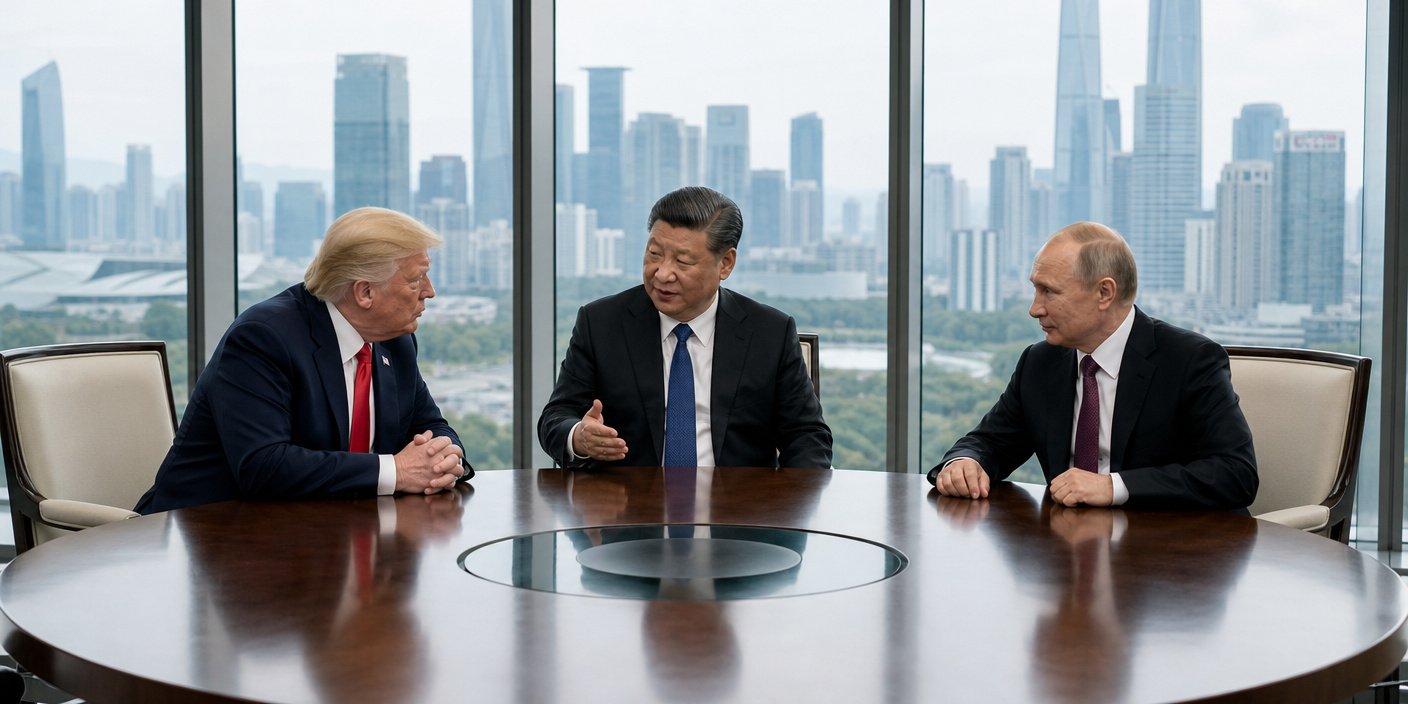
US President Donald Trump, Chinese President Xi Jinping, and Russian President Vladimir Putin have convened for an unprecedented trilateral summit in Shenzhen, China, marking a pivotal moment during this year’s APEC summit. As global tensions reach a critical inflection point, the meeting is exclusively dedicated to the most pressing existential threats of the modern era: the restructuring of nuclear arms control frameworks, the stabilization of global trade relations, and the urgent cessation of active conflicts in Ukraine and Iran.
Key Highlights:
- Historic Trilateral Summit: The first-of-its-kind meeting between President Trump, President Xi, and President Putin is taking place in Shenzhen, focusing on high-stakes diplomacy during the APEC summit.
- Nuclear Arms De-escalation: The leaders are engaged in intensive negotiations to revive and modernize nuclear arms control treaties, aiming to prevent regional escalation.
- Conflict Resolution Strategy: The agenda explicitly targets a diplomatic roadmap to wind down the ongoing proxy wars and active hostilities in Ukraine and Iran.
- APEC Economic Integration: Beyond security, the summit addresses the revitalization of trade routes and tariff policies to mitigate global economic instability.
The Shenzhen Accord: A New Diplomatic Paradigm
The choice of Shenzhen—the pulsating heart of China’s technological and economic miracle—as the venue for this trilateral summit is deeply symbolic. By moving away from traditional Western-centric diplomatic hubs, the meeting creates a neutral, high-intensity environment where the world’s most powerful leaders can bypass bureaucratic delays. This gathering is not merely a formality; it is a calculated effort to create a new “Shenzhen Accord” that could redefine the geopolitical landscape for the next decade.
The Nuclear Deterrence Reset
At the core of the discussions is the urgent need to stabilize the nuclear status quo. With existing treaties appearing increasingly fragile, the delegations are focusing on “transparency protocols” that allow for real-time verification of strategic assets. The primary goal is to shift the discourse from a “Cold War” posture of Mutually Assured Destruction toward a modern framework of Strategic Stability. Intelligence reports suggest that the three powers are discussing the potential for a new tri-lateral non-proliferation agreement. This would mandate regular military-to-military communication channels to prevent accidental escalations—a critical safety valve in an era of rapid technological advancement in hypersonic and AI-integrated weaponry.
Resolving the Geopolitical Flashpoints
Perhaps the most challenging aspect of the Shenzhen summit is the de-confliction strategy regarding the wars in Ukraine and Iran. The current geopolitical architecture is burdened by the complexity of these proxy conflicts. President Trump, President Xi, and President Putin are evaluating a potential “Off-Ramp Strategy” that would decouple these regions from global superpower rivalry. The discussion involves a structured, multi-phase withdrawal of external military support, contingent upon verifiable regional security guarantees. For Ukraine, the proposal centers on an internationally monitored ceasefire zone and the restoration of key economic transit routes. For Iran, the dialogue is centered on regional non-proliferation and the cessation of disruptive regional operations in exchange for a reintegration into global economic markets.
Global Economic Impact and Trade Stability
While security takes center stage, the economic ripple effects of this meeting are immense. APEC economies, which collectively account for over 60% of global GDP, are watching closely as the three leaders discuss trade liberalization and the reduction of supply chain volatility. The summit aims to establish a “Trade Stability Index” that would insulate essential commodity flows—such as energy, grain, and semiconductors—from geopolitical maneuvering. By fostering a more predictable trade environment, the leaders hope to signal to global markets that the era of aggressive economic decoupling is entering a phase of controlled stabilization. The economic agenda is clear: protect the supply chain to prevent the current geopolitical instability from causing further inflationary pressure across the global market.
Future Implications and Implementation
As the summit enters its final sessions, the focus shifts from discussion to implementation. The “Shenzhen Declaration,” if finalized, will set a strict timeline for the drawdown of military assets and the creation of permanent liaison offices for ongoing monitoring. The success of this summit depends largely on the willingness of all three powers to concede tactical advantages in exchange for systemic stability. Analysts predict that if this meeting achieves its stated goals, the resulting decrease in “geopolitical risk premiums” could trigger a significant rally in global financial markets, as investors gain confidence that the most dangerous flashpoints are finally being brought under the diplomatic umbrella.
FAQ: People Also Ask
Q: Why is the meeting taking place in Shenzhen specifically?
A: Shenzhen was selected for its status as a symbol of global economic integration and its neutral, high-security infrastructure, providing an environment conducive to the complex, high-level diplomatic discussions required for this trilateral summit.
Q: What are the primary outcomes expected from the Ukraine and Iran discussions?
A: The primary goal is to establish a “de-escalation roadmap” involving the cessation of external proxy support, the implementation of monitored ceasefire zones, and the reintegration of these regions into stability protocols to prevent further global conflict.
Q: How does this impact existing nuclear treaties?
A: The leaders are working toward a modernized framework that replaces outdated treaties, focusing on transparency, real-time verification protocols, and military-to-military communication channels to prevent accidental nuclear escalation.
Q: Does this signal the end of the APEC summit’s original mandate?
A: No, the trilateral summit is being held concurrently with APEC, integrating the security discussions into the broader regional economic dialogue, thereby ensuring that political stability supports, rather than hinders, trade liberalization.