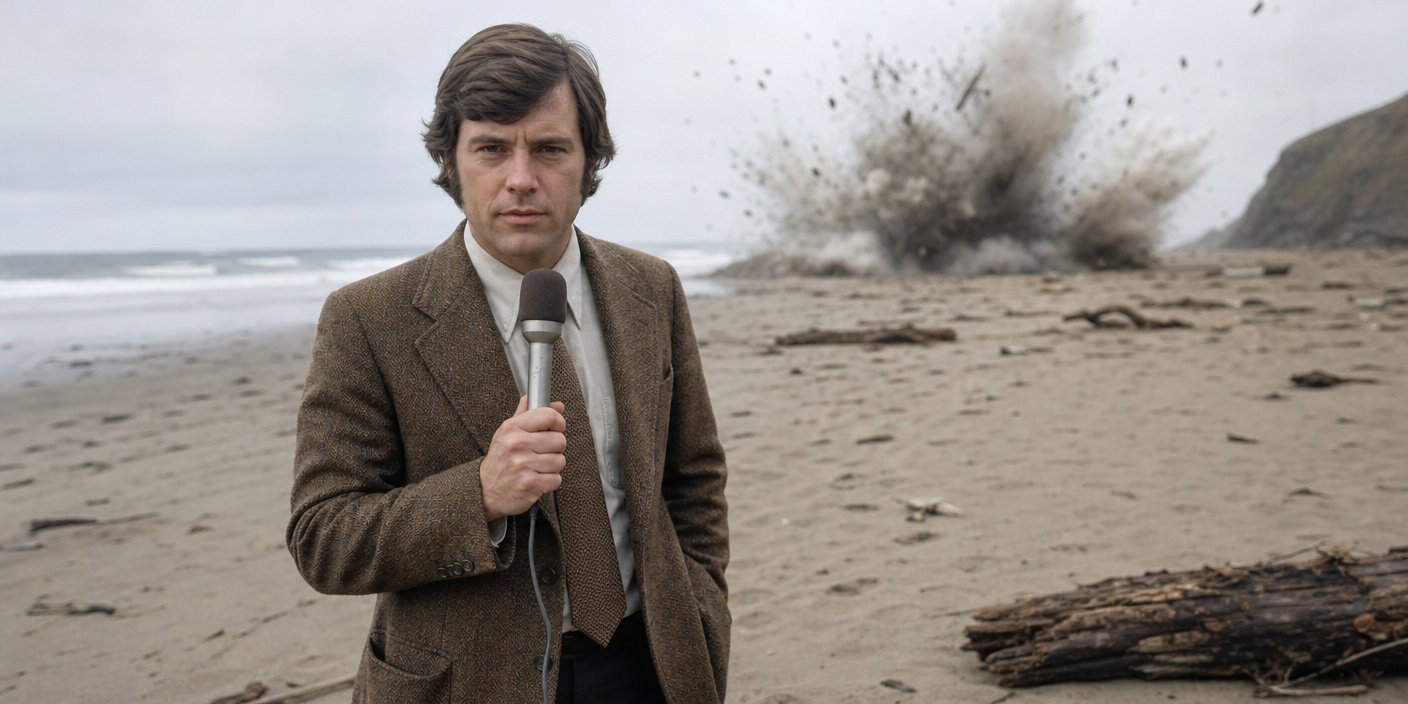
On November 12, 1970, the small coastal town of Florence, Oregon, became the site of a bizarre engineering experiment that would inadvertently cement a young KATU-TV reporter named Paul Linnman into the annals of pop culture history. What began as a local story about a stranded 45-foot, 8-ton sperm whale quickly devolved into a chaotic, blubber-raining spectacle involving 20 cases of dynamite and a complete miscalculation of physics by the Oregon Highway Division. Decades later, Paul Linnman—now a seasoned voice in Portland broadcasting—continues to reflect on how a single afternoon of reporting followed him like a shadow throughout his entire career, transforming a routine news assignment into a permanent, unintentional legacy.
The Anatomy of an Engineering Blunder
The incident began when the sperm whale washed ashore on the Siuslaw River beach. The Oregon Highway Division, tasked with the grim duty of disposal, opted against the standard method of burying the carcass, fearing the tide would exhume it. Instead, George Thornton, a district engineer, proposed a solution that seemed logical in a bureaucratic boardroom but proved disastrous in practice: dynamite. Thornton argued that an explosion would vaporize the whale into small enough pieces for scavengers, such as birds and crabs, to consume. He authorized the use of 20 cases of dynamite—half a ton of high-grade explosive—placed strategically around the creature.
Paul Linnman, then just 25 years old and working for Portland’s KATU-TV, arrived on the scene with cameraman Doug Brazil. They anticipated a somber, if slightly unusual, clean-up story. Instead, they captured a moment that would eventually define the concept of ‘viral’ media long before the internet existed. When the blast occurred, the explosive force was far greater than anticipated, resulting in a concussive boom that sent massive chunks of whale blubber soaring hundreds of feet into the air. The ‘vaporization’ theory was obliterated as heavy, wet debris rained down on onlookers and a nearby parking lot, crushing the roof of a parked Oldsmobile and sending panicked witnesses running for cover.
Paul Linnman’s Journalistic Perspective
For Linnman, reporting the event required the ultimate test of professional composure. ‘I didn’t want to laugh,’ Linnman has often noted in interviews reflecting on the footage. At the time, the mandate was to report the news as it happened, regardless of the absurdity. While the audience watching the footage decades later sees a comedic train wreck, Linnman’s original report was a straightforward, almost dry account of a public works project gone wrong.
Linnman’s perspective on the story has matured significantly over the last 50-plus years. He initially viewed it as a singular moment of professional frustration—he was there to cover a clean-up, not a catastrophe. However, he has come to accept the ‘exploding whale’ as a fundamental part of his identity in the Pacific Northwest media landscape. The footage, which shows the whale carcass literally disintegrating while the announcer maintains a stoic, professional tone, serves as a masterclass in newsroom ethics: the ability to remain objective in the face of the ridiculous.
The Legacy of Viral Journalism
The ‘Exploding Whale’ is widely considered one of the earliest examples of a ‘viral’ video. Before the era of social media, the footage was traded in newsrooms and eventually digitized, finding a second life on the nascent internet of the late 1990s. This transition from a local news filler segment to a global cultural phenomenon highlights several key shifts in media consumption:
1. The Endurance of Human Error: The public is perpetually fascinated by bureaucratic hubris. The failure of the Oregon Highway Division to consult with experts (who later stated they warned against the blast) remains a case study in failed crisis management.
2. The Power of Visual Narrative: Because Linnman and his crew were positioned safely but close enough to capture the impact, the footage provides an unfiltered look at the event. It is visual journalism in its purest, most chaotic form.
3. The Evolution of News Anchoring: Linnman’s style—a relic of the 1970s news anchor persona—provides a sharp contrast to the chaotic images, creating a ‘straight-man’ comedic effect that has kept the video relevant for half a century.
Examining Secondary Angles
Beyond the humor, the incident offers valuable lessons in civil engineering and crisis management. Modern wildlife experts now utilize systematic burial or, in rare cases, specific decomposition strategies that do not involve high explosives. Furthermore, the event serves as a historical marker for the Oregon coastline, illustrating a time when local agencies had more autonomy and less oversight regarding environmental disposal. Finally, the story examines the burden of a ‘signature’ event—how a single, viral moment can sometimes overshadow decades of serious, hard-hitting journalism in the eyes of the public.
FAQ: People Also Ask
Did the explosion actually get rid of the whale?
No. The explosion failed completely. While it sent chunks of blubber into the air, the bulk of the whale carcass remained largely intact on the beach. Highway crews eventually had to bury the remains after all.
What happened to the Oldsmobile crushed in the blast?
The car belonged to a local resident who had parked it in what he believed was a safe zone. The incident remains a famous anecdote in Florence, Oregon, often cited as a reminder of why explosives should be used with extreme caution near human property.
Why does the footage look so clear?
It was shot on 16mm film by KATU-TV’s experienced photography team. The high quality of the equipment, combined with the sheer shock of the event, allowed the footage to age remarkably well, making it perfect for later digitization in the high-definition era.
How does Paul Linnman feel about the incident now?
Linnman has embraced his role in the story. While he spent years establishing a serious career in broadcasting, he acknowledges that the exploding whale is the story that everyone remembers, and he speaks about it with a mix of professional pride and self-deprecating humor.