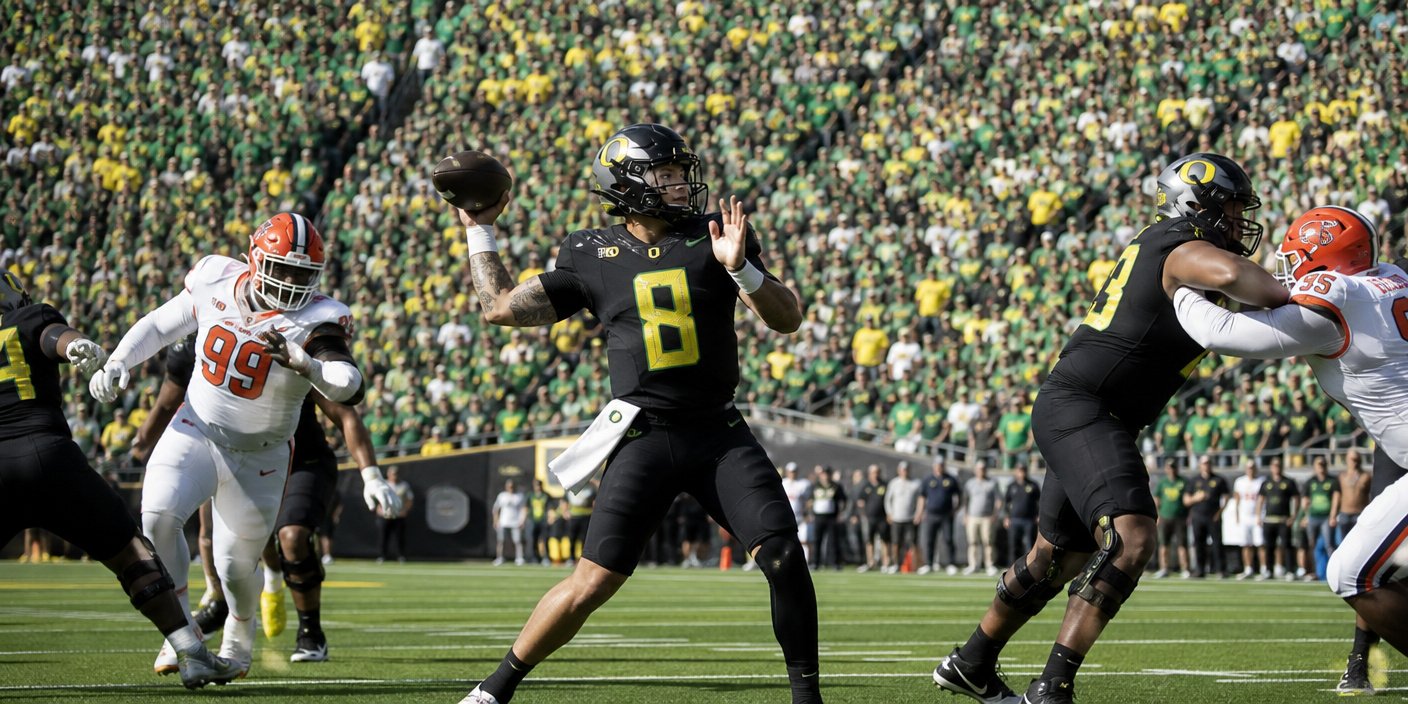
The college football landscape shifts its focus to Eugene, Oregon, as the #1 ranked Oregon Ducks prepare to host the #20 Illinois Fighting Illini in a critical Week 9 matchup. Following their high-profile victory over Ohio State and a subsequent dominant stretch, the Ducks have firmly established themselves as the team to beat in the expanded Big Ten. For Illinois, led by head coach Bret Bielema, this trip to Autzen Stadium represents an opportunity to disrupt the national championship narrative and prove their legitimacy among the conference elite.
Key Highlights
- Rankings Impact: Oregon enters as the AP Poll’s #1 team, while Illinois arrives ranked #20, looking to claim their first win over a #1 team in program history.
- Quarterback Duel: Oregon’s Dillon Gabriel continues his Heisman campaign against Illinois’ Luke Altmyer, who has been a model of efficiency this season.
- The Autzen Factor: The game will be played at the notoriously loud Autzen Stadium, where Oregon holds a formidable home-field advantage.
- Conference Stakes: This is a vital game for Big Ten standings, as Oregon seeks to remain undefeated in conference play.
Oregon’s Ascent and the Tactical Chess Match
The arrival of the Illinois Fighting Illini at Autzen Stadium marks more than just another Saturday on the schedule; it represents a litmus test for both programs in the hyper-competitive new era of the Big Ten Conference. Oregon, under head coach Dan Lanning, has evolved into a well-oiled machine, balancing an explosive passing attack with a defense that has shown remarkable discipline against high-caliber opponents. The Ducks’ transition into the Big Ten has been seamless, but maintaining the intensity required to stay at the top spot in the AP Poll is the primary challenge for the remainder of the season.
The Heisman Trajectory of Dillon Gabriel
At the center of Oregon’s offensive surge is quarterback Dillon Gabriel. His ability to manipulate defensive coverages while maintaining a high completion percentage has been the cornerstone of the Ducks’ success. For the Fighting Illini defense, the objective is containment rather than outright stoppage. Illinois defensive coordinator Aaron Henry will likely employ a mix of zone pressures to force Gabriel into tight windows, hoping to capitalize on any hesitation. However, Gabriel’s experience—honed through multiple seasons of high-pressure collegiate football—suggests that he is well-prepared for the defensive variations Illinois might present. If Gabriel can maintain his rhythm early, it will force Illinois to abandon their preferred ball-control strategy, effectively opening the game up for the Ducks’ speed-oriented receiving corps.
Bielema’s Philosophy vs. Oregon’s Speed
On the other side of the ball, Illinois coach Bret Bielema brings a philosophy deeply rooted in physical, trench-based football. The Illini have thrived on winning the line of scrimmage, utilizing a methodical ground game to shrink the clock and keep opposing high-powered offenses on the sideline. This creates a fascinating tactical dichotomy: Oregon wants to turn this game into a track meet, utilizing space and perimeter speed, while Illinois wants to turn it into a slugfest.
Illinois quarterback Luke Altmyer has been a revelation for the program, displaying composure in critical situations and a knack for avoiding the catastrophic turnover. To upset the Ducks, Altmyer needs to play his cleanest game of the year. He will need to connect on intermediate routes that keep the chains moving, preventing the Oregon offense from finding its groove. The success of this strategy hinges on the Illinois offensive line’s ability to withstand the pressure of Oregon’s front seven, a group that has consistently disrupted backfields throughout the 2024 season.
Secondary Angles: Future Implications
1. Recruiting Grounds: Beyond the scoreboard, this game serves as a massive recruiting showcase. Oregon’s presence in the Big Ten has allowed them to exert influence in recruiting territories that were previously untouched by the program. A high-profile win in a nationally televised window reinforces the Ducks as a destination program for top-tier talent.
2. The Big Ten Power Balance: With traditional powers like Michigan and Ohio State fluctuating, a victory here solidifies Oregon as the conference’s true juggernaut. If Illinois stays competitive, it underscores the depth of the Big Ten, proving that the conference is not just a two-team race but a gauntlet from top to bottom.
3. Autzen Acoustics: The crowd at Autzen Stadium is statistically one of the most disruptive environments in college football. The noise level isn’t just a byproduct of excitement; it is a tactical weapon. If Illinois struggles with communication at the line of scrimmage, we could see early false starts or confusion in pass protection that gives the Oregon pass rush a distinct head start on every snap.
FAQ: People Also Ask
How does this game impact the College Football Playoff race?
For Oregon, a win is essential to maintain their path to the Big Ten Championship and a top-two seed in the CFP bracket. For Illinois, a win would be a resume-defining achievement, likely vaulting them into the top 15 and into the conversation for an at-large playoff bid.
What are the key defensive matchups to watch?
Watch the battle on the perimeter. Oregon’s defensive backs against Illinois’ receiving corps will be critical. If Illinois’ receivers can win their 1-on-1 matchups, it alleviates the pressure on their offensive line and allows Altmyer to sustain drives.
What makes Autzen Stadium such a difficult place to play?
Autzen Stadium is uniquely designed to trap sound. The steep embankments focus the crowd noise directly onto the field, making audible communication between the quarterback and his offensive line nearly impossible during key downs. It is consistently cited by opposing players as one of the loudest venues in the country.