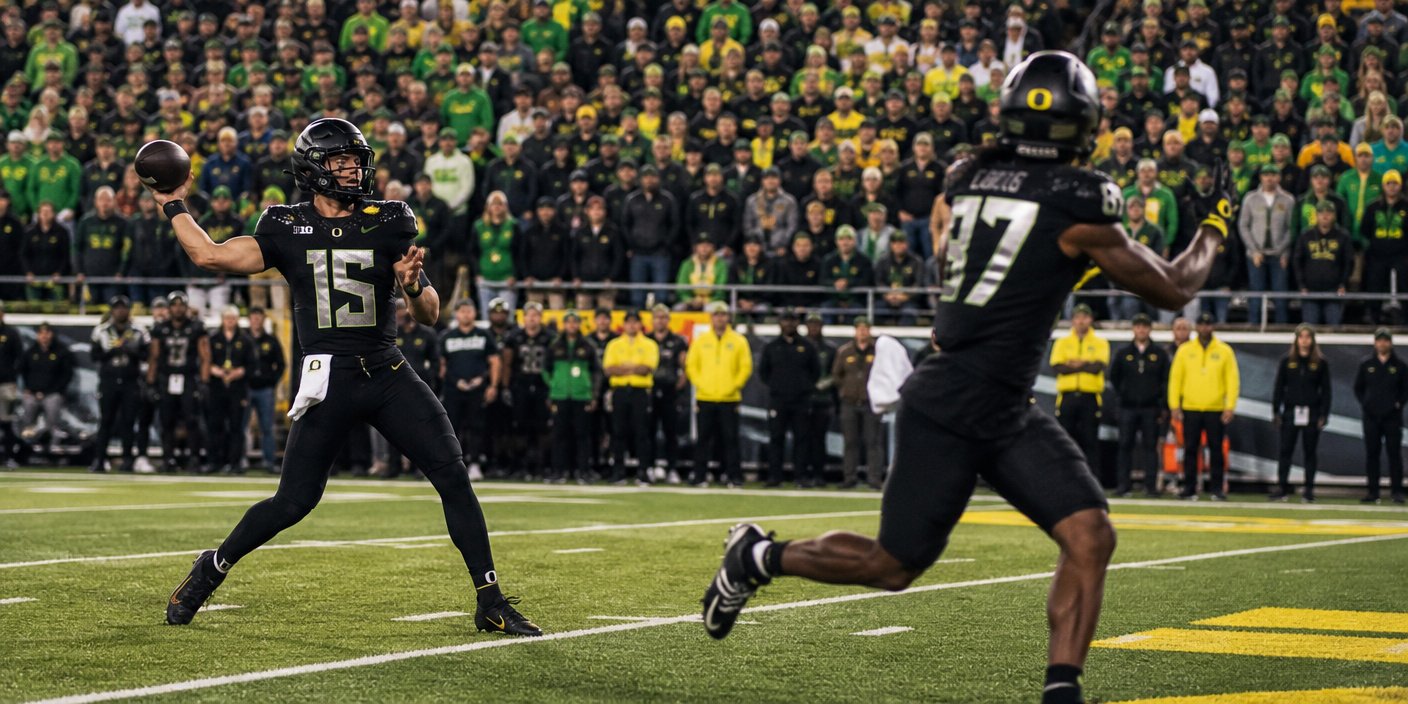
In an electric atmosphere that will be discussed for seasons to come, the Oregon Ducks pulled off a miraculous 17-14 victory over the Nebraska Cornhuskers, saved by the composure of freshman quarterback Dylan Raiola. With the Ducks’ offense stagnating for the better part of three quarters and starting quarterback Brock Thomas struggling to find a rhythm following the injury to Dante Moore, Raiola’s late-game entrance completely shifted the narrative, culminating in a precise 4-yard touchdown pass to Jamari Johnson with only 28 seconds remaining on the clock.
Key Highlights
- The Game-Winner: Dylan Raiola connected with tight end Jamari Johnson for a 4-yard touchdown pass with just 28 seconds remaining in the fourth quarter.
- QB Carousel: The Ducks were forced to pivot after starter Brock Thomas struggled in place of the injured Dante Moore.
- The Comeback: Oregon overcame a stalled offensive effort throughout most of the contest, scoring 17 total points in a defensive battle.
- Crucial Timing: The final drive covered significant ground under extreme pressure, marking a turning point in Oregon’s early-season offensive identity.
A Turning Point in the Pacific Northwest
The victory was far from a foregone conclusion. For most of the afternoon, the Oregon offense looked disjointed. The absence of Dante Moore, who was ruled out prior to kickoff, cast a long shadow over the proceedings. Brock Thomas, thrust into the starting role, faced a formidable Nebraska defensive front that seemed intent on punishing the Ducks’ backfield. Nebraska’s defense was disciplined, aggressive, and clearly prepared for the scheme that Thomas brought to the table. By the start of the fourth quarter, Oregon had managed to muster very little, trailing in a game that felt like it was slipping away into the hands of the Cornhuskers.
However, the coaching staff made a decisive, and perhaps desperate, pivot. Inserting Dylan Raiola into the lineup was not just a change of personnel; it was an attempt to inject a different cadence and vision into an offense that had become predictable. From his first snap, Raiola showed a level of command that belied his experience. He navigated the pocket with a calm demeanor, looking off safeties and delivering strikes to the intermediate levels of the field, effectively loosening up a Nebraska secondary that had been playing tight, aggressive coverage all day.
Analyzing the Final Drive
The final drive was a masterclass in clock management and situational awareness. With the clock ticking down and the Ducks needing a touchdown—not just a field goal—to reclaim the lead, Raiola orchestrated a series of plays that dismantled the Nebraska shell coverage. The decisive play itself, a 4-yard bullet to Jamari Johnson, showcased the synergy between the quarterback and his receiver. Johnson, who had been relatively quiet for much of the game, found the soft spot in the zone coverage near the goal line. Raiola’s throw was not only accurate but placed in a position where only Johnson could make the catch. It was a high-risk, high-reward decision that paid dividends, sending the home crowd into a frenzy and securing the 17-14 result.
This drive was not merely about the final pass; it was about the preceding sequence of downs. Raiola utilized the sideline effectively, stopping the clock and keeping the Nebraska defense on their heels. He moved the ball with an efficiency that had been entirely absent during the first three quarters of play. By the time the Ducks reached the red zone, the defensive momentum had shifted entirely toward the offense.
Strategic Implications for the Season
This win serves as a crucial data point for the Oregon coaching staff regarding their quarterback hierarchy. The dilemma of the ‘quarterback room’ is a classic challenge for high-level programs, but this game provides a strong case for the depth and talent available on the roster. While Dante Moore remains the primary starter when healthy, the emergence of Raiola provides the Ducks with a legitimate insurance policy—and perhaps more. It forces defensive coordinators to prepare for two distinct styles of play, adding a layer of complexity to future game planning.
Furthermore, for the Nebraska Cornhuskers, this loss will undoubtedly be a difficult pill to swallow. Their defense played an elite game for nearly 58 minutes. They limited the big plays that Oregon is famous for and maintained control in the trenches. The late collapse suggests issues with conditioning or focus in the final minutes—elements that head coach staff will surely address in the coming week. The loss highlights the volatility of college football, where a single broken coverage or a missed assignment in the final minute can undo three quarters of dominance.
Looking ahead, Oregon’s ability to win ugly, and to win with backup personnel, speaks to the culture established within the program. Champions are often defined by their ability to respond to adversity, and on this day, the Ducks proved that they have the resilience to withstand a struggle and capitalize on the smallest of opportunities. The 17-14 scoreline may not look impressive on a stat sheet, but it is a critical victory that keeps Oregon in the conversation for major postseason implications.
FAQ: People Also Ask
Q: Why was Brock Thomas starting instead of Dante Moore?
A: Brock Thomas started the game because primary quarterback Dante Moore was sidelined due to an injury sustained prior to the matchup, forcing the coaching staff to utilize their depth chart.
Q: How much time was left on the clock when the winning touchdown was scored?
A: Dylan Raiola connected with Jamari Johnson for the 4-yard touchdown pass with exactly 28 seconds remaining in the game.
Q: What was the final score of the Oregon vs. Nebraska game?
A: The game concluded with a final score of 17-14 in favor of Oregon.
Q: Did Dylan Raiola play the entire game for Oregon?
A: No, Raiola came off the bench. Brock Thomas started the game, and Raiola was inserted later in the contest to provide a spark for the struggling offense.