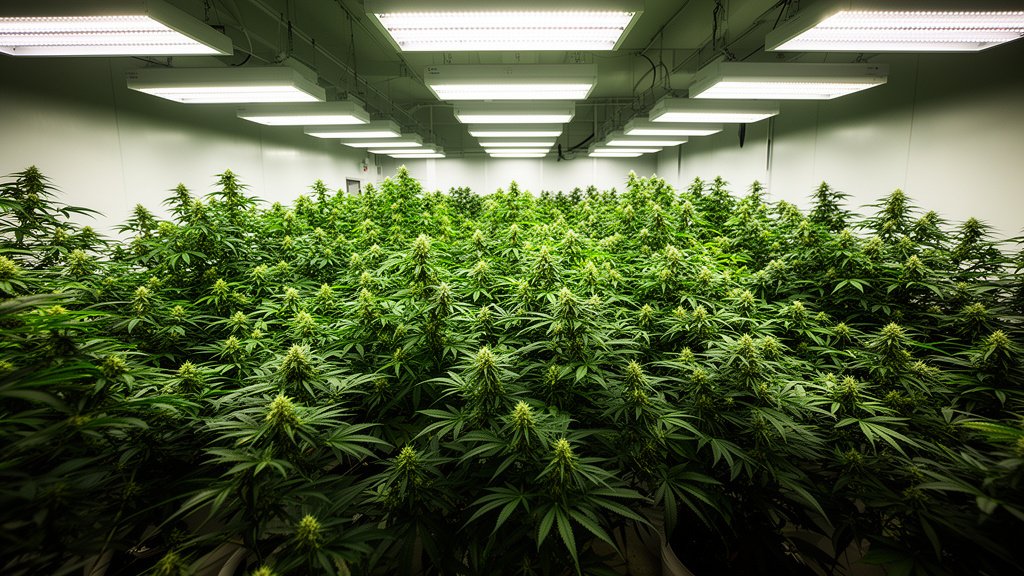
The New York cannabis market has long been defined by a paradox: one of the world’s largest consumer bases struggling against a bottleneck of supply and regulatory complexity. As the Empire State attempts to transition from a troubled medical rollout to a functional adult-use framework, the need for high-quality, indoor-grown flower has become a critical pressure point. Enter Grown Rogue International (GRIN), an Oregon-based cultivation specialist that is effectively betting the house on its ability to fill this vacuum. By acquiring the medical cannabis license and physical assets of PharmaCann in New York for $4.5 million—structured as a mix of $2.5 million in cash and $2.0 million in equity—Grown Rogue is signaling a major shift in how the state’s supply chain will be serviced.
The Mechanics of the Deal
The transaction represents more than just a real estate acquisition; it is a transfer of operational capacity. The deal secures Grown Rogue 40,000 square feet of cultivation canopy, an essential asset in a state where licensing has been slow and industrial-grade indoor space is at a premium. By acquiring these specific assets from PharmaCann, a multi-state operator, Grown Rogue is effectively bypassing the years of red tape, site selection, and construction delays that have hindered other entrants. The $4.5 million valuation is modest by industry standards, suggesting that Grown Rogue is focused on operational efficiency and immediate deployment rather than overleveraging for market share. For the company, this acquisition is a tactical bridgehead. They aren’t just buying space; they are buying the infrastructure necessary to implement their proven, Oregon-tested cultivation methodologies in the most restrictive and lucrative market on the East Coast.
Filling the ‘Indoor Gap’
The central thesis of this expansion is the quality disparity in the New York market. For years, the legal New York cannabis landscape has been criticized for offering product that struggles to compete with the illicit market in terms of bag appeal, terpene profile, and overall potency. Much of the early legal supply was derived from greenhouse or outdoor grows that, while cheaper to produce, often failed to meet the ‘connoisseur’ standards required to convert legacy consumers to the legal market. Grown Rogue’s operational philosophy is built on ‘indoor-first’ cultivation. By bringing this methodology to New York, the company is targeting the middle-to-high-end segment of the market. The gap in New York is not just about volume; it is about the right kind of volume. Consumers in the tri-state area have high expectations for flower aesthetics and experience, and the current supply chain has been largely unable to meet this consistent indoor-grown standard. By utilizing the 40,000 square feet of canopy acquired from PharmaCann, Grown Rogue aims to offer a product that feels less like a corporate commodity and more like a craft-tier experience.
Market Dynamics and Regulatory Hurdles
Operating in New York requires navigating one of the most complex regulatory environments in the United States, overseen by the New York Cannabis Control Board and the Office of Cannabis Management (OCM). The state’s rollout of adult-use dispensaries has been plagued by litigation, delayed licensing, and a proliferation of ‘sticker shops’ (unlicensed retailers). This volatility creates a unique risk-reward profile. While the potential customer base is vast, the retail distribution channels are still maturing. Grown Rogue’s entry, however, is insulated by its focus on cultivation. By positioning themselves as a wholesaler capable of feeding the supply chain, they shift the burden of retail volatility to the downstream partners. Furthermore, as the state pivots toward stricter enforcement against unlicensed operations, the demand for licensed, high-quality, indoor product is expected to surge, creating a favorable tailwind for established operators who can maintain consistent supply chains.
Scaling Quality in a New Geography
One of the most significant challenges for any cannabis operator moving across state lines is the ‘cloning’ of quality. What works in the humid, temperate climate of Oregon does not always translate to the controlled indoor environments of the Northeast. However, the acquisition of an existing facility—complete with established infrastructure—drastically reduces the integration risk. Grown Rogue’s strategy revolves around leveraging their proprietary cultivation SOPs (Standard Operating Procedures) in this new, 40,000-square-foot footprint. The company has historically leaned on a lean-operations model, prioritizing cost-per-gram efficiency without sacrificing the ‘nose’ and trichome density of their flower. Their success in New York will ultimately be determined by their ability to scale this model while managing the increased operational costs of the New York metro region, including energy prices and labor.
The Future of Consolidation
This deal is likely a precursor to further consolidation in the New York market. As capital continues to dry up for mid-tier cannabis companies, larger, more operationally disciplined firms like Grown Rogue are finding opportunities to acquire ‘distressed’ assets from operators who perhaps underestimated the time-to-market for the Empire State. The $4.5 million price tag serves as a benchmark for the current market value of localized production capabilities. For investors, the focus will now turn to the company’s ability to bring this 40,000-square-foot facility to full, profitable operation. If they can capture the premium shelf space, they may well prove that the path to profitability in New York lies in quality-focused indoor cultivation rather than broad, speculative retail expansion.
FAQ: People Also Ask
Q: Why did PharmaCann sell these assets to Grown Rogue?
A: PharmaCann is a multi-state operator that frequently reviews its portfolio to optimize capital allocation. Selling specific assets like the 40,000 square feet of canopy allows them to shed operational overhead and focus on other geographic or vertical priorities, while Grown Rogue was able to acquire a turnkey facility at a favorable price.
Q: What does ‘indoor cultivation gap’ mean for New York consumers?
A: It means that much of the flower currently available in the legal market was grown in greenhouses or outdoors, which can sometimes result in lower quality compared to indoor-grown flower. The ‘gap’ refers to the lack of sufficient supply of high-end, indoor-grown cannabis that matches the expectations of the legacy market.
Q: How does this deal affect Grown Rogue’s stock and long-term strategy?
A: The deal is a significant scaling effort. By entering the NY market, they are gaining access to one of the largest potential cannabis markets in the world. Investors view this as a ‘growth’ move, though the long-term success depends on their ability to manage the high operational costs of the New York market and achieve profitability within their new 40,000 square foot facility.
Q: Is the New York cannabis market considered ‘saturated’?
A: Quite the opposite. While there is a high volume of illicit product, the legal, compliant market is still in its infancy and significantly undersupplied. The primary issue in New York has not been a lack of demand, but a lack of licensed production and retail outlets to satisfy that demand.