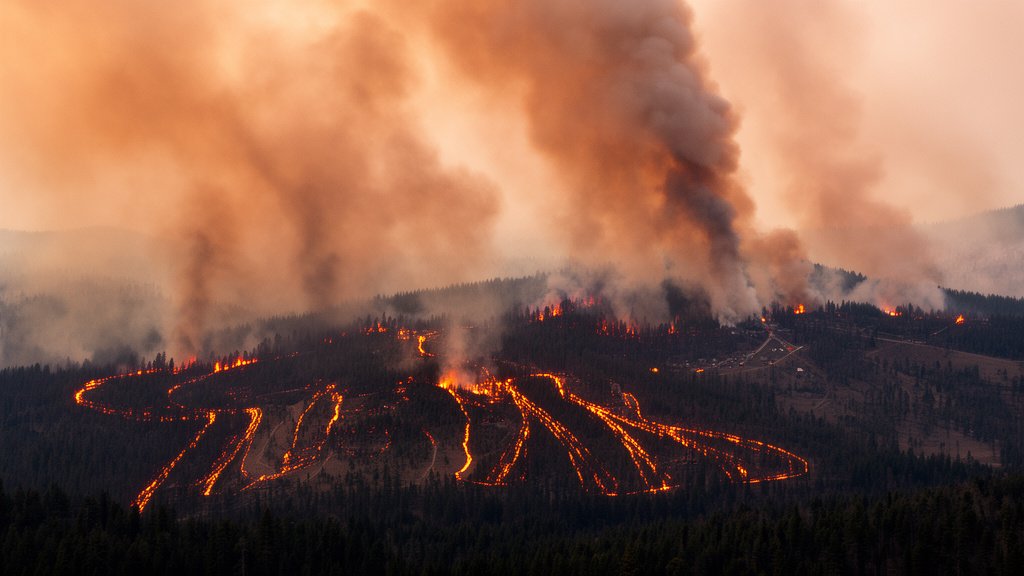
British Columbia has officially declared a provincial state of emergency as the Bald Range wildfire, a fast-moving and volatile blaze, continues to devastate the Okanagan region. The fire, which has surged to approximately 9,500 hectares, has forced thousands of residents to flee their homes, causing widespread disruption across one of the province’s most critical economic and residential corridors. As emergency crews work around the clock, the provincial government has invoked extraordinary measures to expedite the allocation of resources and prioritize public safety in the face of what officials describe as an unprecedented threat.
Key Highlights
- The Bald Range wildfire has scorched 9,500 hectares, prompting an immediate declaration of a provincial state of emergency.
- Mass evacuation orders are currently in effect, displacing thousands of residents across the Okanagan region.
- Significant damage to electrical infrastructure has triggered widespread power outages, complicating both fire suppression efforts and residential safety.
- BC Wildfire Service personnel are operating at maximum capacity, with additional inter-agency support being deployed to contain the blaze.
The Bald Range Crisis: A Region on the Brink
The declaration of a provincial state of emergency marks a significant escalation in the government’s response to the Bald Range wildfire. This legislative tool provides authorities with the power to commandeer assets, enforce mandatory evacuations, and streamline communication between regional districts and federal support agencies. The fire, which began as a localized threat, rapidly evolved into a regional catastrophe due to a combination of dry vegetation, shifting wind patterns, and the complex topography of the Okanagan valley, which serves as a natural chimney for wildfire growth.
The Anatomy of a Rapidly Expanding Blaze
The sheer speed at which the Bald Range wildfire achieved its 9,500-hectare footprint has caught many off-guard. Experts from the BC Wildfire Service (BCWS) indicate that the fire behavior has been erratic, characterized by “spotting,” where embers travel significant distances ahead of the main fire front, igniting new patches of dry brush and forest. This phenomenon has made conventional containment lines difficult to establish. The blaze is currently moving through a mix of interface zones—areas where wild forest lands meet residential developments—creating a high-stakes scenario for both rural homeowners and urban planning authorities. Ground crews are utilizing heavy machinery to create firebreaks, but the intensity of the heat has limited air support visibility in the early stages of the operation.
Infrastructure and Grid Security Under Siege
A secondary, yet equally critical, challenge facing authorities is the impact on BC Hydro infrastructure. The fire’s path has directly intersected with main transmission lines serving the Okanagan region. These power outages are not merely an inconvenience; they have crippled communication networks, impeded the functionality of local water pumping stations, and plunged evacuation zones into darkness, creating hazardous conditions for residents attempting to leave. The restoration of power is currently a secondary priority to fire suppression, but utility crews are on standby, waiting for the fire to retreat from key corridors to begin emergency repairs. The vulnerability of the electrical grid in this region serves as a stark reminder of the need for improved “grid hardening” in the face of increasingly common wildfires.
The Human Toll: Evacuations and Displacement
For the thousands of residents forced to evacuate, the situation is one of profound uncertainty. Evacuation centers have been established in nearby municipalities that are currently deemed safe, but these facilities are rapidly approaching capacity. The logistics of the evacuation have been complicated by the fire’s proximity to major arterial roads. Emergency management officials are urging residents to follow pre-established evacuation routes, noting that unauthorized attempts to stay behind or take unapproved backroads are hindering the movement of emergency vehicles. The psychological impact on the community—many of whom are facing their second or third wildfire season in recent years—is becoming a central concern for local health authorities.
Future Resilience and Strategic Adaptation
While the current focus is purely on containment and life safety, the Bald Range fire will undoubtedly reignite the provincial debate regarding wildfire management and climate adaptation. Secondary to the immediate news, analysts are pointing toward three core areas for future policy:
1. Technological Integration: The adoption of predictive AI and real-time sensor networks is becoming essential for mapping fire progression in the Okanagan’s complex valley geography.
2. Economic Resilience: The forestry and tourism sectors, which are the lifeblood of the Okanagan, face long-term instability. Ensuring that these industries have the capital to recover after the smoke clears is a growing economic priority.
3. Climatological Feedback Loops: The region is experiencing hotter, drier springs, which extend the fire season. Future infrastructure projects will need to be designed with a “fire-first” engineering approach, ensuring that roads, power lines, and water supplies can withstand extreme heat and ember showers.
As the state of emergency remains in effect, the eyes of the nation remain fixed on British Columbia. The recovery phase is still weeks, if not months, away, and the immediate task for responders is preventing the Bald Range fire from merging with smaller, outlying blazes. For now, the priority remains clear: protecting the citizens of the Okanagan and preventing further loss of property in this rapidly developing disaster.
FAQ: People Also Ask
Q: What is the current size of the Bald Range wildfire?
A: The wildfire has currently consumed approximately 9,500 hectares of land. The situation remains fluid, and containment numbers fluctuate as fire behavior changes.
Q: Why was a provincial state of emergency declared?
A: The declaration allows the British Columbia government to mobilize extraordinary resources, bypass certain administrative hurdles, and ensure that evacuation and emergency support operations are prioritized and coordinated efficiently across the affected region.
Q: How are power outages impacting the emergency response?
A: Power outages in the Okanagan region have compromised critical infrastructure, including communication networks and municipal water systems, making it more difficult to coordinate evacuation routes and conduct fire suppression operations.
Q: What should residents do if they are in an evacuation zone?
A: Residents must follow the specific instructions issued by local authorities and the BC Wildfire Service immediately. Do not delay, follow designated evacuation routes, and stay tuned to local emergency radio broadcasts for real-time updates.