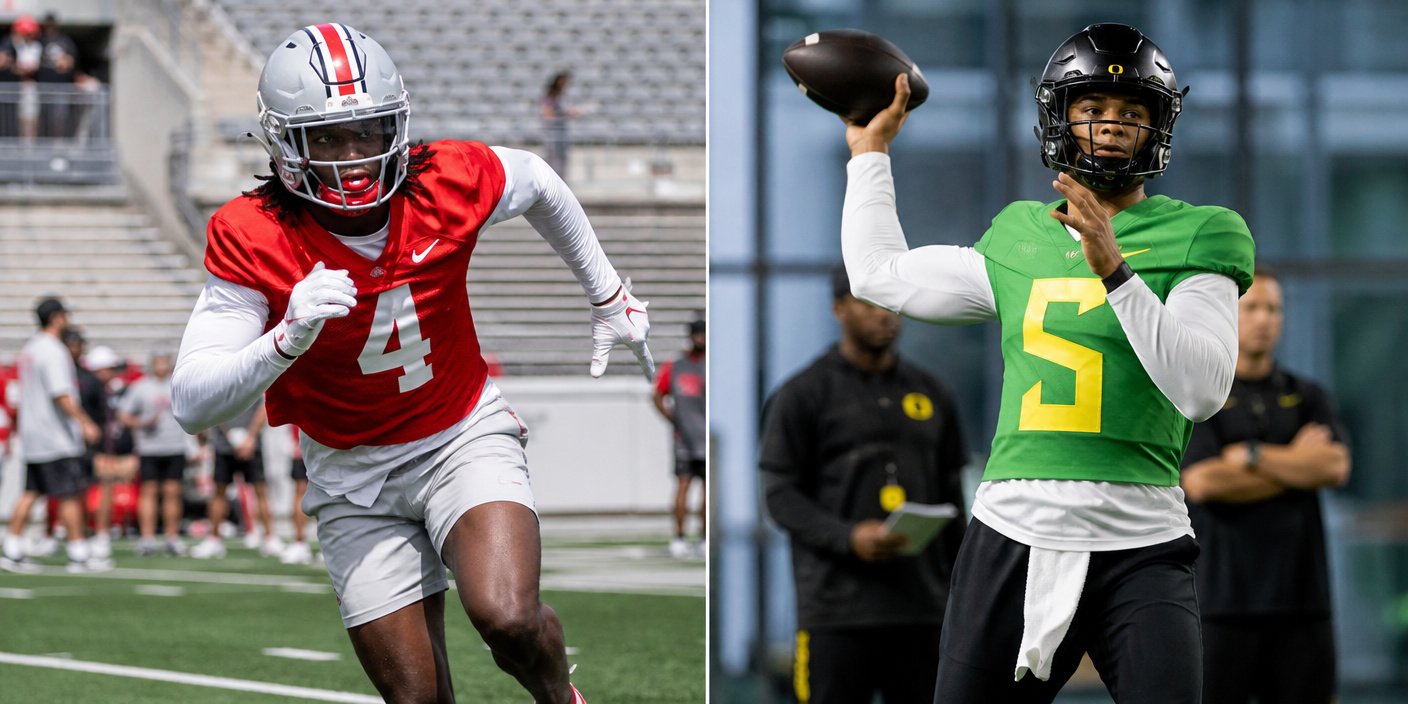
The landscape of college football has shifted, and at the heart of this transformation for two national powerhouses—the Ohio State Buckeyes and the Oregon Ducks—lies the strategic acquisition and utilization of elite-level talent. The emergence of true freshman wide receiver Jeremiah Smith at Ohio State and the strategic integration of transfer quarterback Dante Moore at Oregon have provided their respective programs with more than just athletic prowess; they have bolstered a culture of maturity and long-term planning that is essential for navigating the expanded College Football Playoff era. As the season progresses, both teams have positioned themselves as legitimate national championship contenders, leveraging these individual stars to redefine their offensive ceilings.
Key Highlights
- Jeremiah Smith’s Immediate Impact: The freshman wide receiver has defied the typical learning curve, becoming an instant focal point for Ohio State’s high-octane passing attack and shifting defensive coverage schemes across the Big Ten.
- Dante Moore’s Strategic Depth: By transferring to Oregon, Moore has reinforced one of the most critical positions in the sport, providing the Ducks with elite insurance and a long-term development pathway under coach Dan Lanning.
- Championship Aspirations: Both programs are utilizing these high-profile acquisitions to build depth, challenging the traditional reliance on veteran-only lineups in favor of a hybrid model that prioritizes raw talent and developmental patience.
The New Blueprint for Collegiate Glory
For programs like Ohio State and Oregon, the objective is never merely to participate in the postseason; it is to hoist the national championship trophy. In the current era of Name, Image, and Likeness (NIL) and the transfer portal, the margin for error has narrowed significantly. The narrative surrounding Jeremiah Smith and Dante Moore is not just about their individual accolades; it is about the broader strategy of coaching staffs who are successfully merging immediate impact with long-term roster sustainability.
The Phenomenon of Jeremiah Smith
Jeremiah Smith’s arrival at Ohio State was marked by intense anticipation, but few expected the immediate, record-breaking efficiency he brought to the receiver room. For head coach Ryan Day, Smith represents a tactical luxury: a player whose physical maturity and route-running ability allow for complex offensive schemes that were previously restricted by the developmental timelines of younger players. Smith is not simply a starter; he is a force multiplier. His presence dictates how defensive coordinators game-plan against the Buckeyes, often forcing safeties to shade toward his side of the field. This opens up the intermediate passing game and the rushing lanes, creating a cascading effect of success that characterizes a national championship-caliber offense.
Dante Moore and the Oregon Ecosystem
In Eugene, the situation with Dante Moore presents a different, yet equally vital, strategic advantage for head coach Dan Lanning. Moore, a former five-star recruit, serves as a cornerstone for Oregon’s quarterback room. His decision to embrace the competitive landscape at Oregon, learning behind established starters, speaks to a level of maturity that is increasingly rare in the current college football climate. This depth allows the Ducks to maintain their offensive continuity regardless of injury or situational fatigue. Furthermore, Moore’s presence ensures that Oregon’s quarterback succession plan is stable—a luxury that many top-tier programs are currently lacking.
Maturity Meets Ambition
The shared narrative between Smith and Moore is their collective decision-making. Both athletes have resisted the urge to seek immediate NFL Draft opportunities or instant starting roles in less competitive environments, choosing instead to hone their skills within high-pressure systems. This “championship-first” mentality is infectious. When leaders on a team prioritize collective success over individual statistical vanity, the entire culture shifts. This maturity is a prerequisite for winning in the College Football Playoff, where games are often decided by mental fortitude and the ability to execute under extreme scrutiny.
Coaching Philosophies in Action
The success of both programs is a reflection of the philosophies implemented by Ryan Day and Dan Lanning. Both coaches have mastered the art of blending veteran leadership with transformative youth talent. By creating environments where players like Smith can thrive immediately and players like Moore can develop aggressively, they have immunized their rosters against the volatility of the modern transfer portal. As the regular season bleeds into the high-stakes postseason, the ability of these specific players to perform under the lights will determine whether these championship aspirations translate into reality.
FAQ: People Also Ask
1. Why is Jeremiah Smith considered a “generational” talent for Ohio State?
Jeremiah Smith has demonstrated a rare combination of size, speed, and route-running maturity that is seldom seen in true freshmen. His ability to grasp complex offensive concepts and produce elite statistics early in his tenure has made him a central figure in Ohio State’s title push.
2. How does Dante Moore’s presence impact Oregon’s long-term strategy?
Moore provides Oregon with high-level depth and a clear developmental roadmap. His presence allows the coaching staff to cultivate a elite quarterback pipeline, ensuring that the team remains competitive even as the roster evolves.
3. Are there risks to building a team around younger players like Smith and Moore?
While youth brings high upside, the risk lies in experience. However, both programs have balanced this by surrounding these players with veteran leadership and robust support systems, mitigating the volatility often associated with less experienced collegiate rosters.
4. How does the current playoff format change how OSU and Oregon use their stars?
With an expanded playoff, the endurance of a roster is more critical than ever. Having deep, high-level talent ensures that starters stay fresh and that the team can withstand the attrition of a grueling, multi-week tournament schedule.