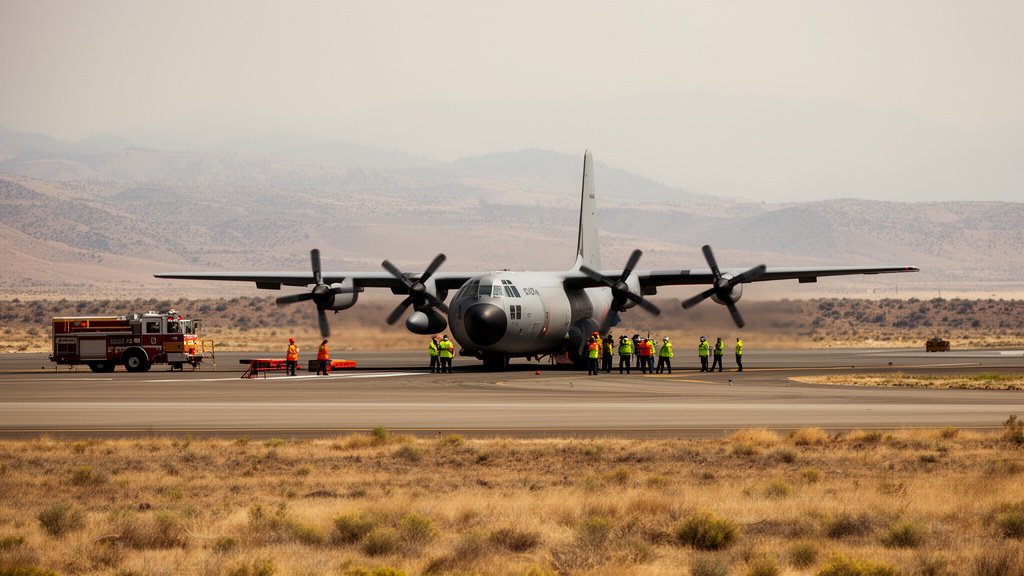
The Northwest Area, primarily covering Oregon and Washington, has officially escalated to National Preparedness Level 5 (PL5), the highest tier in the federal fire management system, signaling that the current fire season has exceeded the region’s organic capacity to suppress the blazes. This escalation triggers a massive, country-wide mobilization of resources and has prompted the arrival of specialized international firefighting personnel to bolster containment efforts. As the Klamath Falls Airtanker Base operates at peak capacity, the deployment of C-130 airtankers represents a critical reinforcement in a battle against increasingly erratic and volatile wildfire behavior.
Key Highlights
- PL5 Escalation: The Northwest Interagency Coordination Center (NWCC) has moved to Preparedness Level 5, indicating all available suppression resources are committed and new fire starts are critically straining local capabilities.
- Global Reinforcements: 15 highly specialized fireline management personnel from Australia and New Zealand have been deployed to the U.S. to assist with command and control, leveraging international experience with large-scale wildfire events.
- Air Support Surge: C-130 airtankers have been stationed at the Klamath Falls Airtanker Base, serving as heavy-duty assets to provide rapid retardant drops in high-risk zones.
- Operational Strain: The shift to PL5 implies a need for National Interagency Fire Center (NIFC) oversight, ensuring that the most critical fires receive priority allocation for national resource sharing.
The Strategic Mobilization of PL5: Understanding the Crisis
The declaration of Preparedness Level 5 is rarely taken lightly by the National Interagency Fire Center (NIFC). It serves as a stark metric of systemic exhaustion within the firefighting community. When the Northwest Area—a region traditionally resilient to fire volatility—reaches PL5, it signifies that the operational complexity, fuel moisture levels, and weather conditions have aligned to create a scenario where local resources are no longer sufficient to maintain an aggressive initial attack strategy.
At this level, the focus shifts from localized containment to a national priority system. Decisions on where to allocate heavy equipment, hand crews, and air support are no longer made by individual districts but are brokered through interagency coordination committees. This shift effectively places the Northwest’s wildfire response under a centralized federal lens, ensuring that when assets—like the C-130 airtankers—become available, they are directed to the most life-threatening and property-endangering blazes, rather than being tied to jurisdictional boundaries.
International Expertise: Why Australia and New Zealand?
The arrival of 15 fireline management personnel from Australia and New Zealand is a testament to the long-standing, reciprocal wildfire agreements between these nations and the United States. While the public often focuses on the physical labor of fire suppression, these specialists are brought in specifically for their expertise in management, logistics, and planning. These professionals, many of whom have managed catastrophic bushfire seasons in their home countries, provide a “force multiplier” effect.
They are embedded into existing incident command teams, offering fresh strategic perspectives on fire behavior modeling and resource management. By integrating these international experts into the command structure, U.S. agencies can optimize the deployment of limited personnel, preventing burnout and ensuring that fatigue management protocols are strictly followed—a critical factor when the fire season stretches into record-breaking durations.
The Klamath Falls Hub: The Role of Heavy Air Power
Klamath Falls, Oregon, has become a pivotal staging ground for the current response. The base acts as a critical node in the aerial firefighting network, specifically housing heavy-lift assets such as the C-130 Hercules airtankers. These aircraft are not merely support vehicles; they are surgical tools in the suppression effort. Capable of dropping thousands of gallons of fire retardant in a single pass, they are essential for creating “control lines” in rugged, inaccessible terrain where ground crews cannot safely operate.
For the pilots and support crews at the Klamath Falls Airtanker Base, the transition to PL5 means operating under intensified tempo. The logistics of reloading retardant, refueling, and performing pre-flight checks must be streamlined to ensure that aircraft spend the minimum amount of time on the ground. This heavy air support is the “break-glass-in-case-of-emergency” asset; its presence in Klamath Falls underscores the severity of the threat to Oregon’s wildland-urban interface.
Secondary Angles: Resilience, Economics, and the Future
1. The Evolution of the Wildfire Season
Historically, the fire season had distinct start and end points. The current, unprecedented length and intensity of the season suggest a shift in the region’s climate baseline. The escalation to PL5 early in the cycle suggests that agencies are effectively fighting against the calendar, forced to maintain high-level readiness for longer durations than current infrastructure was originally designed to handle.
2. Economic Impact of Resource Allocation
The cost of suppression at PL5 is exponential. Beyond the direct cost of fuel and aircraft maintenance, the economic displacement involves the shutdown of forestry and tourism industries across the Northwest. The “opportunity cost” is also significant: by tying up limited resources in one area, other regions are left vulnerable, creating a cascading effect where a fire in one state impacts the safety and insurance premiums of another.
3. The Reciprocal Agreement as a Future Necessity
The success of the current deployment of personnel from Australia and New Zealand highlights that cross-border cooperation is no longer an optional courtesy—it is a functional requirement. Future fire management strategy will likely involve formalized, year-round exchanges of personnel, treating the global “fire season” as a single, rotating operational threat that requires a permanent, internationally integrated workforce.
FAQ: People Also Ask
Q: What exactly does Preparedness Level 5 mean for the average resident?
A: PL5 is the highest level of fire preparedness. For residents, it means federal agencies have exhausted available local and regional resources. If a fire starts near you, you may experience delays in suppression response because all primary assets are already deployed to high-priority incidents elsewhere. It is a signal to maintain extreme vigilance.
Q: Why do we bring firefighters from Australia and New Zealand?
A: The U.S. has a reciprocal agreement with Australia and New Zealand. Their fire seasons typically occur during our winter months, allowing for a strategic exchange of highly trained management and command personnel who are available for deployment when our season peaks.
Q: How effective are C-130s in wildfire suppression?
A: C-130 Hercules airtankers are among the most effective tools for “holding” a fire. While they do not put out a fire on their own, they drop massive lines of fire retardant that cool the fire, slow its spread, and buy time for ground crews to establish containment lines, particularly in terrain that is otherwise impossible to access by foot or vehicle.