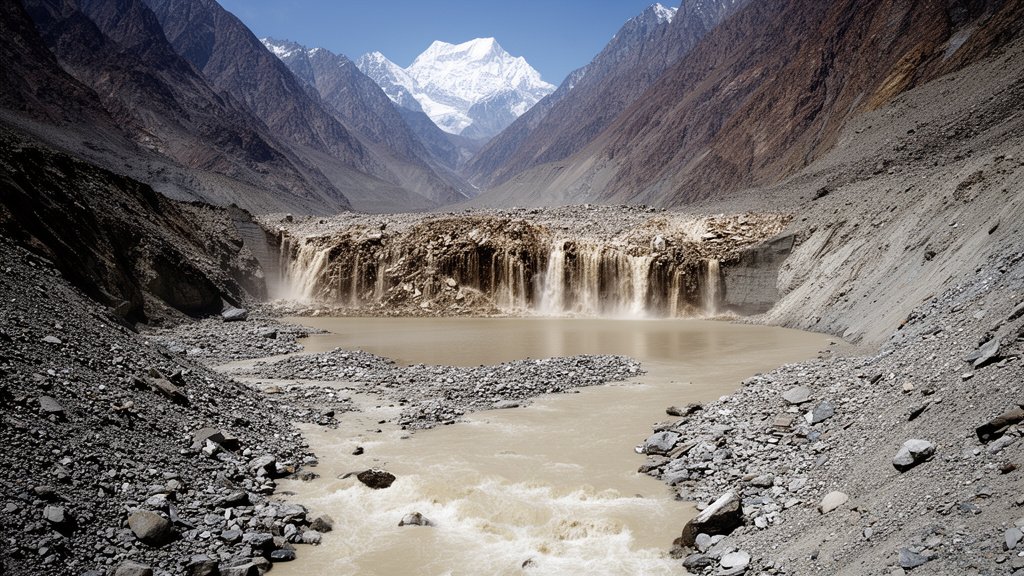
Rescue operations along the volatile Nepal-China border have been abruptly suspended as geological stability deteriorates following the overflow of a massive barrier lake. The formation, created earlier this week when flash floods deposited millions of tons of debris into a critical mountain river gorge, has begun to breach, creating an imminent risk of secondary flooding and downstream landslides. Official reports confirm that the death toll has surged past 500, with search and rescue teams forced to retreat to higher ground to avoid being swept away by potential surges.
Key Highlights
- Total Casualties: The confirmed death toll now exceeds 500 people, with hundreds more listed as missing in the remote Himalayan border region.
- Operational Standoff: Search and rescue teams from both Nepal and China have withdrawn from the primary impact zone due to the imminent collapse of a natural barrier lake.
- Geological Threat: The lake, formed by debris-choked floodwaters, is currently experiencing an overflow that threatens to release a high-velocity wave of water and sediment downstream.
- Diplomatic Coordination: Emergency management agencies from both nations are in constant communication to monitor seismic activity and potential breach patterns.
The Anatomy of a High-Altitude Disaster
The current crisis traces its origin to a catastrophic combination of extreme weather and fragile Himalayan topography. Earlier this week, a flash flood—potentially triggered by an intense localized rainfall event or a minor glacial lake outburst—tore through the upper reaches of the border corridor. As the torrent moved downstream, it picked up loose rock, ice, and soil, eventually forming a “natural dam” within a narrow gorge. This blockage stopped the flow of the river, causing a pool of water to back up rapidly, turning a routine riverbed into a high-risk reservoir.
Experts from the Nepal Disaster Risk Reduction and Management Authority (NDRRMA) have characterized this as a textbook, albeit terrifying, scenario of a landslide-dammed lake. Unlike man-made dams, which are engineered with spillways and reinforced concrete, these geological formations are highly unpredictable. As the water level rose, the pressure on the debris wall increased exponentially. The overflow observed today indicates that the dam is reaching its structural limit, threatening an uncontrolled release that could unleash a torrent of water onto lower-lying villages already devastated by the initial floods.
The Suspension of Rescue Efforts
The decision to halt operations was not taken lightly. On-ground commanders from the Ministry of Emergency Management in China and their Nepalese counterparts reached a consensus that the tactical environment had become “untenable.” The primary risk is not just the water, but the potential for a cascading effect. Should the barrier lake burst, the resulting surge—effectively a man-made tsunami in a canyon setting—would travel at such velocity that escape would be impossible for rescue workers stationed in the low-lying debris fields.
“We are shifting our strategy from active search and recovery to monitoring and downstream evacuation,” a regional emergency coordinator noted. The priority has shifted entirely toward ensuring that villages located in the potential path of the breach are cleared, a monumental task given the destroyed infrastructure and severed communication lines in the region.
Secondary Angles: Understanding the Wider Context
1. The Growing Threat of Climate-Induced GLOFs
While the specific cause of this flash flood remains under investigation, the disaster highlights the increasing frequency of Glacial Lake Outburst Floods (GLOFs) and debris flows in the Himalayas. As global temperatures rise, the rapid melting of glaciers creates unstable lakes high in the mountains. When these lakes burst, they create flash floods that pick up debris, leading to the exact type of barrier lake formation we are seeing now. This incident serves as a grim warning to regional governments that disaster management must evolve to include early warning systems specifically calibrated for mountain hydrology.
2. Geopolitical Cooperation in Extreme Scenarios
This disaster has necessitated unprecedented levels of cooperation between Nepal and China. Despite the geopolitical complexity of border management in the Himalayas, the scale of the 500-plus death toll has forced a unified front. Both nations are utilizing shared satellite imagery and joint meteorological data to track the barrier lake’s status. This level of cross-border operational integration could set a new precedent for disaster response in the Himalayan belt, moving beyond political borders to address shared ecological threats.
3. Long-term Infrastructure Resilience
The destruction of major mountain thoroughfares and the isolation of border communities present a massive economic challenge. Recovery will require not only the reconstruction of physical roads and bridges but also the implementation of geofencing and monitoring technology for river gorges. The cost of such infrastructure is immense, but as these weather events increase in frequency, the status quo of post-disaster reactive rebuilding is becoming financially and humanly unsustainable.
FAQ: People Also Ask
Q: Why was the barrier lake formed?
A: The lake was formed when a massive flash flood transported enormous quantities of sediment, boulders, and ice into a narrow gorge, creating a physical dam that blocked the natural river flow.
Q: What is the current danger level?
A: The danger is extremely high. The lake is currently overflowing, which indicates that the debris dam is likely eroding and could fail at any moment, potentially releasing a catastrophic surge of water and debris downstream.
Q: Will search and rescue efforts resume?
A: Rescue efforts are suspended indefinitely until geologists and emergency teams can confirm the integrity of the barrier or until the water level recedes to a safe threshold. Current operations are focused on evacuating at-risk downstream populations.