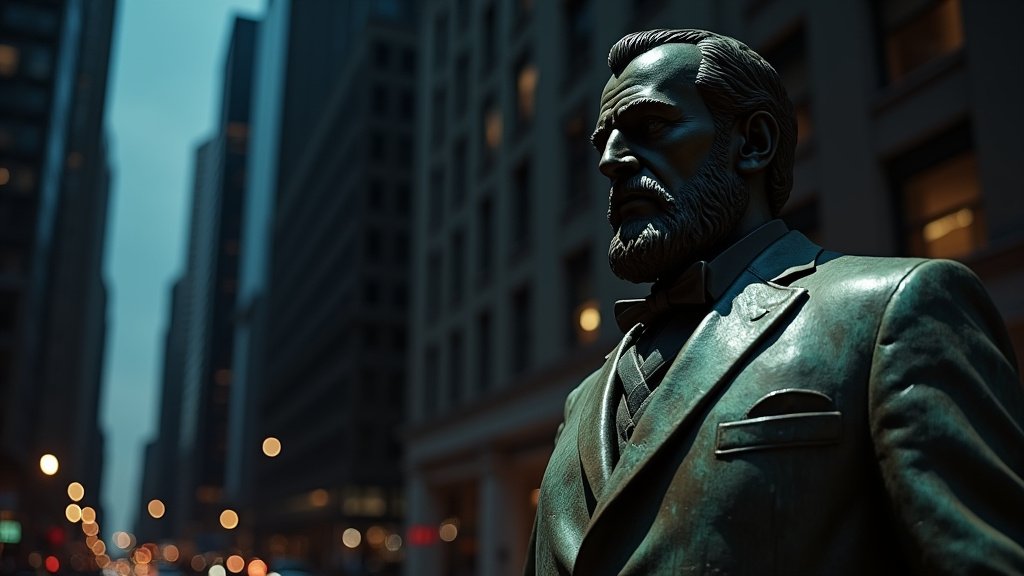
Elusive street artist Banksy has officially confirmed his hand in a provocative new installation that appeared overnight in the heart of London. The sculpture, which features a figure in a suit striding off a plinth with his face entirely obscured by a billowing flag, has captivated commuters and art critics alike in Waterloo Place. By posting a behind-the-scenes video of the installation process on his Instagram account, the Bristol-born artist silenced speculation that the work might be an imitator’s prank, solidifying its place in his storied portfolio of public interventions.
Key Highlights
- Artist Confirmation: Banksy posted a video confirming the work’s authenticity, showing the statue being transported and installed under the cover of night.
- Strategic Location: The sculpture stands in Waterloo Place, a historic site in central London, positioned near statues of King Edward VII and Florence Nightingale.
- Thematic Imagery: The artwork features a man in a suit blinded by a large flag as he steps off a plinth, a potent symbol interpreted by many as a critique of blind nationalism or political myopia.
- Guerrilla Art Tactics: Staying true to his subversive roots, the work was installed without prior permits, utilizing heavy machinery to place the monument on a public traffic island.
The Unsolicited Monument: Analyzing Banksy’s Latest Intervention
The appearance of the “Flag-Blinded” statue—as it has been colloquially dubbed—marks a return to Banksy’s long-standing interest in three-dimensional, satirical sculpture. While the artist is globally renowned for his stencil-based murals that adorn walls from London to Gaza, his occasional forays into statuary carry a specific gravity. In a city already densely populated with imperial monuments and historical commemorations, Banksy’s addition functions as both a physical obstruction and a psychological mirror.
The Anatomy of the Blindness
At the core of this piece is the figure’s posture. The man is captured in mid-stride, his forward momentum suggesting purpose, yet his eyes and head are engulfed by a thick, heavy flag. This choice of imagery is layered with political and social meaning. The flag, traditionally a symbol of identity, patriotism, and unity, here acts as a literal blindfold. In the context of 2026’s geopolitical climate, the sculpture invites observers to consider the dangers of uncritical nationalism. The man is literally walking off a ledge, unaware of the drop because his vision of reality is mediated—and obstructed—by the very object he might ostensibly be honoring or claiming to represent.
Location as Language
Waterloo Place is a historically significant site, home to the Crimean War Memorial and statues of various British luminaries. By placing his “unsolicited” work here, Banksy creates a jarring juxtaposition. The sleek, modern, and slightly cartoonish proportions of his sculpture clash with the classical bronze and marble figures surrounding it. This contrast serves to highlight the perceived disconnect between traditional historical narratives—often static and bronze—and the urgent, shifting realities of the modern day. The artist explicitly chose the location, reportedly noting that “there was a bit of a gap” on the traffic island, a typical dry, understated Banksy commentary on the nature of public space.
The Logistics of Subversion
Banksy’s confirmation video offers a rare glimpse into the logistical nightmare of installing a large-scale sculpture in one of London’s most secure districts. The process involves high-level coordination, heavy machinery, and extreme secrecy. This “guerilla” approach is central to the artist’s brand. It transforms the city into an open-air museum where the audience is not a ticket-buying public, but the unwitting commuter. This act of reclaiming the urban landscape from the bureaucratic oversight of city planning is as much a part of the artwork as the sculpture itself.
Beyond the Stencil: Banksy’s Evolution in Sculpture
While this new work has drawn significant media attention, it is not Banksy’s first foray into the world of statuary. The artist’s history with sculptural installations dates back to at least 2004, with the infamous “The Drinker.” In that instance, Banksy created a satirical riff on Rodin’s “The Thinker,” placing it on Shaftesbury Avenue. That work, much like the current flag-blinded figure, used irony to disrupt the serious, elevated nature of public art. However, there is an evolution in his craft. The current work feels more polished, more deliberate, and perhaps more cynical than his early 2000s interventions.
Secondary Angles of Impact
1. The Question of Permanence vs. Ephemerality: How does the city respond to unauthorized monuments? Does the sculpture’s potential removal become part of the art, or will the city maintain it as an accidental tourist attraction?
2. The Global Rise of Nationalism: The visual metaphor of being “blinded by the flag” speaks to broader international trends. The statue serves as a universal symbol, not just a critique of British politics, but a reflection on how nationalist fervor can obscure objective truth.
3. Art as Public Debate: The video included a clip of a passerby critiquing the work, saying, “I don’t like it.” By including public dissent within his own framing of the work, Banksy acknowledges the subjective and often polarizing nature of his impact on public spaces.
FAQ: People Also Ask
Is the statue officially sanctioned by the city?
No. As is typical with Banksy’s work, this is an unsolicited installation. The artist confirmed his involvement via his personal social media accounts, making it a guerrilla art piece rather than a council-commissioned monument.
Where can I find the statue in London?
It is situated on a traffic island in Waterloo Place, in the St James’s area of Westminster, near the Crimean War Memorial and statues of King Edward VII and Florence Nightingale.
Why is the man blinded by a flag?
While Banksy rarely provides explicit explanations for his works, the visual is widely interpreted as a metaphor for the dangers of blind, unquestioning patriotism and political myopia. The flag, usually a symbol of pride, is ironically used as a tool of obstruction.
Has Banksy created statues before?
Yes, though he is primarily known for graffiti and stenciling. Notable past sculptural works include “The Drinker,” a subversive take on Rodin’s “The Thinker,” which appeared in 2004.