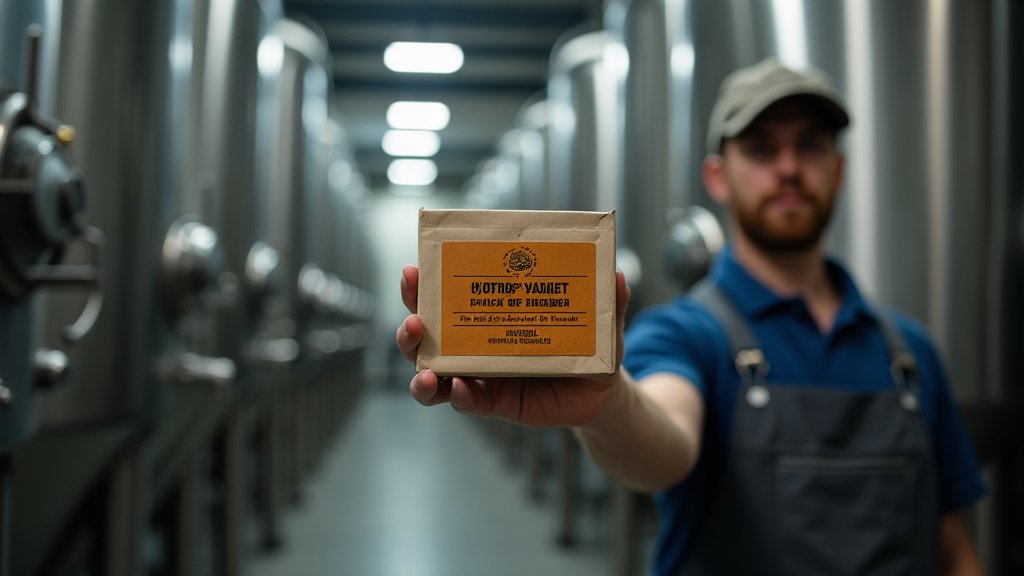
In a move poised to reshape the economics of the craft beer industry, Portland-based Imperial Yeast has officially launched its “Liquid Brick,” a breakthrough product designed to synthesize the high-quality performance profile of liquid yeast with the logistical and financial accessibility typically reserved for dry yeast. For years, professional brewers have faced a binary choice: pay a premium for the nuanced performance of liquid yeast or compromise on specific strain characteristics to utilize the shelf-stable, cheaper dry alternatives. Imperial Yeast’s latest innovation aims to eliminate this trade-off, offering a solution that addresses both operational overhead and fermentation reliability.
Key Highlights
- Hybrid Performance: Delivers the specific, high-quality fermentation characteristics of professional-grade liquid yeast without the traditional cold-chain infrastructure costs.
- Operational Efficiency: Engineered to be cost-competitive with dry yeast, allowing craft breweries to optimize their cost-of-goods-sold (COGS) without sacrificing quality.
- Logistical Superiority: The format allows for easier handling and storage, reducing the footprint and specialized refrigeration requirements that have long hindered medium-to-large-scale liquid yeast adoption.
- Industry Impact: Targeted directly at the current economic climate in craft brewing, where profit margins are tightening and breweries are seeking reliable, sustainable ways to maintain quality consistency.
The Fermentation Revolution: Liquid Brick Explained
The craft brewing industry has long been defined by the tension between quality and efficiency. Liquid yeast has historically been the gold standard for brewers seeking specific, complex flavor profiles—esters, phenols, and attenuation rates that define signature craft beers. However, the reliance on liquid cultures requires rigorous cold-chain management, higher shipping costs, and shorter shelf lives. Conversely, dry yeast offers stability and cost-effectiveness, but often with a limited strain selection that cannot always match the nuance of the vast Imperial Yeast catalog.
Imperial Yeast, operating out of the heart of Portland, Oregon—a global epicenter for craft brewing innovation—has spent years refining the science behind “Liquid Brick.” The product is not merely a rebranding exercise; it is a fundamental shift in yeast handling. By increasing the cell density and altering the packaging environment, Imperial Yeast has created a highly viable product that survives transport and storage better than traditional pouches or blocks, while maintaining the metabolic integrity of their lab-grown cultures.
Bridging the Gap: Performance Meets Price
For the modern craft brewery, every percentage point of margin matters. The inflationary pressures of raw materials—specifically malt and hops—have forced brewers to look for efficiencies in every corner of the brewhouse. Traditionally, yeast management systems or consistent bulk liquid purchases were significant line items.
“Liquid Brick” arrives at a critical juncture. By matching the price point of dry yeast, Imperial Yeast is effectively removing the financial barrier that prevents smaller and mid-sized breweries from choosing higher-end liquid cultures. This democratizes access to premium fermentation tools. Breweries that previously relied on dry “workhorse” yeasts for their flagship products can now transition to strain-specific, optimized cultures without inflating their production budgets. This shift is not just about cost; it is about scaling quality. As breweries look to distribute further or scale up production, consistency becomes paramount. The Liquid Brick format provides a scalable, reliable inoculation strategy that functions across disparate brewhouse sizes.
The Science of Survival
The technological leap behind the Liquid Brick centers on cellular stability. Standard liquid yeast is a living, fragile entity; if it warms up, it dies or produces off-flavors. The Liquid Brick utilizes a proprietary concentration and stabilization technique that keeps the yeast in a dormant, yet highly active, state.
Unlike traditional liquid pitches that essentially act as an “active” culture requiring immediate use, the Liquid Brick is engineered for endurance. This allows breweries to stock inventory without the looming “best-by” date anxiety that has plagued liquid-yeast purchasing for decades. This endurance is achieved without the dehydration process used in dry yeast manufacturing, which is known to stress cells and potentially alter their expression of complex flavor compounds. By skipping the dehydration step, Imperial Yeast maintains the genetic “memory” of the culture, ensuring that the beer brewed in a small pilot plant tastes exactly like the beer brewed in a full-scale production facility.
Market Impact and Sustainability
The introduction of this format also addresses a significant sustainability challenge: waste. Liquid yeast shipments often result in high overheads and risks of spoilage if shipping delays occur. By reducing the complexity of shipping (and the potential for temperature-related damage), Imperial Yeast is also reducing the carbon footprint associated with cold-chain logistics.
Furthermore, this move positions Imperial Yeast as a strategic partner rather than a mere supplier. By providing a product that integrates seamlessly into the workflows of breweries that have standardized on dry yeast, they are opening up a massive segment of the market that was previously locked out. As the craft industry matures, shifting toward operational efficiency, tools like the Liquid Brick will likely become the benchmark for brewery supply chains in the coming years.
FAQ: People Also Ask
Q: How does the Liquid Brick differ from traditional dry yeast?
A: Liquid Brick is not dehydrated. It maintains the original cellular structure and metabolic profile of professional liquid yeast, offering superior flavor complexity compared to dry yeast, which can sometimes be muted due to the stress of the drying process.
Q: Does Liquid Brick require specialized storage like standard liquid yeast?
A: While it is more robust than traditional liquid yeast pouches, it is designed to thrive under standard brewery refrigeration protocols. The key advantage is its enhanced stability during transport, significantly reducing the risk of viability loss compared to traditional liquid formats.
Q: Can any brewery use Liquid Brick, or is it for specific sizes?
A: The product is designed to be scalable. Whether you are a small taproom or a mid-sized regional production facility, the Liquid Brick format allows for consistent inoculation rates, making it highly versatile for various batch sizes.
Q: When will this be available for order?
A: Imperial Yeast has initiated the rollout to its professional distribution network. Interested breweries are encouraged to contact their regional sales representatives to integrate Liquid Brick into their next production schedule.