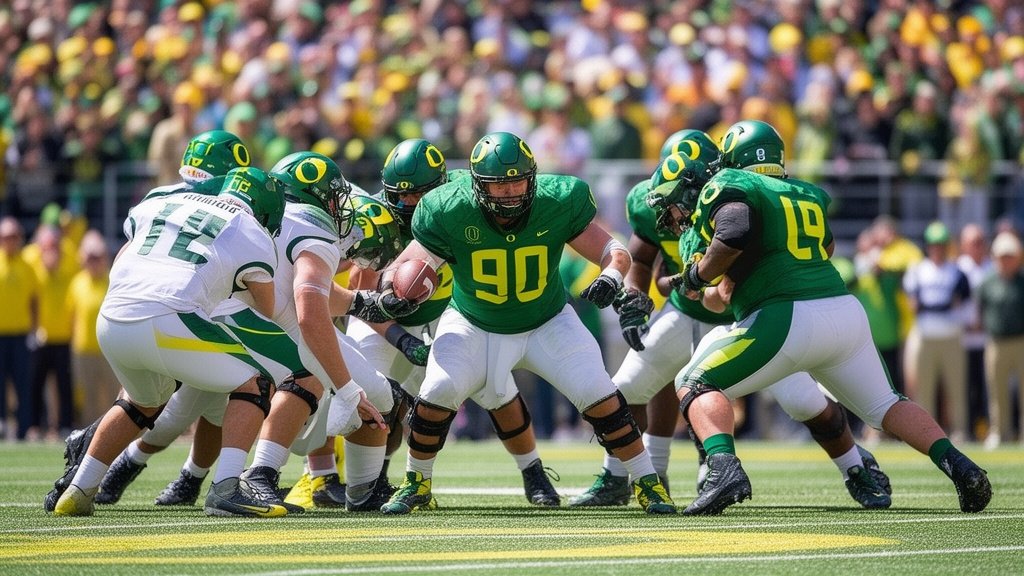
The latest College Football Playoff (CFP) rankings have injected new life into the postseason conversation, as the Oregon Ducks surged three spots to claim the No. 13 position. This move comes directly on the heels of a commanding 31-7 victory over the Michigan Wolverines, a performance that caught the eye of the selection committee and solidified Oregon’s standing as a legitimate contender. As the college football season enters its critical final stretch, the Ducks find themselves in a precarious but promising position—sitting just outside the projected 12-team bracket and needing a flawless finish to guarantee their spot in the dance.
Analyzing the Michigan Victory: A Defensive Masterclass
The 31-7 result against the Michigan Wolverines was more than just a win; it was a statement. For the Oregon Ducks, the game served as a microcosm of their season’s growth. The defensive unit, often scrutinized in the earlier weeks of the season, limited Michigan to a single touchdown, forcing critical turnovers and controlling the line of scrimmage for four quarters. This efficiency is exactly what the CFP Selection Committee looks for when weighing the merits of teams hovering on the bubble. The ability to dominate an opponent of Michigan’s caliber demonstrates a level of consistency and preparation that metrics—like strength of schedule and game control—value highly.
By executing a disciplined game plan, Oregon ensured their statistical resume was bolstered by the win. This specific game provided the necessary data points to convince the committee that the Ducks are not merely a high-ranking team by reputation, but by merit. The 24-point margin of victory is significant; it suggests that Oregon is capable of not just winning, but dismantling teams that have historically posed challenges in the Big Ten landscape.
The 12-Team Calculus: Why No. 13 Is a Precarious Position
Being ranked No. 13 is a psychological and mathematical tightrope. Under the expanded 12-team format, the top four conference champions receive first-round byes, while seeds 5 through 12 battle it out in the first round. Falling into the 13th spot means the Ducks are currently the first team out of the hypothetical field. This position, often referred to as the “bubble,” is where the pressure mounts.
For Oregon, the path forward requires a focus on the factors within their control. The CFP Selection Committee evaluates teams based on a composite of winning percentage, strength of schedule, head-to-head results, and comparison of results against common opponents. At No. 13, Oregon is reliant on chaos above them. To break into the top 12, they need either a favorable loss from a team currently ranked 8th through 12th or to continue winning with the same visual dominance they displayed against Michigan. Every remaining game acts as a playoff game, and the committee will be watching to see if the Ducks can maintain this momentum without slipping against perceived inferior opponents.
The Evolution of the 12-Team Postseason
This year’s playoff structure has fundamentally changed the landscape of college football, and Oregon’s rise to No. 13 is a perfect case study. In the previous four-team format, a team ranked 13th would have been effectively eliminated from contention by mid-November. Today, the expanded bracket offers a lifeline. It incentivizes teams to play harder, even if they have one or two early-season blemishes.
This shift has also increased the economic and cultural impact of late-season games. Programs, universities, and local economies are seeing the benefits of playing “high-stakes” football into late November and December. For the players, the intensity of this environment is unlike anything previously experienced in the sport, as the margin for error is razor-thin. The selection committee’s task has become increasingly complex, as they must now parse through more teams with similar records, placing a higher premium on late-season performance than in the past.
Psychological Pressure on the Squad
Navigating the “Selection Tuesday” cycle is a distinct challenge for student-athletes. Every week, the rankings change, and with those changes come the national headlines, the social media scrutiny, and the weight of expectation. Coaching staffs across the country are tasked with insulating their players from this external noise. For a team like Oregon, which has climbed three spots in a single week, the danger is complacency or the pressure to perform perfectly.
Research into athletic performance at the collegiate level often suggests that teams that “control the controllables”—focusing on the next practice, the next snap, and the next opponent—fare better than those caught in the rankings chase. The leadership within the Oregon locker room will be tested in the coming weeks. Their ability to treat the remaining schedule with the same ferocity they brought to the Michigan game will likely determine if they climb into that coveted 12-team bracket.
The Road Ahead: Finishing Strong
As the regular season winds down, Oregon’s schedule provides both opportunity and risk. To secure a playoff spot, the Ducks must navigate their remaining opponents without a lapse in concentration. The Selection Committee is not just looking at the “what,” but the “how.” Are they passing the “eye test”? Are they winning close games, or losing them? Are they blowing out teams they should be blowing out?
If Oregon continues to play with the intensity seen in their recent victory, the probability of them leaping into the top 12 is high. However, if they stumble, the committee’s justification for keeping them at No. 13—or dropping them further—becomes much easier. The college football world is watching, and for the Ducks, the message is clear: win, and the bracket will follow.
FAQ: People Also Ask
1. What does it mean for Oregon to be No. 13 in the CFP rankings?
It means that according to the current selection committee assessment, Oregon is the first team excluded from the projected 12-team playoff field. They are currently the “first team out” and need to win their remaining games or see higher-ranked teams lose to move into the bracket.
2. How did the win over Michigan affect Oregon’s ranking?
The 31-7 victory over Michigan was a primary driver in their three-spot jump. The committee values dominant wins against quality conference opponents, and the decisive nature of this victory provided concrete evidence of Oregon’s improvement, convincing voters to move them up.
3. Is there still a path to the 12-team playoff for Oregon?
Yes. Oregon still controls their own destiny to a degree. If they continue to win and finish their season strongly, they significantly improve their odds of breaking into the top 12. Their fate will also be influenced by the outcomes of games involving teams ranked directly above them.
4. What criteria does the CFP Selection Committee use?
The committee considers several factors, including winning percentage, strength of schedule, head-to-head results, and performance against common opponents. They also evaluate player availability and, more broadly, game control throughout the season.