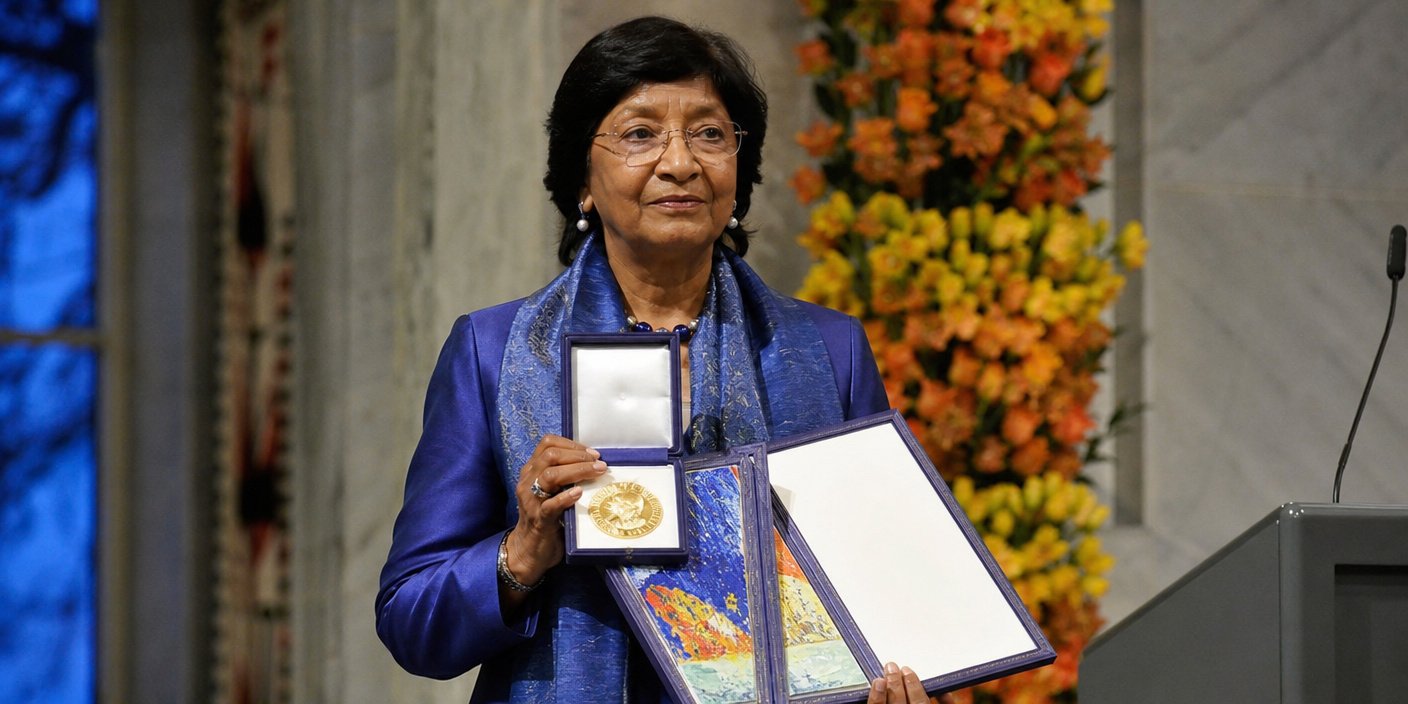
The Norwegian Nobel Committee has officially announced Navi Pillay as the recipient of the 2026 Nobel Peace Prize. The South African-born jurist, recognized for her unwavering dedication to human rights, international criminal law, and the pursuit of accountability for war crimes, joins a distinguished list of laureates whose work has fundamentally shifted the global discourse on humanitarian justice. Pillay’s selection comes at a time of heightened geopolitical instability, with the committee citing her ability to bridge the gap between abstract legal frameworks and the lived realities of victims in conflict zones. From the courtrooms of her native South Africa during the twilight of Apartheid to the corridors of the United Nations in Geneva, Pillay’s career has been defined by a singular focus: that no individual, regardless of rank or station, is above the law.
Key Highlights
- Prestige and Recognition: Navi Pillay is the 2026 Nobel Peace Prize laureate for her lifelong commitment to international human rights and judicial accountability.
- UN Leadership: Served as the UN High Commissioner for Human Rights (2008–2014), where she was pivotal in bringing global attention to discrimination, war crimes, and economic justice.
- Judicial Pioneer: The first non-white woman to be appointed to the High Court of South Africa, laying the groundwork for her later work with the International Criminal Tribunal for Rwanda (ICTR) and the International Criminal Court (ICC).
- Legacy of Impact: The Nobel Committee specifically highlighted her role in establishing legal precedents that protect vulnerable populations during times of state-sponsored violence.
A Lifetime of Justice: The Architecture of an Advocate
To understand the significance of Navi Pillay’s Nobel Peace Prize, one must look back at the trajectory of a career that spanned the most tumultuous decades of the 20th and 21st centuries. Born in Durban, South Africa, in 1941, Pillay’s early exposure to the institutionalized racism of the Apartheid regime was not merely a personal struggle; it was the crucible in which her legal philosophy was forged. She became a lawyer at a time when the legal profession was dominated by white men, and her early practice was dedicated to defending activists, labor leaders, and those caught in the web of the Apartheid security apparatus.
Breaking Barriers in the South African Judiciary
Pillay’s rise was marked by historical firsts. In 1995, following the end of Apartheid, she was appointed by President Nelson Mandela to the High Court of South Africa, becoming the first woman of color to hold such a position. Her tenure on the bench was characterized by a meticulous adherence to constitutional values—values that she would later export to the international stage. Her work at the High Court set a precedent for how judiciary systems in post-conflict societies could reconcile the atrocities of the past while building a foundation for democratic governance. This unique ability to marry the rule of law with a profound sense of social justice became the hallmark of her professional identity.
The UN High Commissioner: Speaking Truth to Power
Perhaps her most visible contribution to the global stage was her tenure as the United Nations High Commissioner for Human Rights from 2008 to 2014. It is rare for a jurist to transition so seamlessly into a diplomatic role, but Pillay utilized the High Commissioner’s office to shift the nature of international discourse. Under her leadership, the Office of the High Commissioner for Human Rights (OHCHR) became more assertive, often positioning itself as an independent arbiter that held powerful member states accountable for their internal conduct.
During her tenure, she did not shy away from controversy. She was vocal about the need for international intervention in conflicts, including those in Syria and Sri Lanka, and she consistently advocated for the rights of marginalized groups, including the LGBTQ+ community, women, and ethnic minorities. Her methodology was consistently rooted in international human rights law, ensuring that her critiques were based on documented evidence rather than political rhetoric. This grounded, evidentiary approach is precisely why the Nobel Committee chose to honor her; in an era of misinformation, Pillay’s reliance on objective, verifiable legal standards offered a beacon of stability.
International Criminal Tribunals and the Fight Against Impunity
Before and after her time at the UN, Pillay was deeply entrenched in the development of international criminal justice. Her service at the International Criminal Tribunal for Rwanda (ICTR), where she eventually served as President, was critical in addressing the gendered nature of war crimes. She pushed for legal interpretations that recognized rape as an act of genocide—a pivotal moment in international jurisprudence. This work laid the foundation for the operations of the International Criminal Court (ICC) in The Hague. Her legacy is not just in the verdicts delivered, but in the evolution of legal language that today allows the global community to prosecute crimes that were previously shielded by the concept of state sovereignty.
The 2026 Vision: Why This Prize Matters Now
As the world navigates the complexities of 2026—marked by rapid technological changes, environmental migration, and resurgent nationalism—the Nobel Committee’s choice of Pillay serves as a deliberate signal. The global order is increasingly under strain, with multilateral institutions facing skepticism. By awarding the prize to a figure who represents the efficacy of the international rule-based order, the Committee is reinforcing the necessity of independent, apolitical legal institutions. Pillay’s Nobel win is a reminder that the path to peace is paved with accountability. Without the mechanisms to hold actors responsible for systemic abuses, true peace remains unattainable. Her win validates the importance of judicial independence in protecting the fabric of civil society.
FAQ: People Also Ask
Q: What was Navi Pillay’s most significant contribution during her time as UN High Commissioner?
A: Her most significant contribution was perhaps her commitment to making human rights issues a central pillar of all UN activities. She firmly established that human rights are not secondary to security or development, but foundational to both. Her advocacy for marginalized communities, often against the wishes of powerful nation-states, set a high bar for her successors.
Q: How does Pillay’s background in South Africa influence her work?
A: Her upbringing under Apartheid instilled in her a profound understanding of how legal systems can be weaponized against vulnerable populations. This perspective allowed her to see through the ‘legality’ of oppressive regimes, driving her to ensure that international law operates as a tool for liberation and protection rather than just administration.
Q: Why was the 2026 Nobel Committee choice considered ‘timely’?
A: In 2026, the international community is grappling with the erosion of trust in global institutions. By honoring a figure who spent her career strengthening these very institutions through judicial rigor and moral clarity, the Committee is emphasizing the continued relevance of international law in maintaining world order.
Q: What is the primary legacy of Navi Pillay in international law?
A: Her primary legacy is the expansion of the definition of war crimes to include gender-based violence, as seen in her work with the ICTR. She fundamentally changed the international understanding of how justice can be delivered to survivors of conflict, moving the needle from mere observation to active prosecution.