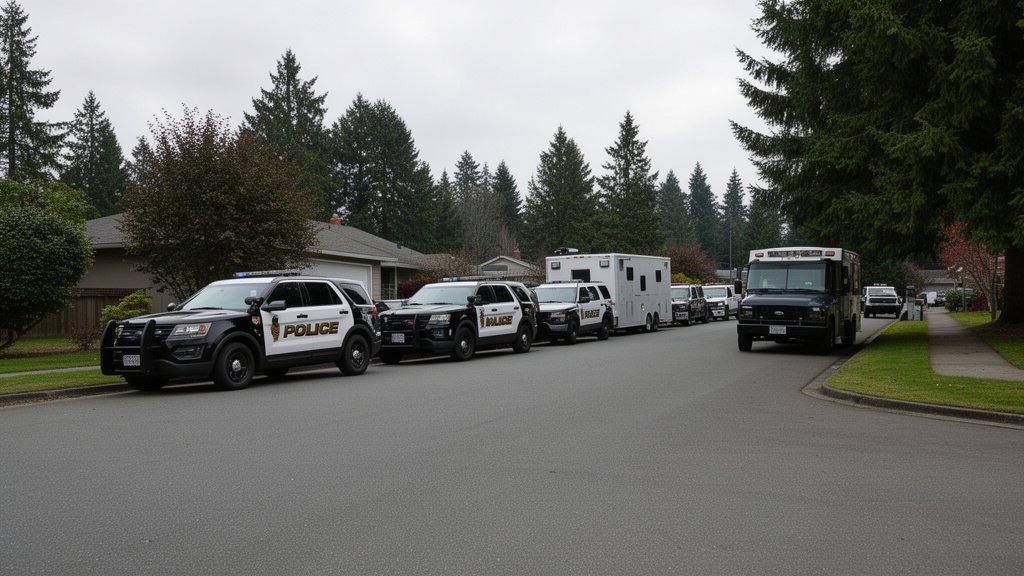
In a rapid and somber conclusion to a terrifying search, authorities confirmed on Sunday, August 23, 2026, that 36-year-old Benjamin Charles Parker, the suspect accused of a quintuple homicide near Forest Grove, Oregon, was discovered dead in Enumclaw, Washington. The discovery, which officials have preliminarily ruled as an apparent suicide, occurred just one day after the grim scene outside Portland was first uncovered, effectively bringing the active multi-state manhunt for the suspect to a sudden halt.
Key Highlights
- Suspect Identified: Benjamin Charles Parker, 36, was named as the sole suspect in the killings of five individuals.
- Discovery Timeline: The victims were found outside Forest Grove, Oregon, on Saturday, August 22, 2026; Parker was found dead in Enumclaw, Washington, on August 23, 2026.
- Cause of Death: Preliminary investigations by Washington law enforcement indicate an apparent suicide, closing the immediate search.
- Jurisdictional Cooperation: The investigation involved extensive coordination between the Forest Grove Police Department, the Washington State Patrol, and regional authorities.
The Procedural Closure of a Mass-Casualty Investigation
The discovery of Benjamin Charles Parker’s body in the quiet community of Enumclaw, Washington, represents a tragic conclusion to one of the most intense manhunts in the Pacific Northwest in recent years. For law enforcement agencies, the death of a suspect in a high-profile case—particularly one involving five victims—presents a complex array of procedural challenges. When a suspect takes their own life, the criminal justice system is denied the traditional mechanisms of accountability: a public trial, the scrutiny of evidence under cross-examination, and the opportunity for victims’ families to confront the accused in a court of law.
The Mechanics of a Multi-State Manhunt
The hours between the discovery of the bodies in Oregon and the locating of the suspect in Washington were marked by extreme coordination. The Oregon-Washington border, frequently traversed by commuters and logistics transport, represents a significant jurisdictional hurdle in criminal investigations. Forest Grove, situated just west of the Portland metropolitan area, is relatively isolated compared to the dense urban sprawl of the city, complicating initial forensic efforts.
When the incident was first reported, law enforcement agencies immediately activated inter-agency protocols. The dissemination of Parker’s physical description and vehicle data across the state lines was nearly instantaneous, utilizing the National Crime Information Center (NCIC) database. This speed is critical in cases of mass violence; as forensic psychologists often note, the ‘post-event window’—the period immediately following a violent act—is when a perpetrator is most likely to commit further acts of harm or end their own life. In this instance, the rapid response likely prevented additional danger to the public, though it came too late for the victims of the initial event.
The Weight of Forensic Silence
With the suspect deceased, investigators from the Washington State Patrol and supporting departments in Enumclaw must now shift their focus from an active search to the ‘post-mortem investigation.’ This involves piecing together the timeline of Parker’s movements from the scene in Forest Grove to the location in Washington. This data is vital, not just for closing the case files, but for providing the victims’ families and the community with the ‘why’ behind such an unthinkable act. Forensic autopsies and digital evidence analysis—tracking phone pings, financial transactions, and vehicle GPS data—will be the primary tools used to construct a narrative of the events that led to the deaths of the five victims.
Challenges of the ‘Empty’ Case File
There is a profound psychological toll taken on a community when the primary suspect cannot be tried. The public often seeks closure through the verdict of a jury. Without a trial, the findings of the police department must serve as the final record. This places an immense burden of accuracy on the forensic teams. Every piece of evidence must be bulletproof, as there will be no defense counsel to challenge the prosecution’s theories, and no judge to adjudicate facts.
Furthermore, the investigation must now pivot toward ensuring no other conspirators were involved. While law enforcement has stated they are confident in the identity of the suspect, the protocol for a quintuple homicide dictates a thorough scrubbing of all digital and social connections. This process ensures that the ‘closing’ of the case does not come at the cost of missing a wider network or enabling future threats. The goal is to transform the investigation from a search for a perpetrator into a comprehensive accounting of the crime, providing the finality that a community in shock desperately needs.
FAQ: People Also Ask
Was there any indication of a motive provided by authorities?
At this time, law enforcement agencies have not released a specific motive. Investigators are currently reviewing digital records and personal effects to understand what may have precipitated the incident.
What happens to the investigation now that the suspect is dead?
The criminal investigation into the homicide remains active, but it transitions from a manhunt to a forensic review. Authorities will continue to gather evidence to confirm the details of the crime and ensure no other individuals were involved or assisted the suspect.
How did the suspect get from Oregon to Washington so quickly?
Law enforcement is currently analyzing traffic cameras, license plate readers, and digital GPS data to establish the exact route and timeline of Parker’s movement between the two states. This timeline is a critical component of the ongoing forensic investigation.
What support is available for the families of the victims?
The Forest Grove community and regional victim advocacy groups have established counseling services and resource centers. Authorities encourage anyone affected by this tragedy to reach out to local mental health services for support.