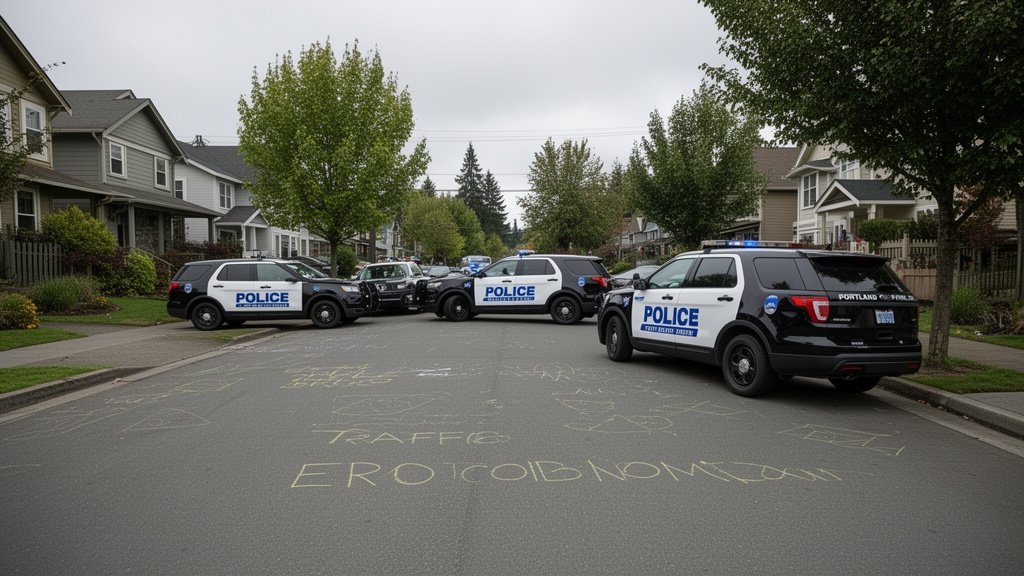
A pedestrian has died hours after being struck by a vehicle in Portland’s South Tabor neighborhood on August 8, marking another tragic incident in the ongoing struggle for traffic safety in the city. The Portland Police Bureau (PPB) has confirmed that 33-year-old Curtis L. Kent was taken into custody following the collision. While Kent initially fled the scene, he later returned, leading to his arrest and subsequent booking on multiple felony charges, including manslaughter. This incident has ignited conversations surrounding road safety, the prevalence of hit-and-run incidents, and the efficacy of Portland’s Vision Zero initiative.
Key Highlights
- Fatal Collision: A pedestrian died from injuries sustained after being struck by a vehicle in Portland’s South Tabor neighborhood on August 8.
- Suspect Arrested: The driver, 33-year-old Curtis L. Kent, fled the scene of the crash but returned shortly thereafter.
- Felony Charges: Kent is currently in custody, facing serious legal consequences, including a charge of manslaughter.
- Ongoing Investigation: The Portland Police Bureau is continuing to process evidence and witness accounts regarding the specific circumstances of the crash.
The Anatomy of a Tragedy: Legal and Procedural Consequences
The collision in South Tabor is not merely a localized traffic event but a significant criminal case that underscores the complexities of vehicular manslaughter investigations. When a driver strikes a pedestrian and leaves the scene, the legal landscape changes immediately. By fleeing, the driver transforms a potential accident into a deliberate criminal act of evasion. For Curtis L. Kent, the decision to leave the site of the collision—even if he returned later—has significant legal ramifications that will be scrutinized by the Multnomah County District Attorney’s Office.
The Impact of Flight
Under Oregon law, the act of fleeing the scene of a crash involving physical injury or death is a serious offense. It complicates the ability of investigators to determine if the driver was impaired at the exact time of the collision. When a driver returns to the scene, as Kent did, investigators must attempt to reconcile the timeline of the crash with the timeline of the suspect’s return. The manslaughter charge suggests that the prosecution believes the collision resulted from reckless or criminal behavior, rather than a mere accident.
The Role of the Portland Police Bureau
The Portland Police Bureau remains the primary entity responsible for the investigation. They utilize specialized collision reconstruction teams to analyze tire marks, vehicle damage, and environmental factors at the scene. In a dense residential area like South Tabor, witness accounts are also critical. The bureau’s Traffic Division often focuses on ‘crash data’ to identify patterns, though in individual cases like this one, the focus shifts to establishing a clear chain of custody and evidence to support the felony charges.
Portland’s Vision Zero and the Reality of Street Safety
Secondary to the legal proceedings is the broader issue of urban infrastructure. Portland’s ‘Vision Zero’ initiative—a strategy aimed at eliminating traffic fatalities and severe injuries—is often the subject of intense debate when incidents like this occur. South Tabor, with its mix of residential streets and arterial roads, is emblematic of many neighborhoods struggling to balance pedestrian safety with vehicle throughput.
Infrastructure vs. Human Error
Engineers often point to ‘Complete Streets’ designs as the solution, which include features like curb extensions, reduced lane widths, and high-visibility crosswalks. However, when incidents involve driver behavior—such as fleeing the scene—the limitation of infrastructure becomes apparent. While physical barriers can reduce speed, they cannot entirely prevent human decisions. This raises the question: is the solution technological, or does it require a stricter enforcement and educational approach regarding driver accountability?
The Psychological Component of ‘Hit-and-Run’
Sociologists and criminologists have long studied why drivers choose to flee. Often described as a ‘flight response’ triggered by extreme panic, the act of leaving the scene is frequently driven by fear of immediate legal consequences (like DUI or lack of insurance). Yet, this choice often guarantees more severe penalties in the long run. By fleeing, the driver shifts the narrative from a potential tragic accident to a deliberate criminal act of evasion, which can be a key factor in sentencing.
Community Impact and Policy Implications
The South Tabor neighborhood, like many others in Portland, relies on community advocacy to push for traffic calming measures. Neighborhood associations are likely to increase pressure on the city to conduct safety audits in the wake of this death. The tragic loss of a life serves as a grim catalyst for policy change, often leading to temporary stop-gap measures—such as increased patrols or temporary traffic delineators—before permanent infrastructure upgrades are considered by the Portland Bureau of Transportation (PBOT).
FAQ: People Also Ask
1. What are the potential penalties for manslaughter in Oregon?
In Oregon, manslaughter in the first degree is a Class A felony, punishable by significant prison time and heavy fines. The exact sentencing depends on a defendant’s prior criminal history and the specific findings of the court, including factors like intoxication or extreme recklessness.
2. How does the Portland Police Bureau investigate fatal pedestrian crashes?
The PPB utilizes its Major Crash Team, which consists of detectives and reconstruction specialists. They analyze evidence at the scene, including vehicle damage, debris fields, and roadway markings, to build a case that determines the cause of the collision.
3. What is Vision Zero in Portland?
Vision Zero is a city-wide initiative with the goal of ending all traffic deaths and serious injuries on Portland streets by 2025. It focuses on street design, education, and enforcement to make streets safer for pedestrians, cyclists, and drivers.
4. Why is leaving the scene of a crash considered a felony?
Leaving the scene of an accident involving injury or death—commonly called a hit-and-run—is a felony because it denies the victim immediate emergency assistance and creates significant barriers to law enforcement investigations, hindering justice and public safety.