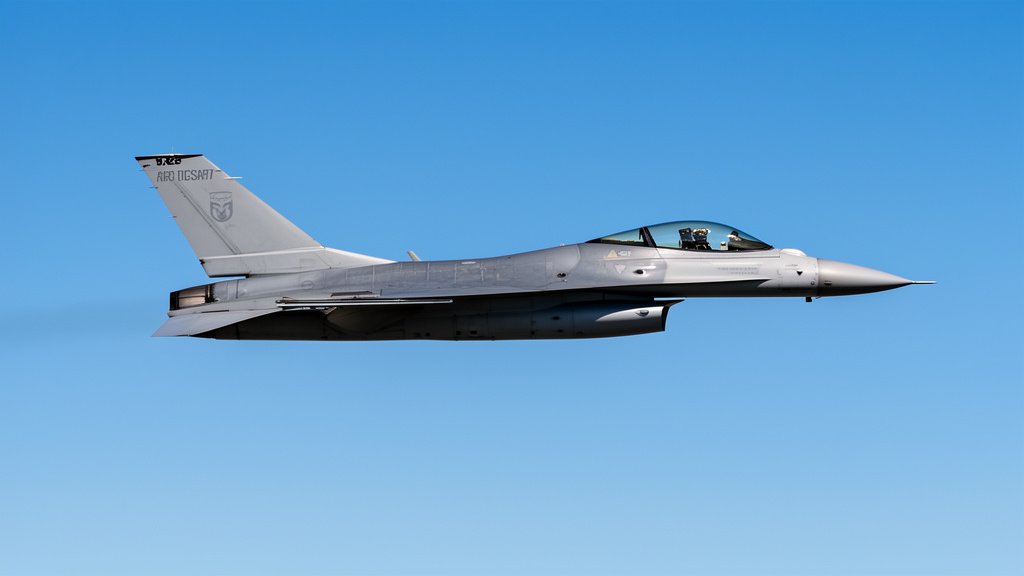
The U.S. military has officially entered the era of autonomous fighter aviation, executing the first successful flight of an F-16 fighter jet under the sole control of artificial intelligence. This milestone was achieved using the VENOM (Viper Experimentation and Next-gen Operations Model) Autonomy Kit, signaling a decisive shift in how the Air Force plans to integrate machine learning into its most complex aerial assets. By removing the pilot from the primary control loop, the mission at Eglin Air Force Base establishes a new baseline for high-speed, high-G autonomous flight, setting the stage for future collaborative combat strategies that merge human tactical oversight with algorithmic execution.
Key Highlights
- Historic Milestone: The U.S. Air Force has completed the first flight of an F-16 fighter jet fully piloted by an artificial intelligence software suite.
- The Technology: The flights utilize the VENOM Autonomy Kit, specifically designed to accelerate the testing of autonomous capabilities on the “Viper” platform.
- Strategic Goal: This development is a core component of the Air Force’s broader Collaborative Combat Aircraft (CCA) program, aiming to create loyal wingman drones.
- Testing Hub: The program is being spearheaded at Eglin Air Force Base, leveraging the expertise of the Air Force Test Pilot School (TPS).
The VENOM Initiative: Redefining Aerial Superiority
The successful integration of the VENOM Autonomy Kit into an F-16 fighter jet represents more than just a technological curiosity; it is a fundamental transformation of military doctrine. For decades, the F-16—famously known as the “Viper”—has been the workhorse of the U.S. Air Force. Now, it has become the primary laboratory for the most aggressive autonomy testing in history. The VENOM initiative was launched specifically to overcome the bottleneck of testing AI software on simulation platforms alone. By transitioning these algorithms from the lab to the cockpit, the military is compressing the development cycle from years to months.
Bridging the Gap Between Simulation and Reality
Historically, the greatest challenge in developing AI for fighter jets has been the “sim-to-real” gap. Algorithms trained in highly controlled digital environments often behave unpredictably when faced with the chaotic variables of atmospheric flight, sensor noise, and real-world latency. The VENOM Autonomy Kit acts as a sophisticated translator, mapping the AI’s decision-making outputs directly to the F-16’s flight control systems. During the recent flights, the AI maintained total control over the aircraft’s flight path, speed, and maneuverability, demonstrating that modern machine learning models can navigate the rigorous demands of fighter aviation without human intervention at the stick. This verification process is critical; before any autonomous system can be trusted with weapon employment, it must first prove it can maintain stable flight through turbulence and high-performance maneuvers.
The Future of Collaborative Combat Aircraft (CCA)
The ultimate objective of the VENOM program is to refine the “brains” of the Collaborative Combat Aircraft program. The Air Force envisions a future fleet where human-piloted jets, such as the F-35 or F-22, operate alongside fleets of autonomous drones. These drones will act as “loyal wingmen,” capable of performing high-risk missions, sensor reconnaissance, and target suppression. The success of the autonomous F-16 flights proves that the control algorithms required to manage such complex formations are rapidly maturing. By standardizing the VENOM kit, engineers can iterate on the software architecture, effectively creating a “plug-and-play” autonomy package that can be deployed across various aircraft models in the near future.
Navigating the Ethics of Autonomous Warfare
With the shift toward autonomous flight, the discourse surrounding ethical AI in the military has reached a fever pitch. The VENOM program is currently focused on flight stability and tactical navigation, but the conversation invariably turns to the role of lethality. Military leadership has emphasized a “human-in-the-loop” policy, ensuring that while the aircraft may fly itself, the decision to engage a target remains a human prerogative. The engineering challenge is to design robust “guardrails” within the AI code—strict operational parameters that prevent the aircraft from acting outside of pre-defined mission rules or safety thresholds. This integration of technical safety limits is arguably as important as the flight control algorithms themselves.
Industrial and Strategic Implications
The shift toward autonomous fighters will ripple through the defense industrial base. Companies specializing in AI software, advanced avionics, and high-speed data processing are seeing an influx of investment and interest as the Air Force moves away from the multi-decade development timelines of traditional hardware-centric aircraft. By leveraging the F-16 platform—which has a proven, reliable airframe—the military is able to test next-generation “software-defined” combat capabilities without the immense costs associated with building entirely new airframes from scratch. This approach not only saves billions in development dollars but also accelerates the deployment of cutting-edge technology to the front lines, ensuring the U.S. maintains a qualitative edge over peer-level adversaries who are pursuing similar autonomous programs.
FAQ: People Also Ask
What is the VENOM Autonomy Kit?
VENOM stands for Viper Experimentation and Next-gen Operations Model. It is a specialized hardware and software kit installed into F-16 fighter jets to allow them to be flown autonomously, providing a platform for testing AI flight algorithms.
Is the AI pilot armed during these tests?
No. Currently, the VENOM flights are focused entirely on flight control, stability, and autonomous navigation. The program is an experimental testing phase, and these aircraft are not engaged in combat or weapon employment during these sorties.
Why use an F-16 for this testing?
The F-16 is a mature, highly capable, and agile airframe with a known flight envelope. Using the F-16 allows the Air Force to isolate the performance of the AI software without having to worry about the aerodynamic risks of testing new software on an experimental or unproven airframe.
Does this mean human pilots are obsolete?
Not at all. The Air Force views these autonomous systems as “force multipliers” rather than replacements. The goal is to enhance the capabilities of human-piloted aircraft by providing them with autonomous wingmen, effectively allowing one human pilot to control and command a larger, more powerful force.