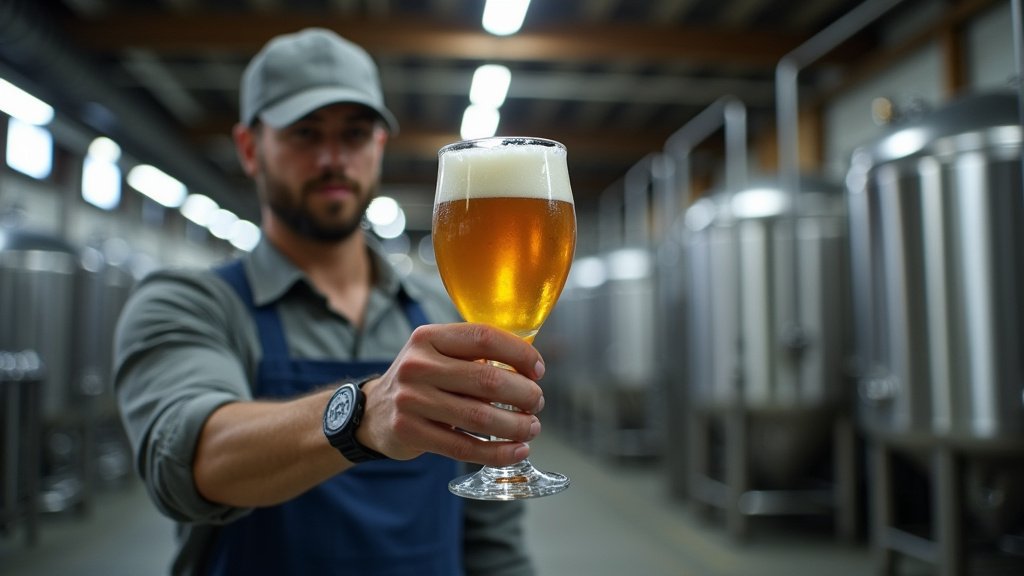
Sunriver Brewing has transformed from a regional destination to a national powerhouse, and at the center of this evolution is lead brewer Patrick Raasch. In a recent appearance on Episode 494 of the industry’s leading craft brewing podcast, Raasch provided a masterclass on the concept of a “throughline of refinement.” By meticulously iterating on flavor profiles while maintaining the technical stability required to scale, Raasch has helped cement Sunriver’s reputation as an award-winning staple of the Pacific Northwest craft scene, proving that consistent, bold flavor is not an accident but a product of rigorous, data-driven brewing science.
Key Highlights
- The Throughline Concept: Patrick Raasch defines the brewery’s success as a “throughline of refinement,” where every batch serves as an opportunity to iterate on quality, balance, and sensory profile without losing the brewery’s signature identity.
- Scaling Success: Sunriver Brewing’s transition from a regional brewpub favorite to a highly decorated, award-winning powerhouse is rooted in maintaining the same attention to detail in high-volume production as they do in small-batch experimentation.
- Data-Driven Flavor: The brewery utilizes precise fermentation monitoring and sensory analysis to ensure their boldly flavored beers—often characterized by high hop profiles or complex malt structures—remain consistent and approachable for the consumer.
- GABF Provenance: The brewery’s commitment to technical excellence has been validated by consistent success at the Great American Beer Festival (GABF), where they have secured multiple medals, signaling their status among the top tier of American independent breweries.
The Architecture of Flavor: Sunriver’s Brewing Philosophy
In the competitive landscape of American craft beer, the distinction between a local standout and a national contender often boils down to consistency. Patrick Raasch’s appearance on Podcast Episode 494 illuminates the specific methodologies Sunriver Brewing employs to stay ahead of the curve. While many breweries succumb to the temptation of chasing fleeting trends, Sunriver has doubled down on a core philosophy: refining the fundamentals.
The Science of Refinement
For Raasch, refinement is not a passive activity; it is an aggressive, iterative process. In the episode, he details how the brewing team at Sunriver approaches their core lineup—specifically their IPAs and lagers. The “throughline” mentioned in the discussion refers to a deliberate consistency in the sensory experience, where the interplay between malt backbone and hop forwardness is constantly calibrated.
This is not merely an artistic endeavor. Raasch emphasizes the use of technical instrumentation, including precise control over fermentation temperatures and yeast health metrics, which are the silent drivers of clean, bold flavors. By analyzing every batch with microscopic scrutiny, the team identifies minor deviations that might go unnoticed in smaller operations but could compromise the brand’s integrity at scale.
From Regional Roots to National Acclaim
The narrative of Sunriver Brewing is inherently linked to its home in the Pacific Northwest—specifically the high-desert environment of Bend, Oregon. However, their impact has transcended geographic boundaries. The brewery’s rise to prominence is frequently measured by its performance at the Great American Beer Festival (GABF), where it has garnered a reputation for winning across various categories.
Raasch notes that winning hardware is a byproduct of their internal focus, not the primary objective. The brewery treats every competition entry as a diagnostic tool. By benchmarking their beers against the best in the country, they gain data points that inform their next round of production. This loop of brewing, competing, and refining is the engine behind their award-winning status.
The Economic Impact of Consistency
Secondary to the technical prowess is the economic model of consistency. For craft breweries, growth is often the most dangerous phase. Scaling production can lead to a dilution of brand equity if the final product changes drastically. Sunriver’s approach effectively mitigates this risk by standardizing their brewing processes to handle increased volume without sacrificing the “soul” of the beer.
Looking at the industry, we can predict that breweries that follow this model—prioritizing technical refinement over rapid, unplanned expansion—are the ones most likely to survive market saturation. As the craft beer industry matures, the consumer is increasingly sophisticated, demanding the same quality in a six-pack bought at a grocery store as they would find on tap at the brewery. Sunriver’s trajectory provides a blueprint for how to meet this demand.
Future-Proofing the Portfolio
Looking forward, Raasch suggests that the next phase for the brewery involves further exploration of hop science and yeast strains that can produce even bolder flavors while maintaining high drinkability. The goal remains the same: a “throughline” of quality that connects the brewery’s humble beginnings to its future growth. As they continue to push the boundaries of what is possible in the brewhouse, the focus remains firmly on the science of the pour.
FAQ: People Also Ask
Q: What is the significance of the “throughline” in Sunriver’s brewing process?
A: The “throughline” represents the consistent, high-quality flavor profile that connects all batches of beer. It is a philosophy of iterative improvement where the brewers refine specific techniques to ensure that every pint, regardless of when it is brewed, meets the brewery’s rigorous quality standards.
Q: How does Sunriver Brewing manage to maintain quality while scaling up production?
A: Sunriver utilizes data-driven brewing practices, including precise control over fermentation environments and rigorous sensory analysis. This ensures that their high-volume production maintains the same technical excellence found in their smaller, experimental batches.
Q: Why are GABF awards important to a brewery like Sunriver?
A: Beyond the prestige, GABF awards serve as a benchmarking tool. The competitive process provides critical data and objective feedback that helps the brewing team identify areas for refinement in their existing recipes.
Q: Is Patrick Raasch the only one responsible for Sunriver’s success?
A: While Raasch is the lead brewer providing the vision, he emphasizes a team-oriented approach to brewing. The collective effort of the entire Sunriver production team is what enables the consistent application of these refined brewing techniques.