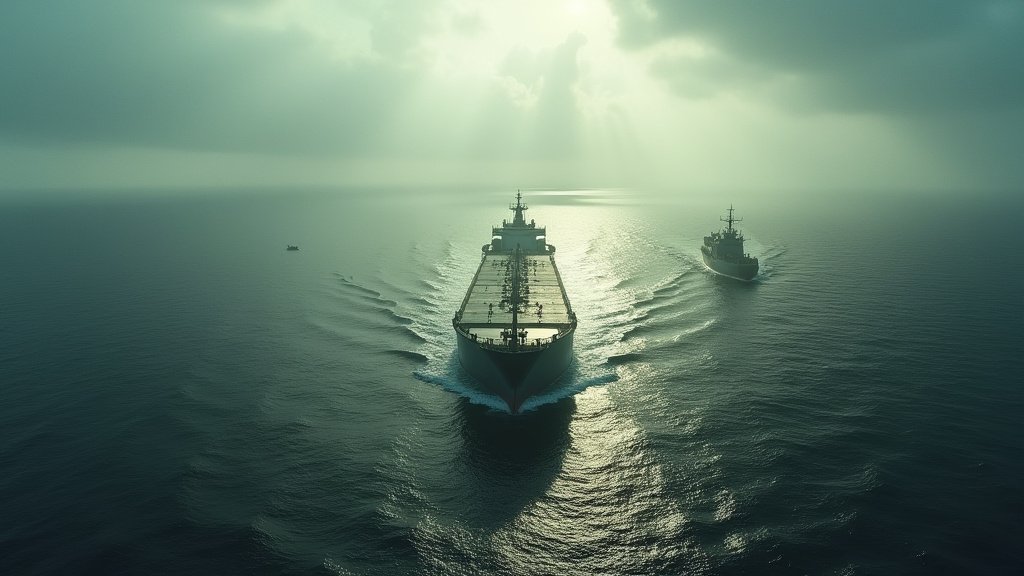
The U.S. Navy has conducted an operation to escort commercial vessels through the Strait of Hormuz, a critical chokepoint for global oil trade, as tensions with Iran continue to escalate.
Key Highlights:
- U.S. Navy escorts provided security for ships transiting the Strait of Hormuz.
- The operation comes amidst heightened regional tensions with Iran.
- The Strait of Hormuz is a vital artery for international oil shipments.
- The U.S. maintains a commitment to freedom of navigation in the region.
Naval Maneuvers in Strategic Waters
The U.S. Navy’s Fifth Fleet has recently undertaken operations to escort commercial shipping through the Strait of Hormuz, a vital maritime passage connecting the Persian Gulf to the Gulf of Oman. This move underscores the ongoing strategic importance of the region and the U.S. commitment to ensuring freedom of navigation for international trade. The Strait of Hormuz is one of the world’s most critical oil transit points, with a significant portion of the world’s oil supply passing through its narrow waters daily. The increased naval presence and escort operations are a direct response to the perceived threats and heightened tensions with Iran, which has previously threatened to disrupt shipping in the strait. The U.S. military’s posture in the region is aimed at deterring any aggressive actions and reassuring allies and global markets of continued stability.
Geopolitical Context and Escalation
This operation unfolds against a backdrop of complex geopolitical dynamics. Recent months have seen a series of incidents and escalations involving Iran and several nations, including the U.S. and its regional partners. These incidents have ranged from seizures of vessels to aerial drone engagements, fueling concerns about a wider conflict. The U.S. Navy’s proactive escort missions are designed to de-escalate potential confrontations by demonstrating readiness and capability, while simultaneously signaling to Iran that any attempts to interfere with legitimate maritime traffic will be met with a firm response. The deployment of naval assets is a delicate balancing act, intended to provide security without provoking direct military engagement. International bodies and diplomatic channels are also actively engaged in seeking de-escalation, but the U.S. military’s role remains crucial in maintaining the physical security of key shipping lanes.
Economic Ramifications of Strait Instability
The Strait of Hormuz is not just a strategic military location; it is an economic linchpin. Any disruption to shipping traffic through the strait can have immediate and far-reaching consequences for global energy markets. Oil prices can spike significantly, impacting economies worldwide, from major importing nations to developing countries reliant on affordable energy. Businesses that depend on the steady flow of goods through the region also face increased costs and uncertainty. The U.S. presence and escort operations aim to mitigate these economic risks by ensuring the unimpeded flow of commerce. The long-term stability of this vital waterway is therefore of paramount importance not only to the nations bordering the Persian Gulf but to the entire global economic system. International cooperation and adherence to maritime law are crucial for safeguarding this economic artery.
U.S. Naval Strategy and Deterrence
The U.S. Navy’s strategy in this region is multifaceted, encompassing forward presence, deterrence, and the protection of vital U.S. interests and international maritime norms. The escort of commercial vessels through the Strait of Hormuz is a tactical manifestation of this broader strategy. By operating in concert with allies and demonstrating a robust capability to respond to threats, the U.S. aims to deter potential adversaries from taking actions that could destabilize the region or endanger international shipping. This includes maintaining a ready force of cruisers, destroyers, and aircraft capable of projecting power and ensuring maritime security. The presence of U.S. naval assets serves as a visible deterrent and a reassurance to allies that their security and economic interests are being protected. The focus remains on maintaining stability and preventing miscalculations that could lead to conflict.
FAQ: People Also Ask
What is the Strait of Hormuz and why is it important?
The Strait of Hormuz is a narrow waterway connecting the Persian Gulf and the Gulf of Oman. It is strategically crucial because a significant portion of the world’s oil supply, particularly from the Middle East, passes through it, making it a vital chokepoint for global energy security and international trade.
What are the current tensions between the U.S. and Iran regarding the Strait of Hormuz?
Tensions often arise due to Iran’s historical threats to close or disrupt shipping in the strait, particularly during periods of heightened geopolitical friction. The U.S. Navy maintains a strong presence to ensure freedom of navigation and deter any such disruptions, leading to periodic naval operations like escorts.
How does the U.S. Navy ensure the safety of ships in the Strait of Hormuz?
The U.S. Navy, primarily through its Fifth Fleet based in Bahrain, conducts patrols, exercises, and, when necessary, provides direct escorts for commercial vessels. This involves positioning naval assets to deter threats and escort ships through the potentially hazardous waters of the strait.
What are the potential economic impacts of a disruption in the Strait of Hormuz?
A disruption could lead to a sharp increase in global oil prices, affecting economies worldwide. It could also impact the supply chains of various industries reliant on the continuous flow of goods through the region, causing price volatility and potential shortages.
What is the U.S. stance on freedom of navigation in international waters?
The United States strongly advocates for freedom of navigation and overflight in accordance with international law. This principle is a cornerstone of U.S. foreign policy, and the U.S. Navy actively works to uphold it in critical maritime passages like the Strait of Hormuz.